Maruf Farzana, Tappis Hannah, Stekelenburg Jelle, van den Akker Thomas
Global Financing Facility, World Bank Group, Kabul, Afghanistan.
Faculty of Science, Athena Institute, Vrije Universiteit Amsterdam, Amsterdam, Netherlands.
Front Glob Womens Health. 2021 Mar 17;2:610578. doi: 10.3389/fgwh.2021.610578. eCollection 2021.
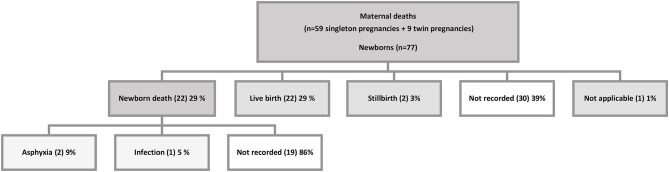
To assess the quality of health facility documentation related to maternal deaths at health facilities in Afghanistan. Analysis of a subset of findings from the in Afghanistan. At each facility, maternity registers were reviewed to obtain data related to maternity caseload, and number and causes of maternal deaths in the year preceding the survey. Detailed chart reviews were conducted for up to three maternal deaths per facility. Analyses included completeness of charts, quality of documentation, and cause of death using WHO application of International Statistical Classification of Disease to deaths during pregnancy, childbirth and the puerperium. Only 129/226 (57%) of facilities had mortality registers available for review on the day of assessment and 41/226 (18%) had charts documenting maternal deaths during the previous year. We reviewed 68 maternal death cases from the 41 facilities. Cause of death was not recorded in nearly half of maternal death cases reviewed. Information regarding mode of birth was missing in over half of the charts, and one third did not capture gestational age at time of death. Hypertensive disorders of pregnancy and obstetric hemorrhage were the most common direct causes of death, followed by maternal sepsis and unanticipated complications of clinical management including anesthesia-related complications. Documented indirect causes of maternal deaths were anemia, cardiac arrest, kidney and hepatic failure. Charts revealed at least eight maternal deaths from indirect causes that were not captured in register books, indicating omission or misclassification of registered deaths. Considerable gaps in quality of recordkeeping exist in Afghanistan, including underreporting, misclassification and incompleteness. This hampers efforts to improve quality of maternal and newborn health data and priority setting.
评估阿富汗医疗机构中与孕产妇死亡相关的医疗设施文件质量。对阿富汗相关调查结果的一个子集进行分析。在每个医疗机构,审查孕产妇登记册以获取与孕产妇病例数以及调查前一年孕产妇死亡人数和原因相关的数据。对每个医疗机构最多三例孕产妇死亡病例进行详细的病历审查。分析包括病历的完整性、文件质量以及使用世界卫生组织对《国际疾病分类》中关于妊娠、分娩和产褥期死亡的应用来确定死亡原因。在评估当天,只有129/226(57%)的医疗机构有死亡率登记册可供审查,41/226(18%)的医疗机构有记录前一年孕产妇死亡情况的病历。我们审查了41个医疗机构的68例孕产妇死亡病例。在近一半接受审查的孕产妇死亡病例中未记录死亡原因。超过一半的病历中缺少关于分娩方式的信息,三分之一的病历未记录死亡时的孕周。妊娠高血压疾病和产科出血是最常见的直接死亡原因,其次是孕产妇败血症以及包括麻醉相关并发症在内的临床管理意外并发症。记录的孕产妇死亡间接原因有贫血、心脏骤停、肾衰竭和肝衰竭。病历显示至少有八例间接原因导致的孕产妇死亡未在登记簿中记录,这表明登记死亡存在遗漏或错误分类。阿富汗在记录保存质量方面存在相当大的差距,包括报告不足、错误分类和不完整。这阻碍了改善孕产妇和新生儿健康数据质量以及确定优先事项的努力。