School of Science and Technology, Örebro University, 702 81, Örebro, Sweden.
Key Laboratory of Animal Ecology and Conservation Biology, Institute of Zoology, Chinese Academy of Sciences, Beijing, 100101, China.
Metabolomics. 2021 Nov 24;17(12):103. doi: 10.1007/s11306-021-01853-9.
Poly-/per-fluoroalkyl substances (PFAS) are widespread environmental pollutants that may induce metabolic perturbations in humans, including particularly alterations in lipid profiles. Prenatal exposure to PFAS can cause lasting effects on offspring metabolic health, however, the underlying mechanisms are still unknown.
The goal of the study was to investigate the impact of prenatal PFAS exposure on the lipid profiles in cord blood.
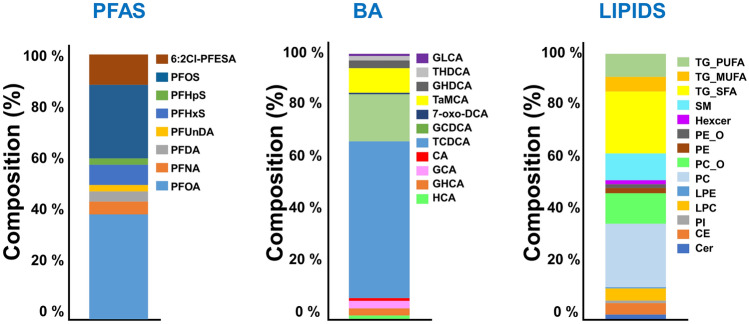
Herein, we combined determination of bile acids (BAs) and molecular lipids by liquid chromatography with ultra-high-resolution mass spectrometry, and separately quantified cord blood concentrations of sixteen PFAS in a cohort of Chinese infants (104 subjects) in a cross-sectional study. We then evaluated associations between PFAS concentration and lipidome using partial correlation network analysis, debiased sparse partial correlation, linear regression analysis and correlation analysis.
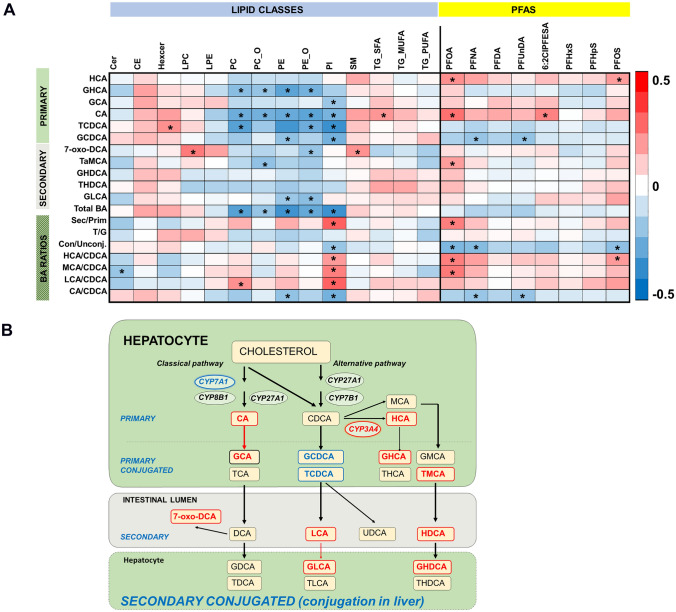
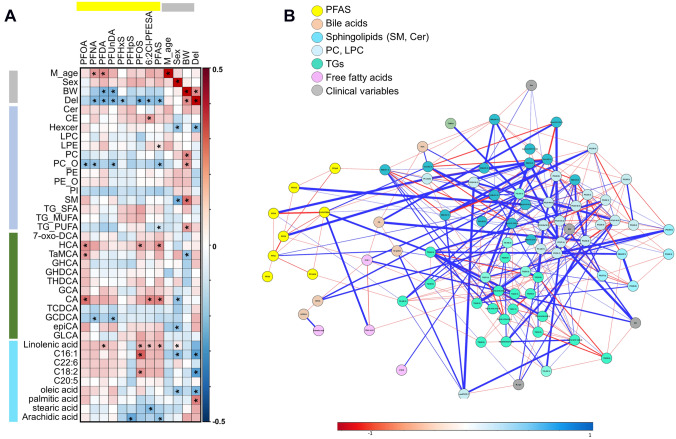
PFAS levels showed significant associations with the lipid profiles; specifically, PFAS exposure was positively correlated with triacylgycerols (TG) and several bile acids. Importantly, exposure to perfluorooctanoic acid (PFOA), perfluorooctane sulfonic acid (PFOS), perfluorononanoic acid (PFNA) and perfluorohexane sulfonic acid (PFHxS) were associated with increased levels of TGs with saturated fatty acids while multiple classes of phospholipids were decreased. In addition, several free fatty acids showed significant positive correlations with PFOS.
Our results indicated that prenatal exposure to PFAS mediated metabolic changes, which may explain the associations reported between PFAS exposure and metabolic health later in life.
多/全氟烷基物质(PFAS)是广泛存在的环境污染物,可能会在人类中引起代谢紊乱,包括脂质谱的特别改变。PFAS 产前暴露会对后代的代谢健康造成持久影响,但潜在机制尚不清楚。
本研究旨在探讨产前 PFAS 暴露对脐带血脂质谱的影响。
在此,我们通过液相色谱与超高分辨率质谱相结合,联合测定了胆汁酸(BAs)和分子脂质,并在一项中国婴儿的横断面研究中(104 例),分别定量了脐带血中 16 种 PFAS 的浓度。然后,我们使用偏相关网络分析、无偏稀疏偏相关、线性回归分析和相关分析来评估 PFAS 浓度与脂质组之间的关联。
PFAS 水平与脂质谱呈显著相关;具体来说,PFAS 暴露与三酰甘油(TG)和几种胆汁酸呈正相关。重要的是,全氟辛酸(PFOA)、全氟辛烷磺酸(PFOS)、全氟壬酸(PFNA)和全氟己烷磺酸(PFHxS)的暴露与具有饱和脂肪酸的 TG 水平升高有关,而多种磷脂类则减少。此外,几种游离脂肪酸与 PFOS 呈显著正相关。
我们的结果表明,PFAS 产前暴露介导了代谢变化,这可能解释了 PFAS 暴露与生命后期代谢健康之间的关联。