Department of Pharmaceutical Sciences, School of Pharmaceutical Sciences of Ribeirão Preto, University of São Paulo, Av. do Café, s/n, Ribeirão Preto, SP, 14040-903, Brazil.
Eur J Drug Metab Pharmacokinet. 2022 Jan;47(1):19-30. doi: 10.1007/s13318-021-00736-7. Epub 2021 Nov 23.
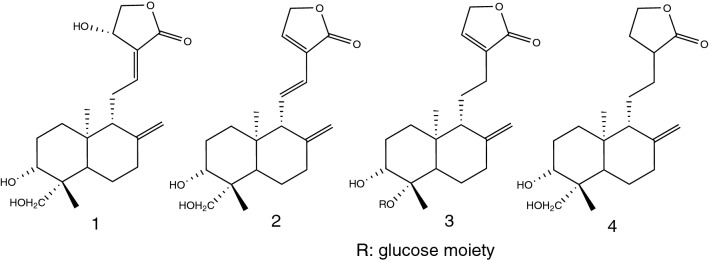
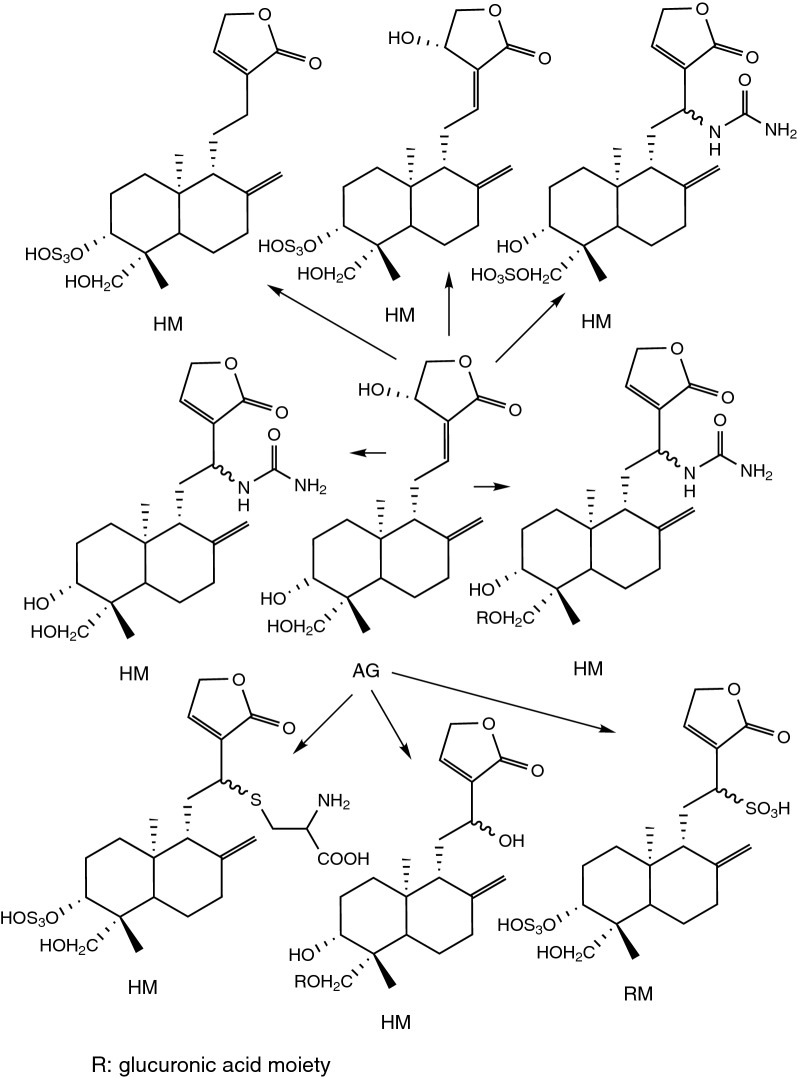
Diterpene lactones have been identified as active compounds in several medicinal plants, including Andrographis paniculata (Burm. f.) Nees, which is a medicinal plant that has been used for centuries across the world. Andrographolide is the major diterpene from A. paniculata and the main bioactive constituent of this species. The effectiveness of diterpenes can be affected by factors that limit their oral bioavailability, such as their poor water solubility, slow dissolution rates, low gastrointestinal absorption, high chemical and metabolic instability, and rapid excretion. In this context, the purpose of the present review is to compile and compare literature data on the bioavailability of diterpene lactones from A. paniculata after oral administration in medicinal plant extracts or in their free forms and to highlight strategies that have been used to improve their oral bioavailability. Considering that medicinal plant extracts are commonly used as dried powder that is reconstituted in water before oral administration, novel pharmaceutical formulation strategies that are used to overcome difficulties with diterpene solubility are also compiled in this review. The use of self-microemulsifying drug delivery systems is a good strategy to enhance the dissolution and consequently the bioavailability of andrographolide after oral administration of A. paniculata extract formulations. On the other hand, herbosome technology, pH-sensitive nanoparticles, nanosuspensions, nanoemulsions, nanocrystal suspensions, nanocrystal-based solid dispersions, and solid dispersion systems are useful to formulate andrographolide in its free form and increase its oral bioavailability. The use of a suitable andrographolide delivery system is essential to achieve its therapeutic potential.
二萜内酯已被鉴定为几种药用植物中的活性化合物,包括穿心莲(Burm. f.) Nees,这是一种在世界各地使用了几个世纪的药用植物。穿心莲内酯是穿心莲的主要二萜,也是该物种的主要生物活性成分。二萜的有效性可能会受到限制其口服生物利用度的因素的影响,例如其较差的水溶性、缓慢的溶解速率、低胃肠道吸收、高化学和代谢不稳定性以及快速排泄。在这种情况下,本综述的目的是编译和比较口服给药时穿心莲中二萜内酯的生物利用度的文献数据,这些二萜内酯来自药用植物提取物或其游离形式,并强调已用于提高其口服生物利用度的策略。考虑到药用植物提取物通常用作口服前在水中重新配制的干粉末,本综述还编译了用于克服二萜溶解度困难的新型药物制剂策略。自微乳给药系统的使用是一种很好的策略,可以增强穿心莲提取物制剂口服给药后穿心莲内酯的溶解和生物利用度。另一方面,草药体技术、pH 敏感纳米粒、纳米混悬剂、纳米乳液、纳米晶体混悬剂、基于纳米晶体的固体分散体和固体分散体系统可用于将穿心莲内酯制成游离形式并提高其口服生物利用度。使用合适的穿心莲内酯递送系统对于实现其治疗潜力至关重要。