Palliative Care and Resilience Lab, Seattle Children's Research Institute, Seattle, Washington.
Division of Hematology/Oncology, Department of Pediatrics, University of Washington School of Medicine, Seattle.
JAMA Netw Open. 2021 Nov 1;4(11):e2136039. doi: 10.1001/jamanetworkopen.2021.36039.
Adolescents and young adults (AYAs) with cancer have a high risk of poor psychosocial outcomes. The Promoting Resilience in Stress Management (PRISM) intervention is one of few psychosocial interventions targeting younger people with cancer that has demonstrated efficacy in a randomized clinical trial.
To explore 2-year trajectories of patient-reported well-being among AYA cancer survivors. The hypothesis was that AYAs who initially responded to PRISM would report sustained positive changes.
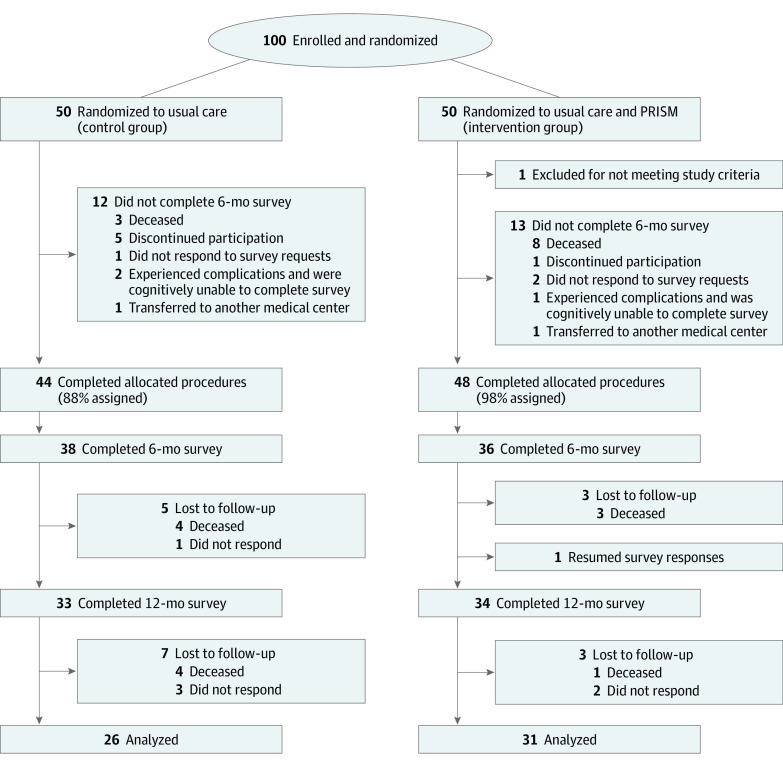
DESIGN, SETTING, AND PARTICIPANTS: This secondary analysis of data from a single-center, parallel, phase 2 randomized clinical trial was conducted from January 2015 to October 2016. Eligible participants were English-speaking AYAs between ages 13 and 25 years with cancer treated at a single, quaternary children's hospital in the US. Participants were randomly assigned (1:1) to PRISM or usual care. Data were analyzed between March 2021 and June 2021.
PRISM is a brief, skills-based coaching program targeting 4 resilience resources (stress management, goal setting, cognitive reframing, and meaning making).
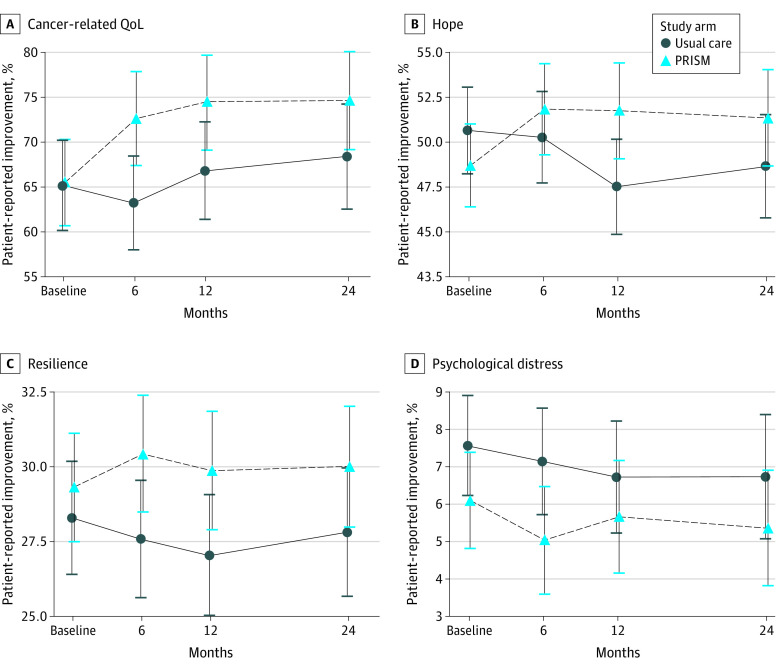
Patient-reported cancer-related quality of life (QoL) (PedsQL scale), hope (Hope scale), resilience (Connor-Davidson Resilience scale), and psychological distress (Kessler-6 scale) were collected at baseline, 6, 12, and 24 months. Data from AYAs who remained alive at 24 months were analyzed. Improvement was defined as a positive change in instrument scores between baseline and 6 months (ie, the end of the PRISM program) and used linear mixed effects regression to assess changes over time.
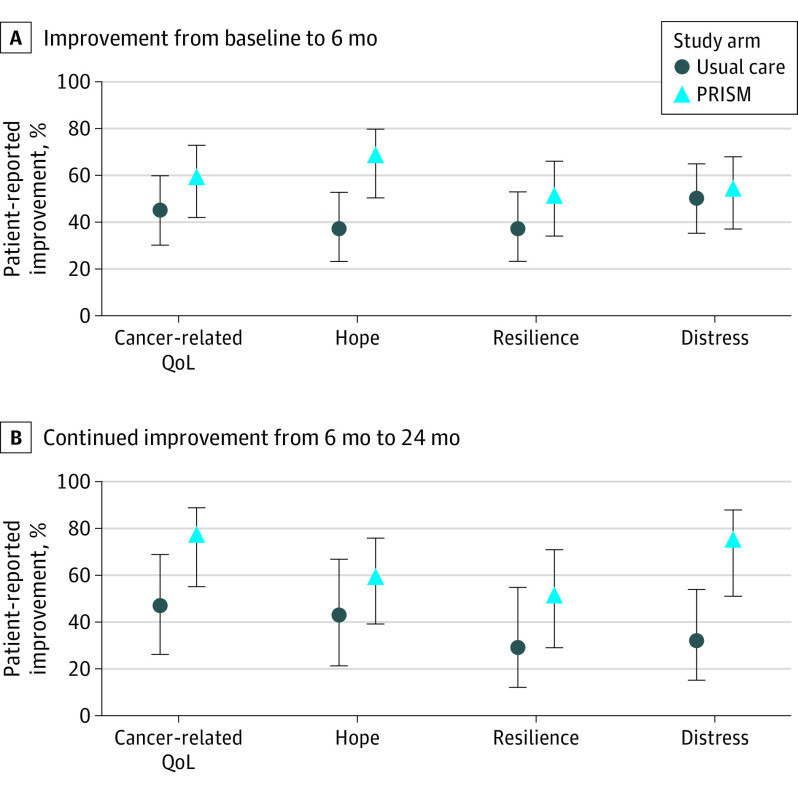
A total of 57 AYAs were included in analysis at 24 months (62% of 92 randomized). Twenty-six participants (46%) were female; 36 (63%) were between ages 13 and 17 years; and 20 (35%) identified as part of a racial or ethnic minority group (4 [7%] Asian, 11 [19%] Hispanic or Latino, 16 [28%] mixed race or other). PRISM was associated with improved QoL, hope, resilience, and distress between baseline and 6 months, and these associations were sustained for QoL over 12 months (β = 7.4; 95% CI, 0.8 to 14; P = .03) and hope throughout the study period (12 months: β = 6.2; 95% CI, 2.7 to 9.6; P < .001; 24 months: β = 4.6; 95% CI, 1 to 8.3; P = .01). Of those whose scores improved between baseline and 6 months, PRISM participants more commonly reported sustained improvements in QoL (16 of 21 participants [76%] vs 8 of 17 [47%]), hope (14 of 24 participants [58%] vs 6 of 14 [43%]), resilience (9 of 18 participants [50%] vs 4 of 14 [29%]), and distress (14 of 19 participants [74%] vs 6 of 19 [32%]) at 24 months compared with usual care.
These results suggest that PRISM was associated with sustained improvements in psychosocial outcomes as reported by adolescents and young adults. Those who responded to PRISM in the first 6 months reported continued well-being 2 years later.
ClinicalTrials.gov Identifier: NCT02340884.
重要性:患有癌症的青少年和年轻人 (AYA) 有很高的出现不良心理社会结局的风险。Promoting Resilience in Stress Management (PRISM) 干预措施是少数几种针对年轻癌症患者的心理社会干预措施之一,在一项随机临床试验中已证明其有效性。
目的:探讨癌症幸存者中患者报告的健康状况的 2 年轨迹。假设最初对 PRISM 有反应的 AYA 会报告持续的积极变化。
设计、地点和参与者:这是对来自美国单中心、平行、2 期随机临床试验的数据的二次分析。符合条件的参与者为在一家四等儿童医院接受治疗的年龄在 13 至 25 岁之间的英语患者。参与者被随机分配(1:1)接受 PRISM 或常规护理。数据于 2021 年 3 月至 2021 年 6 月之间进行分析。
干预措施:PRISM 是一种简短的、基于技能的辅导计划,针对 4 种恢复力资源(压力管理、目标设定、认知重构和意义建构)。
主要结果和措施:在基线、6、12 和 24 个月时收集了患者报告的癌症相关生活质量(PedsQL 量表)、希望(Hope 量表)、韧性(Connor-Davidson 韧性量表)和心理困扰(Kessler-6 量表)。分析了在 24 个月时仍存活的 AYA 数据。改善定义为在基线和 6 个月(即 PRISM 计划结束时)之间的工具评分的阳性变化,并使用线性混合效应回归来评估随时间的变化。
结果:在 24 个月时,共有 57 名 AYA 参与了分析(92 名随机参与者的 62%)。26 名参与者(46%)为女性;36 名(63%)年龄在 13 至 17 岁之间;20 名(35%)被确定为种族或少数民族群体的一部分(4 [7%] 为亚洲人,11 [19%] 为西班牙裔或拉丁裔,16 [28%] 为混合种族或其他)。PRISM 与 QoL、希望、韧性和困扰在基线和 6 个月之间的改善相关,这些关联在 12 个月时 QoL (β=7.4;95%CI,0.8 至 14;P=0.03)和整个研究期间的希望(12 个月:β=6.2;95%CI,2.7 至 9.6;P<0.001;24 个月:β=4.6;95%CI,1 至 8.3;P=0.01)方面得以持续。在基线和 6 个月之间评分有所改善的参与者中,PRISM 参与者更常报告 QoL(21 名参与者中的 16 名[76%]与 17 名参与者中的 8 名[47%])、希望(24 名参与者中的 14 名[58%]与 14 名参与者中的 6 名[43%])、韧性(18 名参与者中的 9 名[50%]与 14 名参与者中的 4 名[29%])和困扰(19 名参与者中的 14 名[74%]与 19 名参与者中的 6 名[32%])方面的持续改善。
结论和相关性:这些结果表明,PRISM 与青少年和年轻人报告的心理社会结局的持续改善相关。那些在最初的 6 个月内对 PRISM 有反应的人在 2 年后报告了持续的幸福感。
试验注册:ClinicalTrials.gov 标识符:NCT02340884。