Institute of Experimental Biomedicine I, University Hospital Würzburg, Würzburg, Germany.
Rudolf Virchow Center for Integrative and Translational Bioimaging, University of Würzburg, Würzburg, Germany.
Sci Rep. 2021 Nov 24;11(1):22887. doi: 10.1038/s41598-021-02360-6.
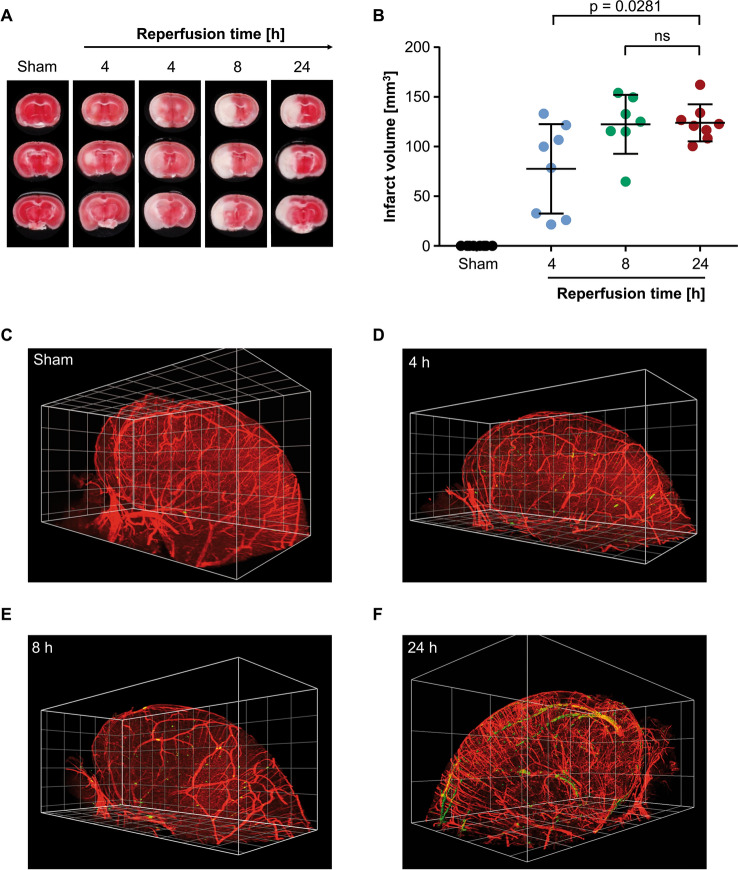
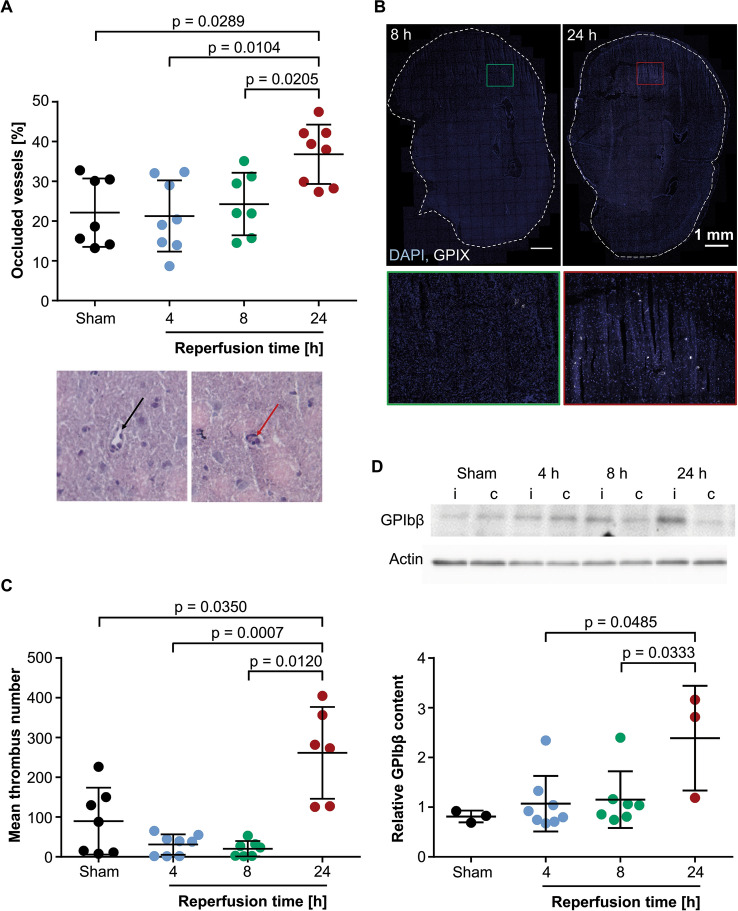
Ischemic stroke is among the leading causes of disability and death worldwide. In acute ischemic stroke, successful recanalization of occluded vessels is the primary therapeutic aim, but even if it is achieved, not all patients benefit. Although blockade of platelet aggregation did not prevent infarct progression, cerebral thrombosis as cause of secondary infarct growth has remained a matter of debate. As cerebral thrombi are frequently observed after experimental stroke, a thrombus-induced impairment of the brain microcirculation is considered to contribute to tissue damage. Here, we combine the model of transient middle cerebral artery occlusion (tMCAO) with light sheet fluorescence microscopy and immunohistochemistry of brain slices to investigate the kinetics of thrombus formation and infarct progression. Our data reveal that tissue damage already peaks after 8 h of reperfusion following 60 min MCAO, while cerebral thrombi are only observed at later time points. Thus, cerebral thrombosis is not causative for secondary infarct growth during ischemic stroke.
缺血性脑卒中是全球范围内导致残疾和死亡的主要原因之一。在急性缺血性脑卒中患者中,成功再通闭塞血管是主要的治疗目标,但即使实现了这一目标,并非所有患者都能从中获益。尽管血小板聚集的阻断不能阻止梗死进展,但血栓形成作为继发性梗死扩大的原因仍存在争议。由于在实验性脑卒中后经常观察到脑血栓,因此认为血栓诱导的脑微循环损伤有助于组织损伤。在这里,我们将短暂性大脑中动脉闭塞(tMCAO)模型与脑切片的光片荧光显微镜和免疫组织化学相结合,以研究血栓形成和梗死进展的动力学。我们的数据表明,在 60 分钟 MCAO 后再灌注 8 小时后,组织损伤已经达到峰值,而在较晚的时间点才观察到脑血栓。因此,在缺血性脑卒中期间,脑血栓并不是继发性梗死扩大的原因。