Institute of Ophthalmology, University College London, 11-43 Bath Street, London, EC1V9EL, UK.
Sci Rep. 2021 Nov 24;11(1):22872. doi: 10.1038/s41598-021-02311-1.
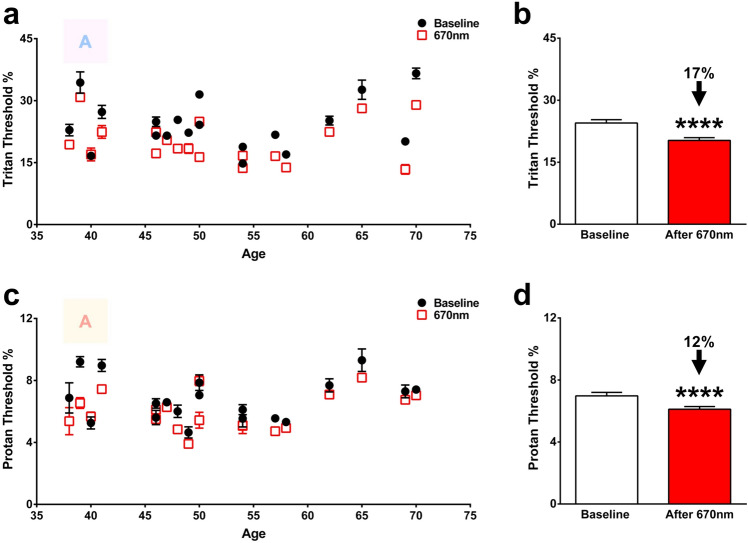
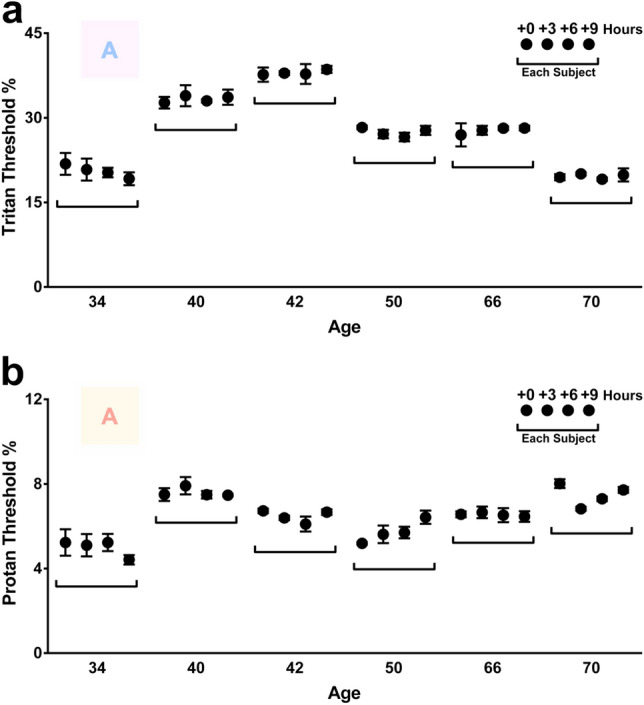
Mitochondrial decline in ageing robs cells of ATP. However, animal studies show that long wavelength exposure (650-900 nm) over weeks partially restores ATP and improves function. The likely mechanism is via long wavelengths reducing nanoscopic interfacial water viscosity around ATP rota pumps, improving their efficiency. Recently, repeated 670 nm exposures have been used on the aged human retina, which has high-energy demands and significant mitochondrial and functional decline, to improve vision. We show here that single 3 min 670 nm exposures, at much lower energies than previously used, are sufficient to significantly improve for 1 week cone mediated colour contrast thresholds (detection) in ageing populations (37-70 years) to levels associated with younger subjects. But light needs to be delivered at specific times. In environments with artificial lighting humans are rarely dark-adapted, hence cone function becomes critical. This intervention, demonstrated to improve aged mitochondrial function can be applied to enhance colour vision in old age.
衰老导致线粒体衰退,从而使细胞失去 ATP。然而,动物研究表明,数周的长波长(650-900nm)照射可以部分恢复 ATP 并改善功能。其可能的机制是长波长降低了围绕 ATP 旋转泵的纳米级界面水的粘度,从而提高了其效率。最近,在能量需求高、线粒体和功能明显衰退的老年人类视网膜上重复进行了 670nm 暴露,以改善视力。我们在这里表明,单次 3 分钟 670nm 暴露,其能量远低于以前使用的能量,足以显著改善 37-70 岁老年人群的锥体细胞介导的彩色对比度阈值(检测),使其达到与年轻受试者相关的水平。但是,光需要在特定的时间送达。在人工照明的环境中,人类很少处于暗适应状态,因此锥体细胞功能变得至关重要。这种已被证明可改善衰老线粒体功能的干预措施可用于增强老年时期的色觉。