Kimura Yuya, Suzukawa Maho, Inoue Norihiko, Imai Shinobu, Akazawa Manabu, Matsui Hirotoshi
Clinical Research Center, National Hospital Organization Tokyo National Hospital, Tokyo, Japan.
Department of Health Policy and Informatics, Tokyo Medical and Dental University Graduate School, Tokyo, Japan.
World Allergy Organ J. 2021 Nov 5;14(11):100600. doi: 10.1016/j.waojou.2021.100600. eCollection 2021 Nov.
Studies have shown the efficacy of asthma biologics in real-world settings, confirming the generalizability of randomized controlled trial (RCT) results, but studies on more than one biologic are scarce. Accordingly, little is known about the different background characteristics in users of asthma biologics. This study aimed to describe the backgrounds of asthma patients using biologics (omalizumab, mepolizumab, benralizumab, and dupilumab) and examine the effectiveness of these biologics for reducing asthma exacerbations and total systemic corticosteroid doses.
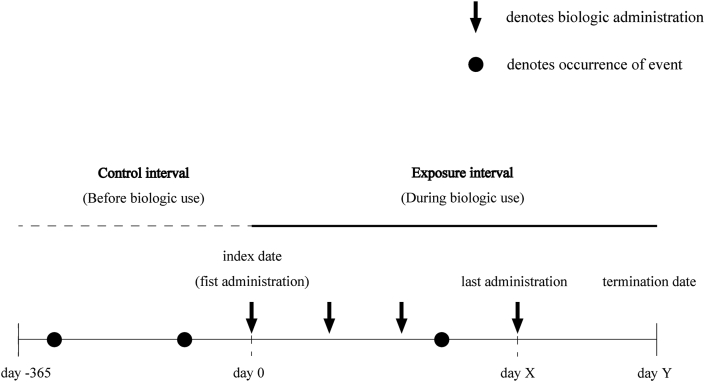
We conducted a retrospective cohort study using self-controlled methods to evaluate the association between the use of biologics and reduction in exacerbations and hospitalizations using a large-scale health insurance claims database in Japan.
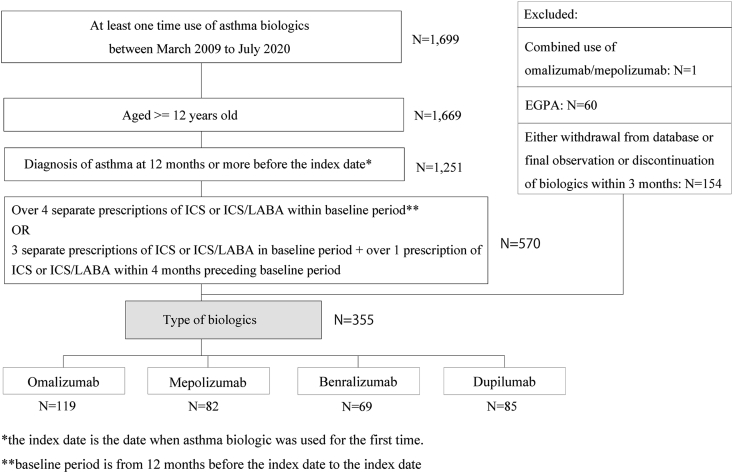
Of 355 continuously treated asthma patients using biologics, 119, 82, 69, and 85 patients were assigned to the omalizumab, mepolizumab, benralizumab, and dupilumab groups, respectively. The baseline characteristics differed among users of biologics. The incidence ratios of exacerbations and hospitalizations during biologics use were 0.68 (95% confidence interval, 0.62-0.74) and 0.65 (0.55-0.77) compared with the period before biologics use. The total systemic corticosteroid dose equivalent to prednisolone per person-year was reduced from a median of 600 [interquartile range, 90-1713] mg to 164 [0-1010] mg ( < .001). Similar results were obtained for individual biologics with a few exceptions.
The background characteristics of biologics users differed in a real-world setting. Our results confirmed findings from RCTs demonstrating that each biologic (omalizumab, mepolizumab, benralizumab, and dupilumab) is associated with decreased exacerbation numbers and corticosteroid-sparing effects, even outside of the controlled settings of RCTs.
研究已表明哮喘生物制剂在实际应用中的疗效,证实了随机对照试验(RCT)结果的可推广性,但针对不止一种生物制剂的研究较少。因此,对于哮喘生物制剂使用者的不同背景特征知之甚少。本研究旨在描述使用生物制剂(奥马珠单抗、美泊利单抗、贝那利珠单抗和度普利尤单抗)的哮喘患者的背景情况,并检验这些生物制剂在减少哮喘发作和全身皮质类固醇总剂量方面的有效性。
我们采用自我对照方法进行了一项回顾性队列研究,利用日本的一个大规模医疗保险理赔数据库评估生物制剂的使用与发作和住院减少之间的关联。
在355名持续接受生物制剂治疗的哮喘患者中,分别有119、82、69和85名患者被分配到奥马珠单抗、美泊利单抗、贝那利珠单抗和度普利尤单抗组。生物制剂使用者的基线特征有所不同。与使用生物制剂之前的时期相比,使用生物制剂期间发作和住院的发病率比分别为0.68(95%置信区间,0.62 - 0.74)和0.65(0.55 - 0.77)。每人每年相当于泼尼松龙的全身皮质类固醇总剂量从中位数600[四分位间距,90 - 1713]mg降至164[0 - 1010]mg(P <.001)。除少数例外情况外,个别生物制剂也获得了类似结果。
在实际应用中,生物制剂使用者的背景特征存在差异。我们的结果证实了随机对照试验的结果,表明即使在随机对照试验的受控环境之外,每种生物制剂(奥马珠单抗、美泊利单抗、贝那利珠单抗和度普利尤单抗)都与发作次数减少和皮质类固醇节省效应相关。