Iannella Mattia, De Simone Walter, D'Alessandro Paola, Biondi Maurizio
Department of Life, Health & Environmental Sciences, University of L'Aquila, L'Aquila, Abruzzo, Italy.
PeerJ. 2021 Nov 19;9:e12387. doi: 10.7717/peerj.12387. eCollection 2021.
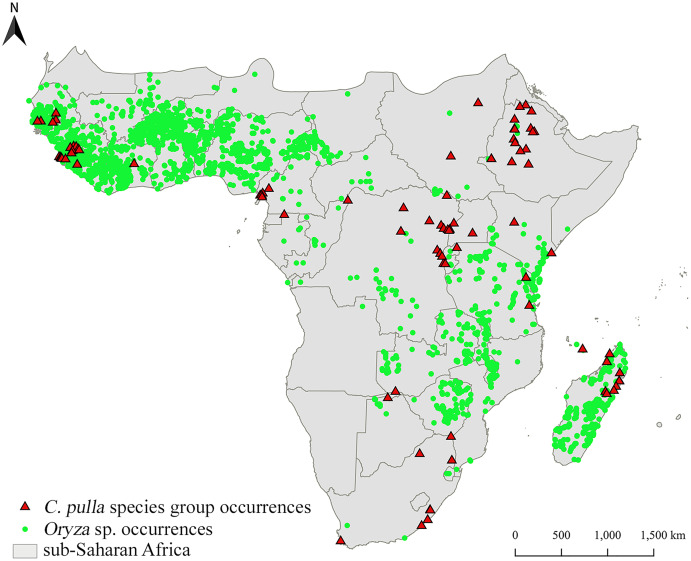
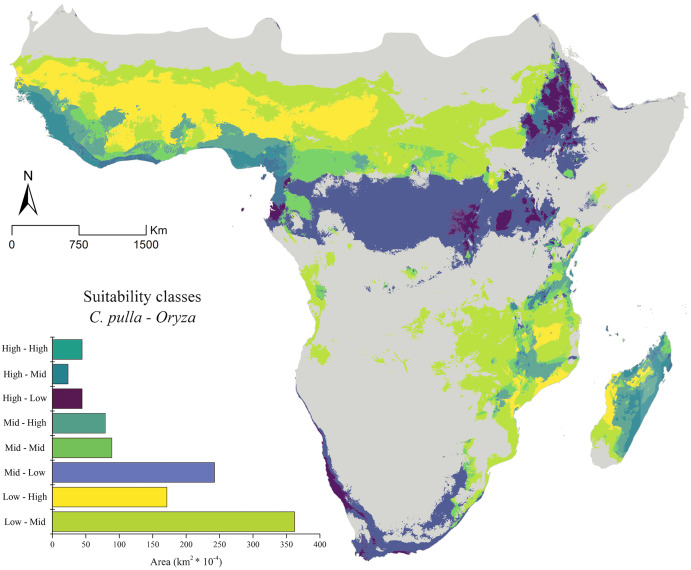
Rice is a staple food for many countries, being fundamental for a large part of the worlds' population. In sub-Saharan Africa, its importance is currently high and is likely to become even more relevant, considering that the number of people and the per-capita consumption are both predicted to increase. The flea beetles belonging to the species group ( group), a harmful rice pest, are an important vector of the Rice Yellow Mottle Virus, a disease which leads even to 80-100% yield losses in rice production. We present a continental-scale study aiming at: (1) locating current and future suitable territories for both group and rice; (2) identifying areas where rice cultivations may occur without suffering the presence of group using an Ecological Niche Modelling (ENM) approach; (3) estimating current and future connectivity among group populations and areas predicted to host rice cultivations, based on the most recent land-use estimates for future agricultural trends; (4) proposing a new connectivity index called "Pest Aggression Index" (PAI) to measure the agricultural susceptibility to the potential future invasions of pests and disease; (5) quantifying losses in terms of production when rice cultivations co-occur with the group and identifying the SSA countries which, in the future inferred scenarios, will potentially suffer the greatest losses.
Sub-Saharan Africa.
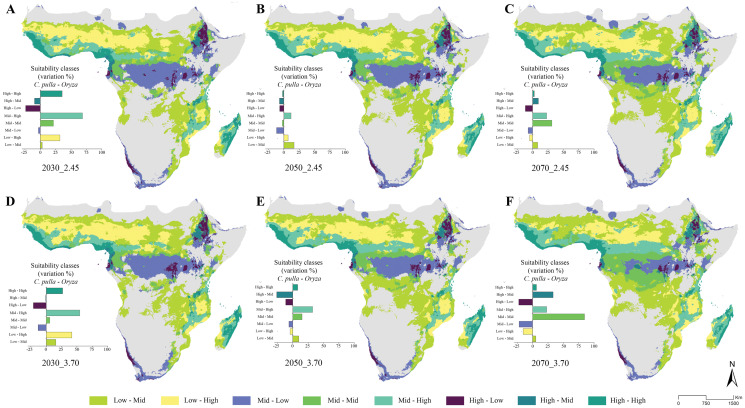
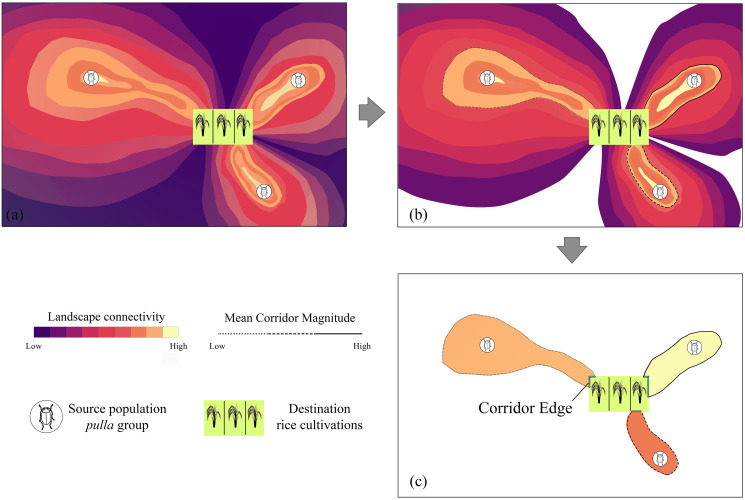
Since the ongoing climate and land-use changes affect species' distributions, we first assess the impact of these changes through a spatially-jackknifed Maxent-based Ecological Niche Modelling in GIS environment, for both the group and rice, in two climatic/socioeconomic future scenarios (SSP_2.45 and 3.70). We then assess the connectivity potential of the group populations towards rice cultivations, for both current and future predictions, through a circuit theory-based approach (Circuitscape implemented in Julia language). We finally measure the rice production and GPD loss per country through the spatial index named "Pest Aggression Index", based on the inferred connectivity magnitude.
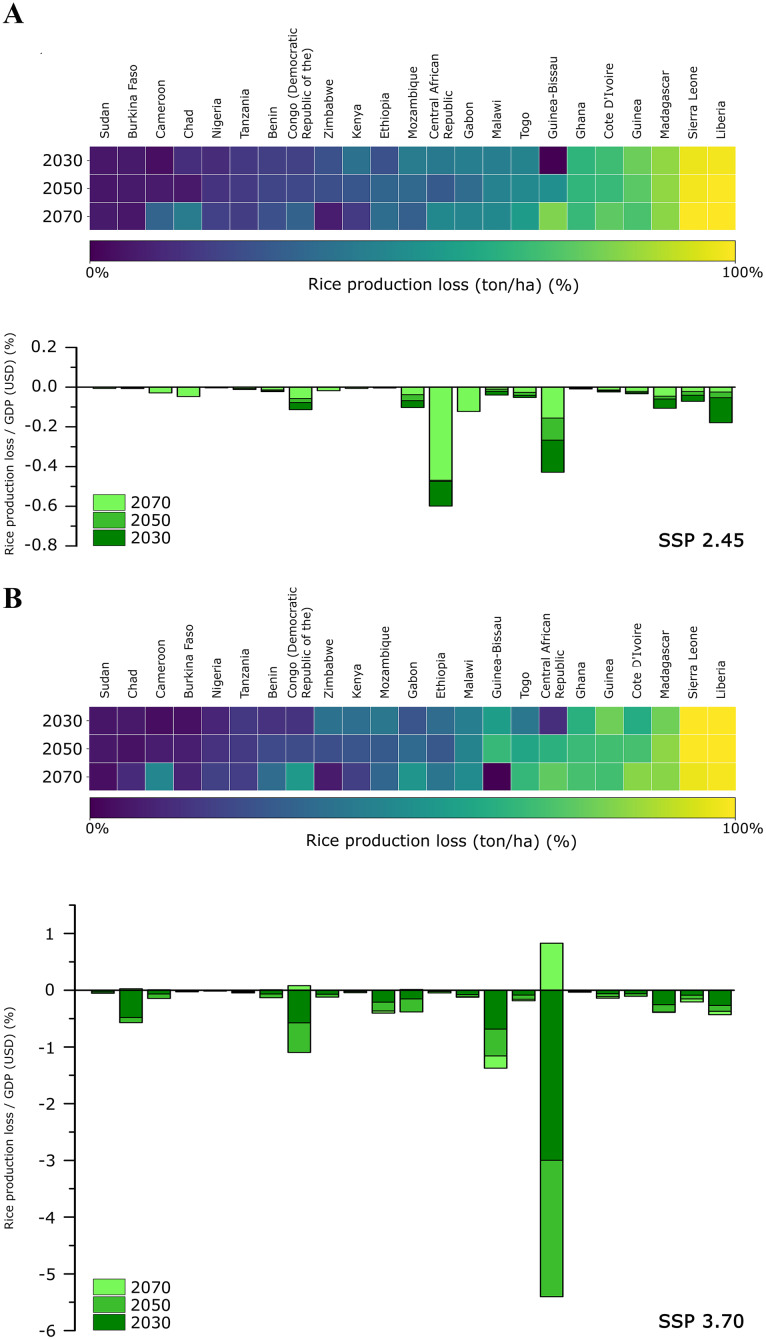
The most considerable losses in rice production are observed for Liberia, Sierra Leone and Madagascar in all future scenarios (2030, 2050, 2070). The future economic cost, calculated as USD lost from rice losses/country's GDP results are high for Central African Republic (-0.6% in SSP_2.45 and -3.0% in SSP_3.70) and Guinea-Bissau (-0.4% in SSP_2.45 and -0.68% in SSP_3.70), with relevant losses also obtained for other countries.
Since our results are spatially explicit and focused on each country, we encourage careful land-use planning. Our findings could support best practices to avoid the future settlement of new cultivations in territories where rice would be attacked by group and the virus, bringing economic and biodiversity losses.
水稻是许多国家的主食,对世界上很大一部分人口至关重要。在撒哈拉以南非洲,其重要性目前很高,而且考虑到预计人口数量和人均消费量都将增加,其重要性可能会变得更加突出。属于该物种组(某组)的稻叶甲是一种有害的水稻害虫,是水稻黄斑驳病毒的重要传播媒介,这种疾病在水稻生产中甚至会导致80%-100%的产量损失。我们开展了一项大陆规模的研究,旨在:(1)确定当前和未来适合某组和水稻生长的区域;(2)使用生态位建模(ENM)方法确定水稻种植可能不会受到某组侵害的区域;(3)根据未来农业趋势的最新土地利用估计,估计某组种群与预计种植水稻的区域之间当前和未来的连通性;(4)提出一种名为“害虫侵袭指数”(PAI)的新连通性指数,以衡量农业对未来害虫和疾病潜在入侵的易感性;(5)量化水稻种植与某组共存时的产量损失,并确定在未来推断情景中可能遭受最大损失的撒哈拉以南非洲国家。
撒哈拉以南非洲。
由于当前的气候和土地利用变化会影响物种分布,我们首先在GIS环境中通过基于空间留一法的最大熵生态位建模,评估这些变化对某组和水稻在两种气候/社会经济未来情景(SSP_2.45和3.70)下的影响。然后,我们通过基于电路理论的方法(用Julia语言实现的Circuitscape)评估某组种群对当前和未来预测的水稻种植区域的连通性潜力。最后,我们根据推断的连通性强度,通过名为“害虫侵袭指数”的空间指数来衡量每个国家的水稻产量和GDP损失。
在所有未来情景(2030年、2050年、2070年)中,利比里亚、塞拉利昂和马达加斯加的水稻产量损失最为严重。以水稻损失导致的美元损失/国家GDP计算的未来经济成本,中非共和国(在SSP_2.45中为-0.6%,在SSP_3.70中为-3.0%)和几内亚比绍(在SSP_2.45中为-0.4%,在SSP_3.70中为-0.68%)较高,其他国家也有相关损失。
由于我们的结果在空间上是明确的,并且关注每个国家,我们鼓励进行谨慎的土地利用规划。我们的研究结果可以支持最佳实践,以避免在水稻会受到某组和病毒攻击、造成经济和生物多样性损失的地区未来建立新的种植区。