
一种用二氧化钛纳米粒子功能化的壳聚糖纳米粒子的新型制剂。
A novel formulation of chitosan nanoparticles functionalized with titanium dioxide nanoparticles.
作者信息
Al-Nemrawi Nusaiba, Nimrawi Sukaina
机构信息
Department of Pharmaceutical Technology, Faculty of Pharmacy, University of Science and Technology, Irbid, Jordan.
Faculty of Pharmacy, Zarqa University, Zarqa, Jordan.
出版信息
J Adv Pharm Technol Res. 2021 Oct-Dec;12(4):402-407. doi: 10.4103/japtr.japtr_22_21. Epub 2021 Oct 20.
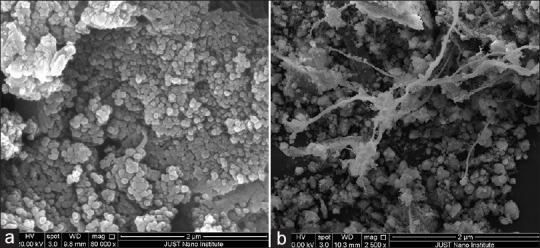
Herein, chitosan nanoparticles (CS-NPs) were prepared and functionalized chemically with titanium dioxide nanoparticles (TiO-NPs) to allow on-demand degradation of CS-NPs, using ultraviolet (UV) irradiation as a trigger. This is expected to allow drug release depending on patients' needs or physiological circumstances. Eleven formulations were arranged and their particle size, charge, and polydispersity were determined. The effect of CS-NPs size and the amount of TiO-NPs, on the system collapse, was studied accordingly. Moreover, the collapse of these systems was examined using a fluorescence microscope after loading CS-NPs with Rhodamine. The formulations showed high monodispersity and had sizes ranged between 170 and 440 nm and charges ranged between +5 and +34 mV. Scanning electron microscope, Fourier-transform infrared spectroscopy, and X-ray diffraction proved the chemical deposition of TiO-NPs on CS-NPs. The dye test showed that there are two factors that oppose each other and affected the deposition of TiO-NPs on CS-NPs, the size of CS-NPs, and the amount of TiO-NPs used. In addition, the dye test showed that the deposition of TiO-NPs is a saturated process that relies on the amount of TiO-NPs used initially. Finally, the intensity of Rhodamine released from these systems after illumination with UV light was related to the amount of TiO-NPs deposited on CS-NPs. In conclusion, functionalization of CS-NPs with TiO-NPs can be controlled and used to rupture CS-NPs on demand by illumination with UV light.
在此,制备了壳聚糖纳米颗粒(CS-NPs),并使用二氧化钛纳米颗粒(TiO-NPs)对其进行化学功能化,以通过紫外线(UV)照射作为触发因素实现CS-NPs的按需降解。预计这将根据患者的需求或生理状况实现药物释放。安排了11种配方,并测定了它们的粒径、电荷和多分散性。相应地研究了CS-NPs尺寸和TiO-NPs用量对系统崩溃的影响。此外,在用罗丹明负载CS-NPs后,使用荧光显微镜检查了这些系统的崩溃情况。这些配方显示出高单分散性,粒径在170至440nm之间,电荷在+5至+34mV之间。扫描电子显微镜、傅里叶变换红外光谱和X射线衍射证明了TiO-NPs在CS-NPs上的化学沉积。染料测试表明,有两个相互对立的因素影响TiO-NPs在CS-NPs上的沉积,即CS-NPs的尺寸和TiO-NPs的用量。此外,染料测试表明,TiO-NPs的沉积是一个依赖于初始使用的TiO-NPs量的饱和过程。最后,用紫外光照射后从这些系统中释放的罗丹明强度与沉积在CS-NPs上的TiO-NPs量有关。总之,用TiO-NPs对CS-NPs进行功能化可以得到控制,并用于通过紫外光照射按需破坏CS-NPs。



 Zotero 插件