Lee Min-Kyu, Lee Hyun, Park Cheonil, Kang In-Gu, Kim Jinyoung, Kim Hyoun-Ee, Jung Hyun-Do, Jang Tae-Sik
Department of Materials Science and Engineering, Seoul National University, Seoul, 08826, Republic of Korea.
Querrey Simpson Institute for Bioelectronics, Northwestern University, Evanston, IL, 60208, USA.
Bioact Mater. 2021 Jul 10;9:239-250. doi: 10.1016/j.bioactmat.2021.07.003. eCollection 2022 Mar.
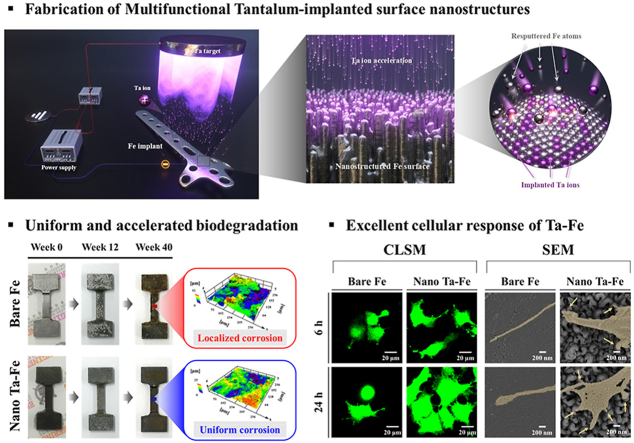
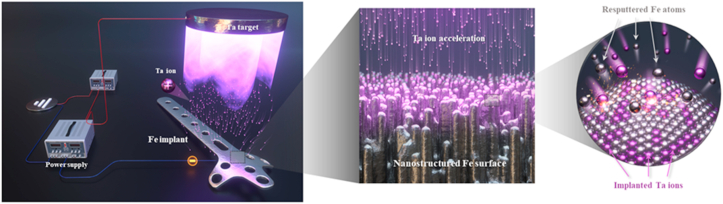
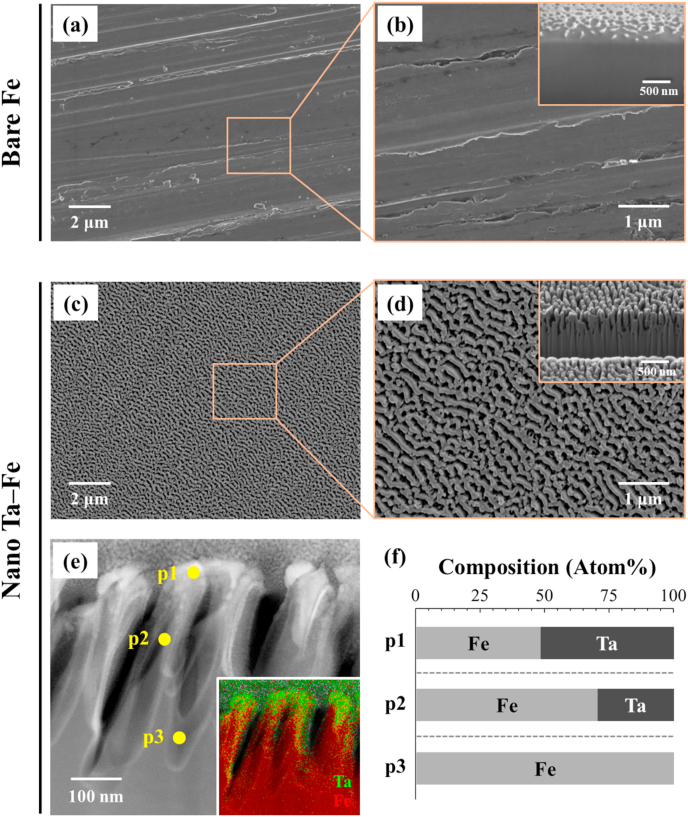
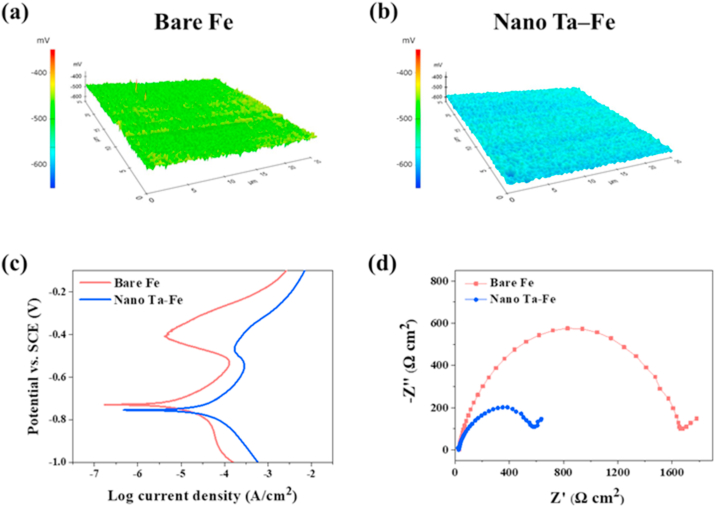
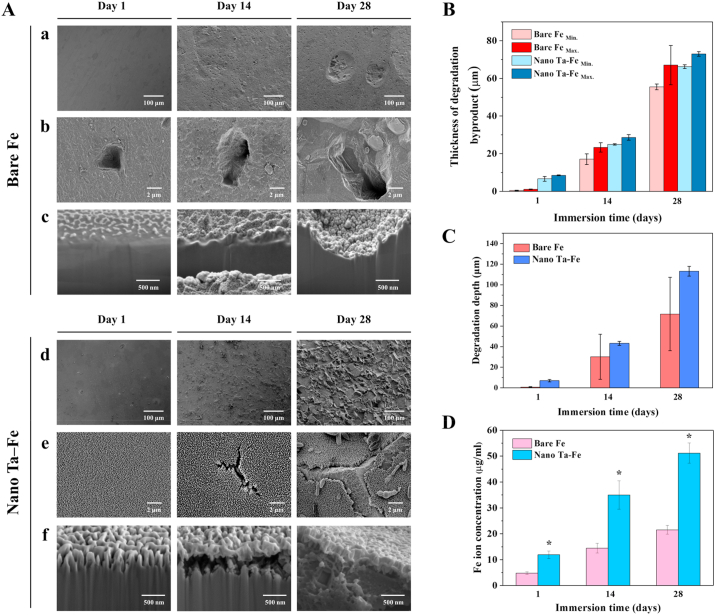
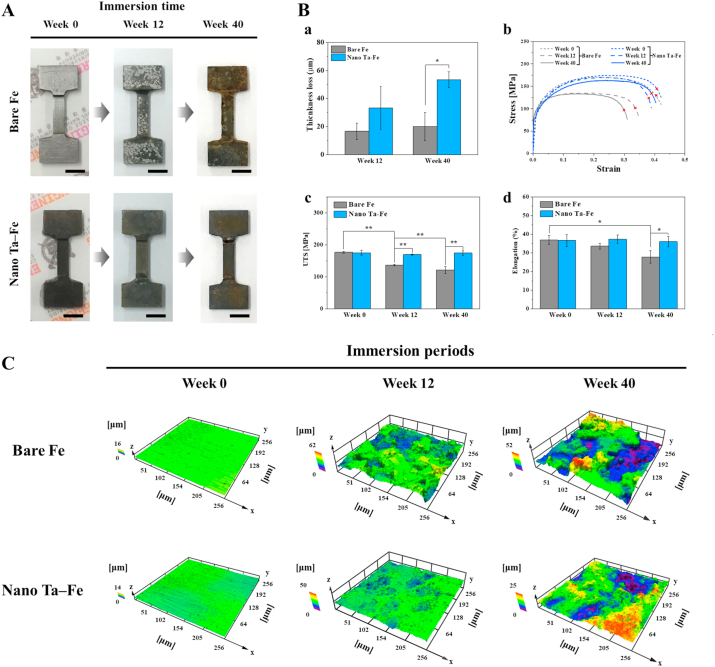
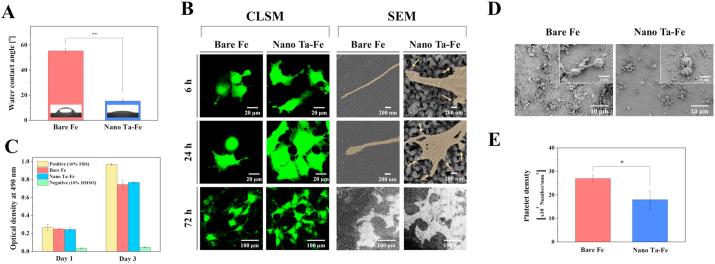
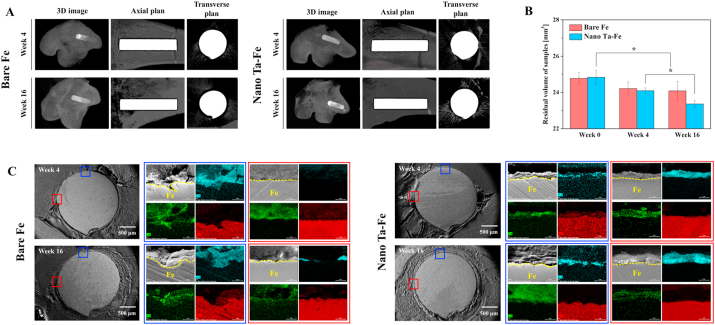
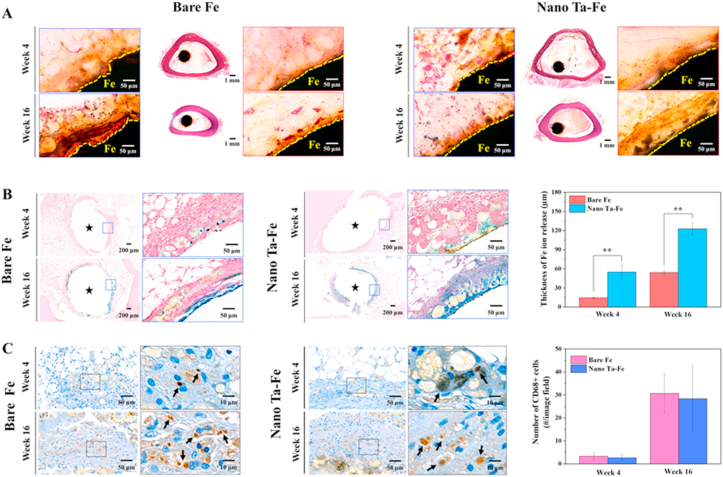
In recent years, pure iron (Fe) has attracted significant attention as a promising biodegradable orthopedic implant material due to its excellent mechanical and biological properties. However, in physiological conditions, Fe has an extremely slow degradation rate with localized and irregular degradation, which is problematic for practical applications. In this study, we developed a novel combination of a nanostructured surface topography and galvanic reaction to achieve uniform and accelerated degradation of an Fe implant. The target-ion induced plasma sputtering (TIPS) technique was applied on the Fe implant to introduce biologically compatible and electrochemically noble tantalum (Ta) onto its surface and develop surface nano-galvanic couples. Electrochemical tests revealed that the uniformly distributed nano-galvanic corrosion cells of the TIPS-treated sample (nano Ta-Fe) led to relatively uniform and accelerated surface degradation compared to that of bare Fe. Furthermore, the mechanical properties of nano Ta-Fe remained almost constant during a long-term immersion test (~40 weeks). Biocompatibility was also assessed on surfaces of bare Fe and nano Ta-Fe using osteoblast responses through direct and indirect contact assays and an rabbit femur medullary cavity implantation model. The results revealed that nano Ta-Fe not only enhanced cell adhesion and spreading on its surface, but also exhibited no signs of cellular or tissue toxicity. These results demonstrate the immense potential of Ta-implanted surface nanostructures as an effective solution for the practical application of Fe-based orthopedic implants, ensuring long-term biosafety and clinical efficacy.
近年来,纯铁(Fe)因其优异的力学性能和生物学性能,作为一种有前景的可生物降解骨科植入材料而备受关注。然而,在生理条件下,铁的降解速度极慢,降解局部化且不规则,这在实际应用中存在问题。在本研究中,我们开发了一种新型的纳米结构表面形貌与电偶反应相结合的方法,以实现铁植入物的均匀加速降解。采用靶离子诱导等离子体溅射(TIPS)技术对铁植入物进行处理,在其表面引入生物相容性好且电化学惰性的钽(Ta),形成表面纳米电偶对。电化学测试表明,与裸铁相比,经TIPS处理的样品(纳米Ta-Fe)中均匀分布的纳米电偶腐蚀电池导致表面降解相对均匀且加速。此外,在长期浸泡试验(约40周)期间,纳米Ta-Fe的力学性能几乎保持不变。还通过直接和间接接触试验以及兔股骨骨髓腔植入模型,利用成骨细胞反应评估了裸铁和纳米Ta-Fe表面的生物相容性。结果表明,纳米Ta-Fe不仅增强了细胞在其表面的黏附与铺展,而且没有细胞或组织毒性的迹象。这些结果证明了植入钽的表面纳米结构作为铁基骨科植入物实际应用的有效解决方案具有巨大潜力,确保了长期的生物安全性和临床疗效。