Department of Gynecology and Obstetrics, University Hospital of the RWTH Aachen, Pauwelsstrasse 30, 52074, Aachen, Germany.
Department of Psychiatry, Psychotherapy and Psychosomatics, University Hospital of the RWTH Aachen, Pauwelsstrasse 30, 52074, Aachen, Germany.
Arch Gynecol Obstet. 2022 Mar;305(3):625-630. doi: 10.1007/s00404-021-06337-8. Epub 2021 Nov 26.
To evaluate the occurrence of anxiety in women attending a colposcopic examination within the new cervical cancer screening in Germany.
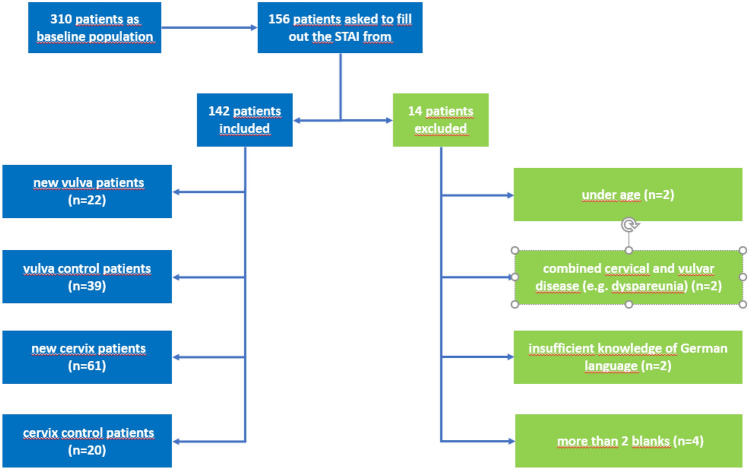
One hundred and fifty-six patients were asked to fill out Spielbergers STAI inventory form prior to their colposcopic examination. For the statistical analysis, a two by two between-group design was applied including the following group factors: the repeat factors included patients, who presented to our centre of dysplasia for the first time (new) and patients who have had an examination in our centre before (repeat). Further, the factor diagnosis included two groups: first, patients with cervical dysplasia and second, patients with vulva diseases.
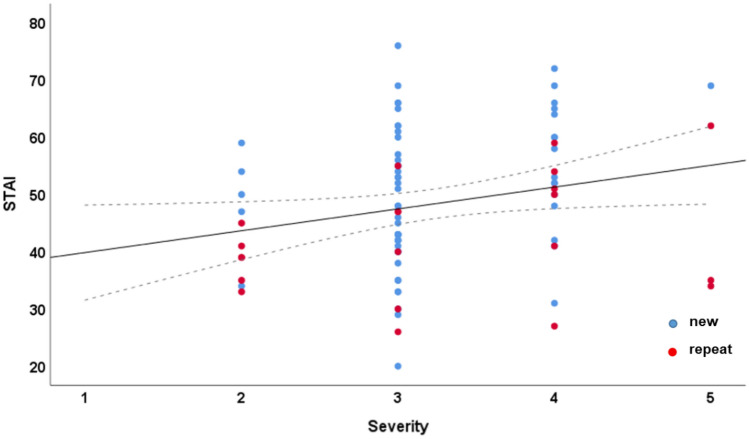
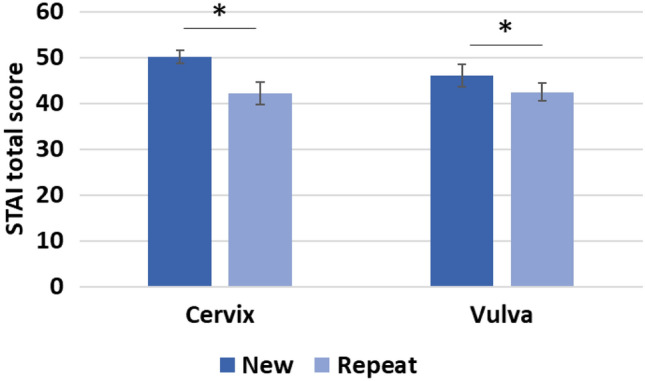
The analysis of the STAI results showed that patients presenting with cervical dysplasia for the first time had the highest levels of anxiety, directly followed by new patients in the vulva group. The ANOVA revealed a main effect of the repeat factor, F(1,140) = 7.53, p = 0.007. There was no significant effect of diagnosis.
Regardless of the diagnosis, patients being transferred for a colposcopy within the cervical cancer screening program for the first time have very high anxiety levels. The prospect of a potentially painful examination seems to be a key factor. Only a scientific evaluation of the new cervical cancer screening will be able to show if the rising numbers of colposcopic examinations is really worth the risk of exposing so many more women to the emotional distress of a colposcopy.
评估德国新宫颈癌筛查中接受阴道镜检查的女性焦虑的发生情况。
在阴道镜检查前,156 名患者被要求填写 Spielberger STAI 量表。为了进行统计分析,采用了二乘二的组间设计,包括以下组因素:重复因素包括首次到我们中心就诊的患者(新)和以前在我们中心检查过的患者(重复)。此外,诊断因素包括两组:第一组为宫颈病变患者,第二组为外阴疾病患者。
STAI 结果分析显示,首次出现宫颈病变的患者焦虑程度最高,紧随其后的是外阴组的新患者。方差分析显示,重复因素的主效应显著,F(1,140)=7.53,p=0.007。诊断因素无显著影响。
无论诊断如何,首次转介进行阴道镜检查的宫颈癌筛查患者的焦虑水平非常高。潜在的疼痛检查的前景似乎是一个关键因素。只有对新的宫颈癌筛查进行科学评估,才能确定如此多的女性因阴道镜检查而遭受情绪困扰的风险是否真的值得增加阴道镜检查的数量。