Rehman Shazia, Rehman Nadia, Mumtaz Ayesha, Jiang Jindong
Department of Biomedical Sciences, Pak-Austria Fachhochschule, Institute of Applied Sciences and Technology, Haripur 22621, Pakistan.
Department of Mathematics, Wah Campus, COMSATS University Islamabad, Wah Cantt 47040, Pakistan.
Healthcare (Basel). 2021 Oct 29;9(11):1468. doi: 10.3390/healthcare9111468.
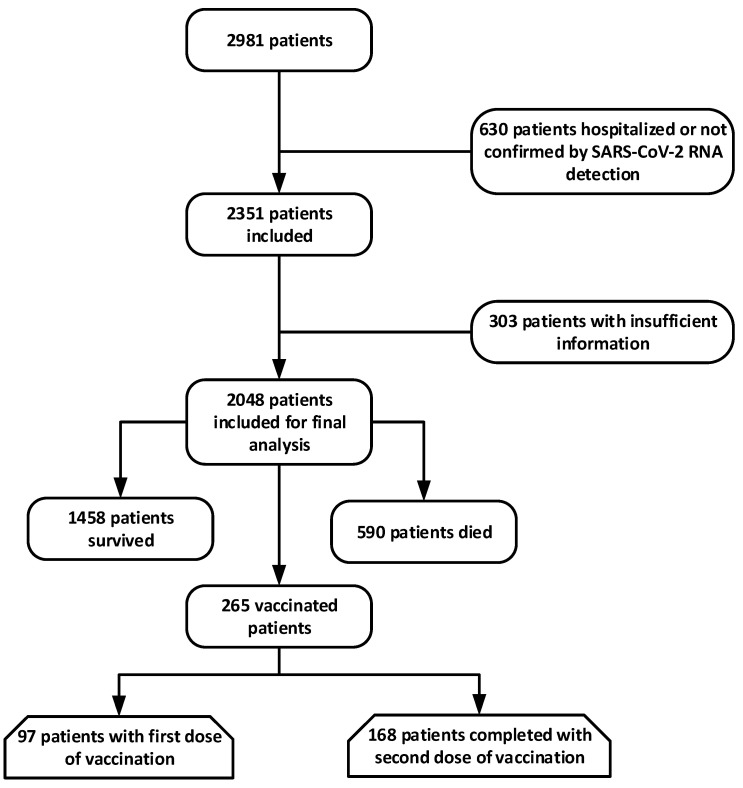
COVID-19 is a rapidly disseminating infectious disease conferred by the World Health Organization (WHO) as severe acute respiratory syndrome coronavirus 2 (SARS-CoV-2). Epidemiological and clinical characteristics data have been identified for patients with COVID-19, but mortality-related risk factors and a comprehensive clinical course of disease in a developing country have not been specifically defined. This retrospective, single-center cohort study involved all successive inpatients having a positive COVID-19 polymerase chain reaction (PCR), with deceased or discharged clinical outcomes from 1 January to 10 May 2021. Data were extracted from electronic medical records on demographic, clinical, radiological, and laboratory findings as well as complications faced and treatment provided during follow-up, involving serial samples for viral RNA identification, and compared between the dead and survivors. To investigate the risk factors associated with in-hospital mortality, we employed the multivariate logistic regression model. In this study, 2048 patients were involved, 1458 of whom were discharged, and 590 died in hospital. More than half of patients were identified as male with old age being the potential risk factor of mortality. Exactly 94.8% of all patients presented with fever at the time of admission. Several comorbidities were present in the study population, with the most frequent comorbidity being cardiovascular diseases (1177 of 2048) and hypertension (975 of 2048) followed by cerebrovascular disease and diabetes mellitus. Mortality rates for infected patients were observed as higher in severe patients (46.3%) compared with non-severe cases (26.1%) during a follow-up. Multivariate regression analysis showed a significant association of in-hospital mortality of patients with older age, presence of hypertension and cardiovascular diseases as underlying comorbidities, increased level of cardiac troponin I and d-dimer concentration on admission, as well as septicemia and ARDS as a complication during illness. To minimize the risk of death in COVID19 patients, as well as the risk of severe complications, urgent public health measures should be properly planned and implemented on those vulnerable populations. To detect early manifestations of clinical problems, thorough and regular follow-up is warranted.
新型冠状病毒肺炎(COVID-19)是一种迅速传播的传染病,世界卫生组织(WHO)将其定义为由严重急性呼吸综合征冠状病毒2(SARS-CoV-2)引起。已确定了COVID-19患者的流行病学和临床特征数据,但在一个发展中国家,与死亡率相关的危险因素以及疾病的全面临床病程尚未明确界定。这项回顾性、单中心队列研究纳入了2021年1月1日至5月10日期间所有COVID-19聚合酶链反应(PCR)呈阳性、临床结局为死亡或出院的连续住院患者。从电子病历中提取了关于人口统计学、临床、放射学和实验室检查结果的数据,以及随访期间面临的并发症和接受的治疗情况,包括用于病毒RNA鉴定的系列样本,并在死亡患者和存活患者之间进行了比较。为了研究与院内死亡相关的危险因素,我们采用了多因素逻辑回归模型。本研究共纳入2048例患者,其中1458例出院,590例死亡。超过一半的患者为男性,老年是死亡的潜在危险因素。所有患者中,确切地说94.8%在入院时出现发热。研究人群中存在几种合并症,最常见的合并症是心血管疾病(2048例中的1177例)和高血压(2048例中的975例),其次是脑血管疾病和糖尿病。在随访期间,观察到重症患者(46.3%)的感染患者死亡率高于非重症患者(26.1%)。多因素回归分析显示,患者的院内死亡与年龄较大、存在高血压和心血管疾病作为基础合并症、入院时心肌肌钙蛋白I水平升高和D-二聚体浓度升高,以及疾病期间出现败血症和急性呼吸窘迫综合征(ARDS)作为并发症显著相关。为了将COVID-19患者的死亡风险以及严重并发症的风险降至最低,应针对这些脆弱人群妥善规划和实施紧急公共卫生措施。为了检测临床问题的早期表现,有必要进行全面和定期的随访。