Bogard Jessica R, Andrew Neil L, Farrell Penny, Herrero Mario, Sharp Michael K, Tutuo Jillian
Agriculture and Food, Commonwealth Scientific and Industrial Research Organisation (CSIRO), Brisbane, QLD 4067, Australia.
Australian National Centre for Ocean Resources and Security (ANCORS), University of Wollongong, Wollongong, NSW 2522, Australia.
Foods. 2021 Oct 27;10(11):2592. doi: 10.3390/foods10112592.
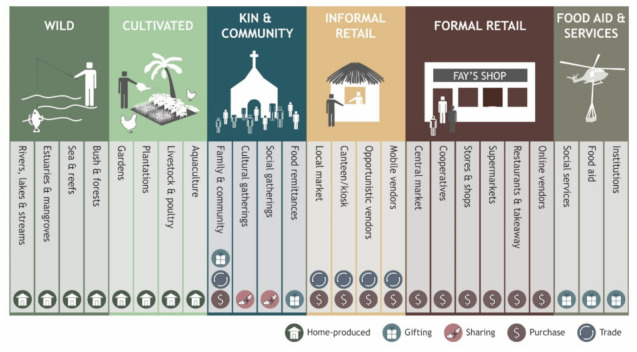
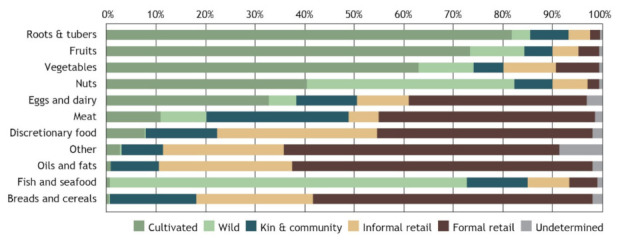
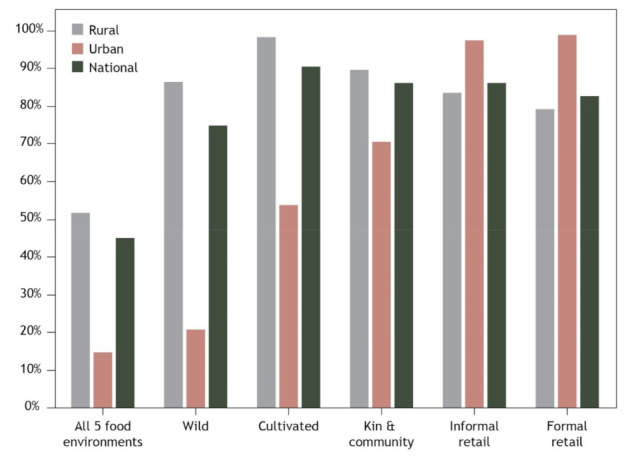
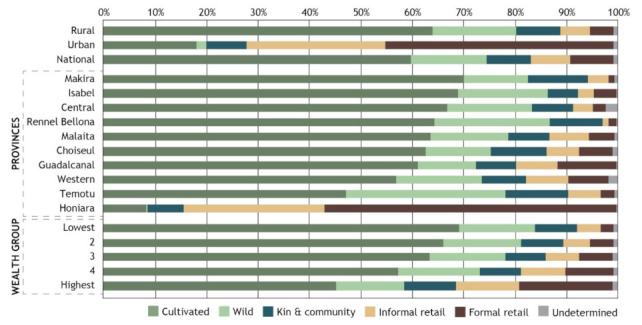
Extensive literature describes the importance of food environments (FEs) as a driver of food choices and nutrition outcomes; yet existing FE frameworks do not adequately capture the diversity of FEs relevant to the Pacific Region. This limits identification of opportunities in food systems to reduce the multiple burden of malnutrition. We present a conceptual typology of FEs including six primary FEs relevant in the Pacific; wild; cultivated; kin and community; informal retail; formal retail; and food aid and services. We then apply this typology to food acquisition data from Solomon Islands 2012/13 Household Income and Expenditure Survey and analyse the relationship between FEs and diet quality. The cultivated FE accounts for 60% of the quantity of food acquired nationally, followed by wild (15%), kin and community (9%), and formal and informal retail FEs (8% each), with wide variation between urban and rural households, provinces and wealth groups. Reliance on different FEs is a significant predictor of diet quality and affirms the importance of subsistence fisheries and agriculture, and community and kinship networks. Integration of a FE typology such as the one presented here in commonly conducted household expenditure surveys offers significant opportunity to advance our understanding of food system leverage points to improve nutrition and health.
大量文献描述了食物环境(FEs)作为食物选择和营养结果驱动因素的重要性;然而,现有的食物环境框架未能充分涵盖与太平洋地区相关的食物环境的多样性。这限制了在食物系统中识别减少营养不良多重负担的机会。我们提出了一种食物环境的概念类型,包括与太平洋地区相关的六种主要食物环境;野生的;种植的;亲属和社区的;非正式零售的;正式零售的;以及食品援助和服务。然后,我们将这种类型应用于所罗门群岛2012/13年家庭收入和支出调查的食物获取数据,并分析食物环境与饮食质量之间的关系。在所获取的全国食物总量中,种植的食物环境占60%,其次是野生的(15%)、亲属和社区的(9%)以及正式和非正式零售的食物环境(各占8%),城乡家庭、省份和财富群体之间存在很大差异。对不同食物环境的依赖是饮食质量的一个重要预测指标,并肯定了自给性渔业和农业以及社区和亲属关系网络的重要性。将本文提出的这种食物环境类型纳入通常进行的家庭支出调查中,为推进我们对改善营养和健康的食物系统杠杆点的理解提供了重要机会。