Stergiadis Sokratis, Qin Nanbing, Faludi Gergely, Beauclercq Stephane, Pitt Joe, Desnica Natasa, Pétursdóttir Ásta H, Newton Eric E, Angelidis Angelos E, Givens Ian, Humphries David J, Gunnlaugsdóttir Helga, Juniper Darren T
Department of Animal Sciences, School of Agriculture, Policy and Development, University of Reading, P.O. Box 237, Earley Gate, Reading RG6 6EU, UK.
Georgikon Campus, Szent Istvan University, Deák Ferenc u. 16, H-8360 Keszthely, Hungary.
Foods. 2021 Nov 9;10(11):2733. doi: 10.3390/foods10112733.
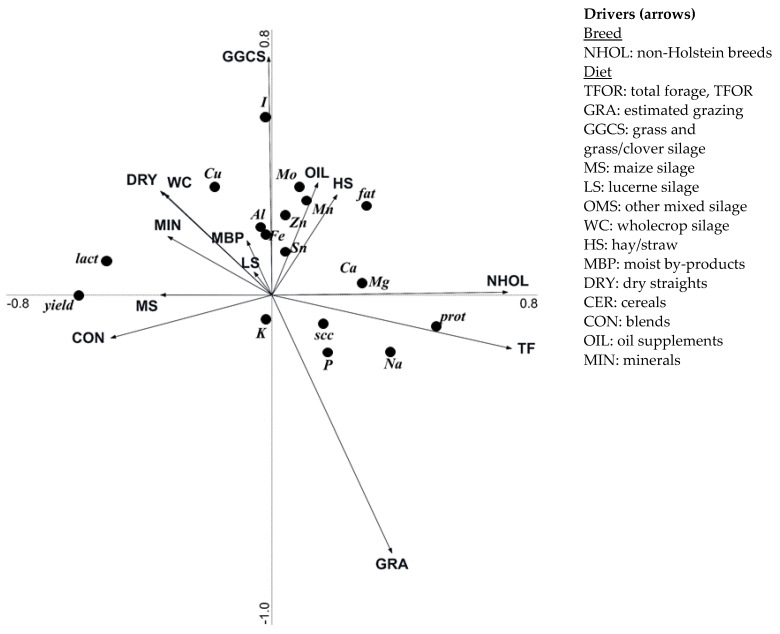
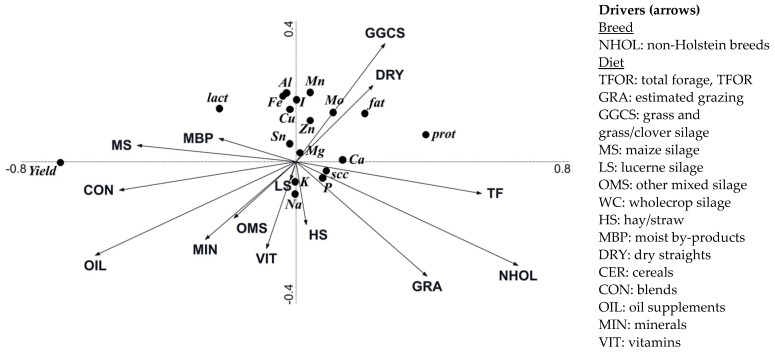
Thirty conventional and twenty-four organic dairy farms were divided into equal numbers within system groups: high-pasture, standard-pasture, and low-pasture groups. Milk samples were collected monthly for 12 consecutive months. Milk from high-pasture organic farms contained less fat and protein than standard- and low-pasture organic farms, but more lactose than low-pasture organic farms. Grazing, concentrate feed intake and the contribution of non-Holstein breeds were the key drivers for these changes. Milk Ca and P concentrations were lower in standard-pasture conventional farms than the other conventional groups. Milk from low-pasture organic farms contained less Ca than high- and standard-pasture organic farms, while high-pasture organic farms produced milk with the highest Sn concentration. Differences in mineral concentrations were driven by the contribution of non-Holstein breeds, feeding practices, and grazing activity; but due to their relatively low numerical differences between groups, the subsequent impact on consumers' dietary mineral intakes would be minor.
30个传统奶牛场和24个有机奶牛场被平均分为系统组:高牧草组、标准牧草组和低牧草组。连续12个月每月采集牛奶样本。高牧草有机农场的牛奶脂肪和蛋白质含量低于标准牧草和低牧草有机农场,但乳糖含量高于低牧草有机农场。放牧、精饲料摄入量和非荷斯坦品种的占比是这些变化的关键驱动因素。标准牧草传统农场的牛奶钙和磷浓度低于其他传统组。低牧草有机农场的牛奶钙含量低于高牧草和标准牧草有机农场,而高牧草有机农场生产的牛奶锡浓度最高。矿物质浓度的差异是由非荷斯坦品种的占比、饲养方式和放牧活动导致的;但由于组间数值差异相对较小,其对消费者膳食矿物质摄入量的后续影响较小。