Zahri Khadijah Nabilah Mohd, Khalil Khalilah Abdul, Gomez-Fuentes Claudio, Zulkharnain Azham, Sabri Suriana, Convey Peter, Lim Sooa, Ahmad Siti Aqlima
Department of Biochemistry, Faculty of Biotechnology and Biomolecular Sciences, Universiti Putra Malaysia, Serdang 43400, Selangor, Malaysia.
School of Biology, Faculty of Applied Sciences, Universiti Teknologi MARA, Section 2, Shah Alam 45000, Selangor, Malaysia.
Foods. 2021 Nov 14;10(11):2801. doi: 10.3390/foods10112801.
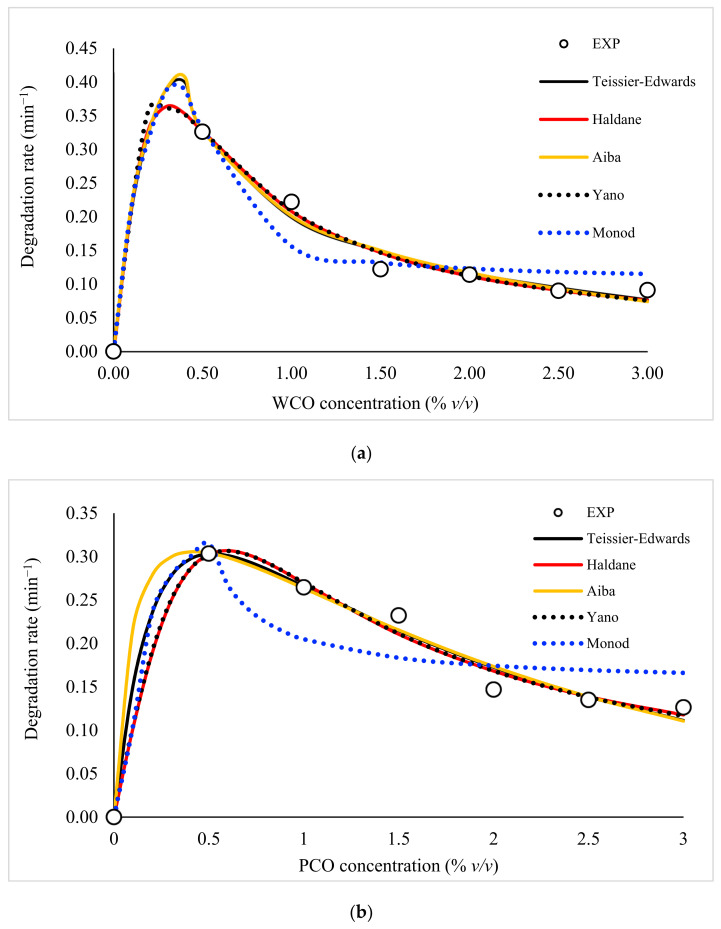
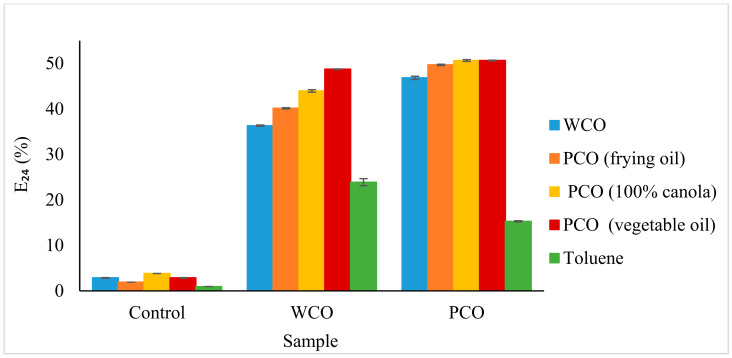
An Antarctic soil bacterial consortium (reference BS14) was confirmed to biodegrade canola oil, and kinetic studies on this biodegradation were carried out. The purpose of this study was to examine the ability of BS14 to produce biosurfactants during the biodegradation of canola oil. Secondary mathematical equations were chosen for kinetic analyses (Monod, Haldane, Teissier-Edwards, Aiba and Yano models). At the same time, biosurfactant production was confirmed through a preliminary screening test and further optimised using response surface methodology (RSM). Mathematical modelling demonstrated that the best-fitting model was the Haldane model for both waste (WCO) and pure canola oil (PCO) degradation. Kinetic parameters including the maximum degradation rate () and maximum concentration of substrate tolerated () were obtained. For WCO degradation these were 0.365 min and 0.308%, respectively, while for PCO they were 0.307 min and 0.591%, respectively. The results of all preliminary screenings for biosurfactants were positive. BS14 was able to produce biosurfactant concentrations of up to 13.44 and 14.06 mg/mL in the presence of WCO and PCO, respectively, after optimisation. The optimum values for each factor were determined using a three-dimensional contour plot generated in a central composite design, where a combination of 0.06% salinity, pH 7.30 and 1.55% initial substrate concentration led to the highest biosurfactant production when using WCO. Using PCO, the highest biosurfactant yield was obtained at 0.13% salinity, pH 7.30 and 1.25% initial substrate concentration. This study could help inform the development of large-scale bioremediation applications, not only for the degradation of canola oil but also of other hydrocarbons in the Antarctic by utilising the biosurfactants produced by BS14.
一个南极土壤细菌群落(参考编号BS14)被证实能够对菜籽油进行生物降解,并对这种生物降解过程进行了动力学研究。本研究的目的是考察BS14在菜籽油生物降解过程中产生生物表面活性剂的能力。选择二级数学方程进行动力学分析(莫诺德模型、霍尔丹模型、泰西耶 - 爱德华兹模型、相场模型和矢野模型)。同时,通过初步筛选试验确认了生物表面活性剂的产生,并使用响应面方法(RSM)进一步优化。数学建模表明,对于废菜籽油(WCO)和纯菜籽油(PCO)的降解,最佳拟合模型均为霍尔丹模型。获得了包括最大降解速率()和最大耐受底物浓度()在内的动力学参数。对于WCO降解,这些参数分别为0.365分钟和0.308%,而对于PCO,它们分别为0.307分钟和0.591%。所有生物表面活性剂初步筛选的结果均为阳性。优化后,在存在WCO和PCO的情况下,BS14分别能够产生高达13.44和14.06毫克/毫升的生物表面活性剂浓度。使用中心复合设计生成的三维等高线图确定了每个因素的最佳值,其中当使用WCO时,0.06%的盐度、pH值7.30和1.55%的初始底物浓度组合导致生物表面活性剂产量最高。使用PCO时,在0.13%的盐度、pH值7.30和1.25%的初始底物浓度下获得了最高的生物表面活性剂产量。本研究不仅有助于为大规模生物修复应用的开发提供信息,以降解菜籽油,还可利用BS14产生的生物表面活性剂降解南极的其他碳氢化合物。