Jurišić Grubešić Renata, Nazlić Marija, Miletić Tina, Vuko Elma, Vuletić Nenad, Ljubenkov Ivica, Dunkić Valerija
Faculty of Medicine, University of Rijeka, Braće Branchetta 20, HR-51000 Rijeka, Croatia.
Faculty of Science, University of Split, Ruđera Boškovića 33, HR-21000 Split, Croatia.
Antioxidants (Basel). 2021 Nov 18;10(11):1832. doi: 10.3390/antiox10111832.
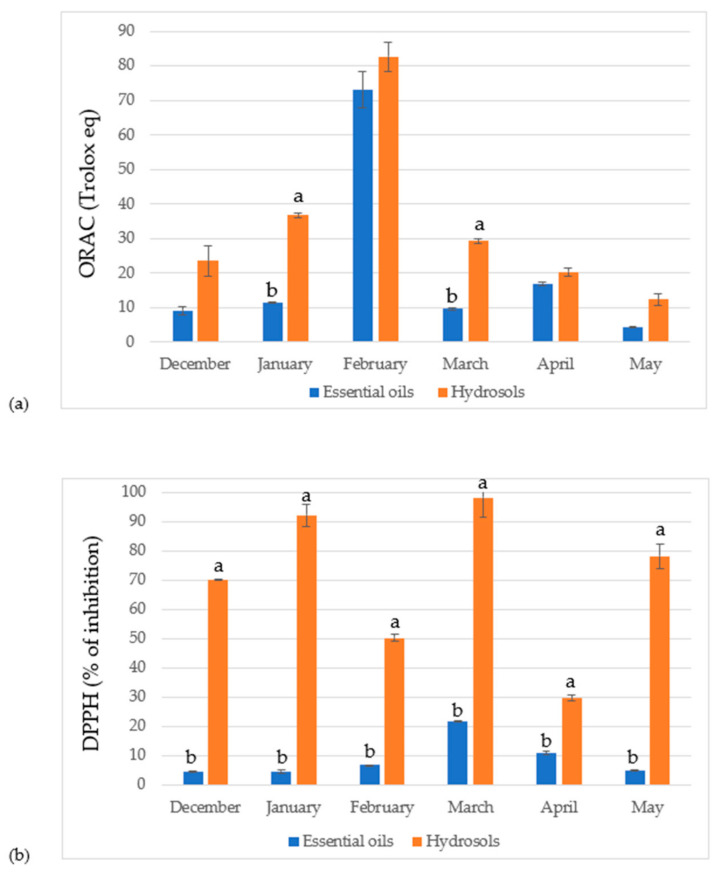
Previous research on specialized metabolites of olive leaves has focused on the phenolic components and their biological role. The research in this article focuses on the metabolites that form free volatile compounds (FVCs). The composition of FVCs is divided into compounds isolated in the oil phase (essential oils; EO) and in the aqueous phase (hydrosols; Hy) from leaves of L. cultivar Oblica. Plant material was collected from the same olive tree over a six-month period, from December to May, and analyzed by gas chromatography-mass spectrometry (GC-MS). The compounds -caryophyllene, α-humulene, -aromadendrene, docosane, hexadecanoic acid and oleic acid were identified in all EO study periods. In the Hy in all studied periods, the major compounds are α-pinene, -ionone, myristicin, docosane, -hexanol, oleic acid and -damascenone. The differences in the qualitative composition of FVC are directly related to the phenological development of the leaves. Antioxidant capacity of the EOs and hydrosols was measured with two methods, ORAC and DPPH. Hydrosol extracts showed higher capacity than the EOs in all methods.
先前对橄榄叶特殊代谢产物的研究主要集中在酚类成分及其生物学作用上。本文的研究重点是形成游离挥发性化合物(FVCs)的代谢产物。FVCs的组成分为从油橄榄品种奥布利卡(L. cultivar Oblica)叶片的油相中分离出的化合物(精油;EO)和水相中分离出的化合物(纯露;Hy)。在12月至5月的六个月时间里,从同一棵橄榄树上采集植物材料,并通过气相色谱 - 质谱联用仪(GC-MS)进行分析。在所有精油研究阶段均鉴定出了石竹烯、α-葎草烯、γ-石竹烯、二十二烷、十六烷酸和油酸等化合物。在所有研究阶段的纯露中,主要化合物为α-蒎烯、β-紫罗兰酮、肉豆蔻醚、二十二烷、β-己醇、油酸和β-大马酮。FVCs定性组成的差异与叶片的物候发育直接相关。采用氧自由基吸收能力(ORAC)和二苯基苦味酰基自由基(DPPH)两种方法测定了精油和纯露的抗氧化能力。在所有方法中,纯露提取物均显示出比精油更高的抗氧化能力。