Rudolf-Boehm-Institute for Pharmacology and Toxicology, Leipzig University, 04107 Leipzig, Germany.
Department for Environmental Immunology, Helmholtz Centre for Environmental Research-UFZ, 04318 Leipzig, Germany.
Int J Mol Sci. 2021 Nov 12;22(22):12269. doi: 10.3390/ijms222212269.
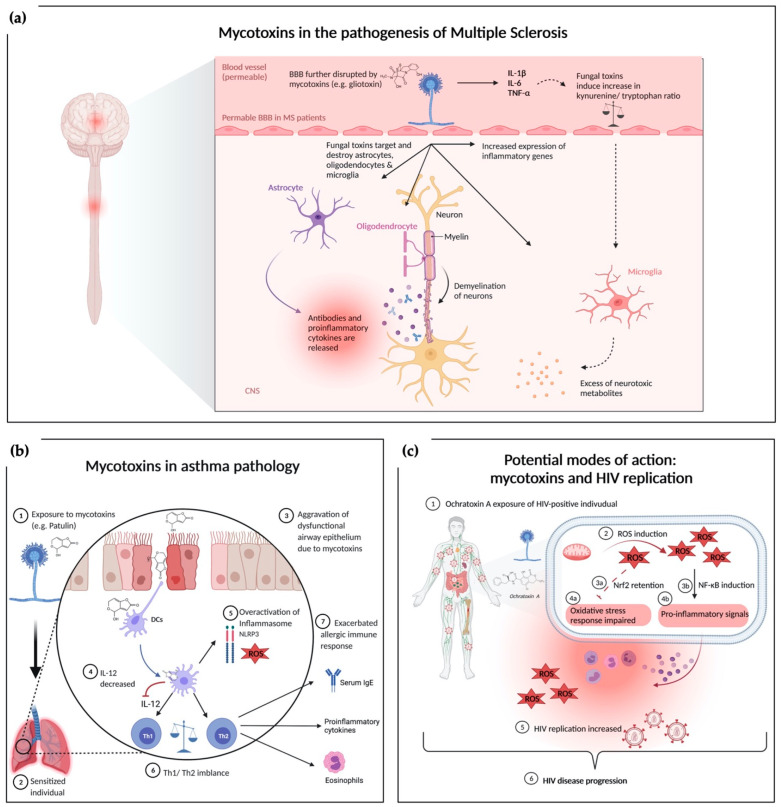
Fungi represent one of the most diverse and abundant eukaryotes on earth. The interplay between mold exposure and the host immune system is still not fully elucidated. Literature research focusing on up-to-date publications is providing a heterogenous picture of evidence and opinions regarding the role of mold and mycotoxins in the development of immune diseases. While the induction of allergic immune responses by molds is generally acknowledged, other direct health effects like the toxic mold syndrome are controversially discussed. However, recent observations indicate a particular importance of mold/mycotoxin exposure in individuals with pre-existing dysregulation of the immune system, due to exacerbation of underlying pathophysiology including allergic and non-allergic chronic inflammatory diseases, autoimmune disorders, and even human immunodeficiency virus (HIV) disease progression. In this review, we focus on the impact of mycotoxins regarding their impact on disease progression in pre-existing immune dysregulation. This is complemented by experimental in vivo and in vitro findings to present cellular and molecular modes of action. Furthermore, we discuss hypothetical mechanisms of action, where evidence is missing since much remains to be discovered.
真菌是地球上最多样和最丰富的真核生物之一。霉菌暴露与宿主免疫系统之间的相互作用仍未完全阐明。目前的文献研究侧重于最新的出版物,为霉菌和霉菌毒素在免疫性疾病发展中的作用提供了混杂的证据和观点。虽然霉菌引起的过敏免疫反应是公认的,但其他直接的健康影响,如霉菌中毒综合征,仍存在争议。然而,最近的观察表明,由于潜在的病理生理学(包括过敏和非过敏慢性炎症性疾病、自身免疫性疾病,甚至人类免疫缺陷病毒 (HIV) 疾病进展)的加剧,霉菌/霉菌毒素暴露在免疫系统预先失调的个体中具有特别重要的意义。在这篇综述中,我们重点关注霉菌毒素对预先存在的免疫失调疾病进展的影响。这是通过体内和体外实验的发现来补充的,以展示细胞和分子作用模式。此外,我们还讨论了假设的作用机制,因为缺乏证据,还有很多有待发现。