Takeishi Junpei, Tatewaki Yasuko, Nakase Taizen, Takano Yumi, Tomita Naoki, Yamamoto Shuzo, Mutoh Tatsushi, Taki Yasuyuki
Department of Aging Research and Geriatric Medicine, Institute of Development, Aging and Cancer, Tohoku University, Sendai 980-8575, Japan.
Department of Geriatric Medicine and Neuroimaging, Tohoku University Hospital, Sendai 980-8575, Japan.
Int J Mol Sci. 2021 Nov 15;22(22):12310. doi: 10.3390/ijms222212310.
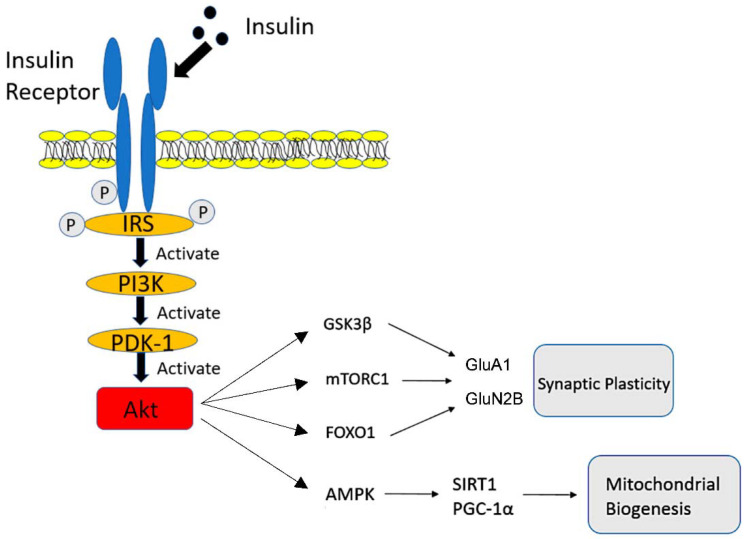
Recently, type 2 diabetes mellitus (T2DM) has been reported to be strongly associated with Alzheimer's disease (AD). This is partly due to insulin resistance in the brain. Insulin signaling and the number of insulin receptors may decline in the brain of T2DM patients, resulting in impaired synaptic formation, neuronal plasticity, and mitochondrial metabolism. In AD patients, hypometabolism of glucose in the brain is observed before the onset of symptoms. Amyloid-β accumulation, a main pathology of AD, also relates to impaired insulin action and glucose metabolism, although ketone metabolism is not affected. Therefore, the shift from glucose metabolism to ketone metabolism may be a reasonable pathway for neuronal protection. To promote ketone metabolism, medium-chain triglyceride (MCT) oil and a ketogenic diet could be introduced as an alternative source of energy in the brain of AD patients.
最近,据报道2型糖尿病(T2DM)与阿尔茨海默病(AD)密切相关。部分原因是大脑中的胰岛素抵抗。T2DM患者大脑中的胰岛素信号传导和胰岛素受体数量可能会下降,导致突触形成、神经元可塑性和线粒体代谢受损。在AD患者中,在症状出现之前就观察到大脑中葡萄糖代谢减退。淀粉样β蛋白积累是AD的主要病理学特征,尽管酮代谢不受影响,但它也与胰岛素作用和葡萄糖代谢受损有关。因此,从葡萄糖代谢向酮代谢的转变可能是神经元保护的合理途径。为促进酮代谢,可引入中链甘油三酯(MCT)油和生酮饮食作为AD患者大脑中的替代能量来源。