
自噬体闭合的关键调节因子。
Key Regulators of Autophagosome Closure.
机构信息
Center of Excellence for Environmental Safety and Biological Effects, Faculty of Environment and Life Sciences, Beijing International Science and Technology Cooperation Base for Antiviral Drugs, Beijing University of Technology, 100 Ping Le Yuan, Chaoyang District, Beijing 100124, China.
Laboratory for Marine Fisheries and Aquaculture, Qingdao National Laboratory for Marine Science and Technology, Key Laboratory of Maricultural Organism Disease Control, Ministry of Agriculture and Rural Affairs, Yellow Sea Fisheries Research Institute, Chinese Academy of Fishery Sciences, Qingdao 266071, China.
出版信息
Cells. 2021 Oct 20;10(11):2814. doi: 10.3390/cells10112814.
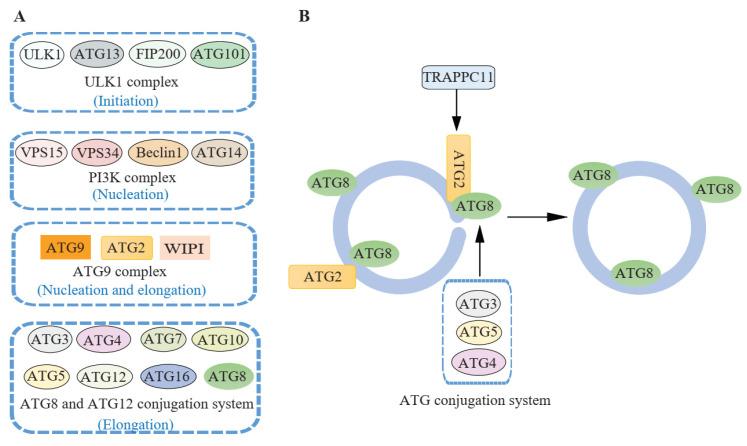
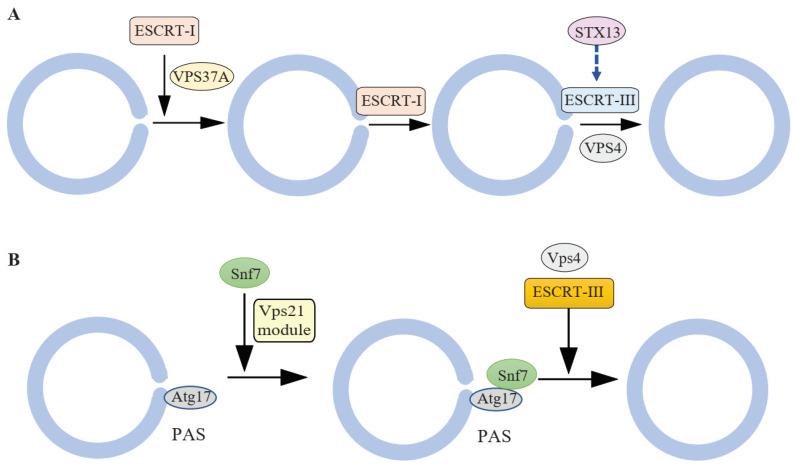
Autophagy is an evolutionarily conserved pathway, in which cytoplasmic components are sequestered within double-membrane vesicles called autophagosomes and then transported into lysosomes or vacuoles for degradation. Over 40 conserved autophagy-related (ATG) genes define the core machinery for the five processes of autophagy: initiation, nucleation, elongation, closure, and fusion. In this review, we focus on one of the least well-characterized events in autophagy, namely the closure of the isolation membrane/phagophore to form the sealed autophagosome. This process is tightly regulated by ESCRT machinery, ATG proteins, Rab GTPase and Rab-related proteins, SNAREs, sphingomyelin, and calcium. We summarize recent progress in the regulation of autophagosome closure and discuss the key questions remaining to be addressed.
自噬是一种进化上保守的途径,其中细胞质成分被隔离在称为自噬体的双层膜泡中,然后运输到溶酶体或液泡中进行降解。超过 40 种保守的自噬相关(ATG)基因定义了自噬的五个过程的核心机制:起始、成核、延伸、闭合和融合。在这篇综述中,我们重点介绍自噬中一个研究最少的事件,即隔离膜/吞噬体的闭合形成封闭的自噬体。这个过程受到 ESCRT 机制、ATG 蛋白、Rab GTPase 和 Rab 相关蛋白、SNAREs、神经鞘磷脂和钙的严格调节。我们总结了自噬体闭合调节的最新进展,并讨论了仍需解决的关键问题。

 Zotero 插件