Qi Jiajin, Su Gongmeiyue, Li Zhao
Institute of Engineering Medicine, Beijing Institute of Technology, Beijing 100081, China.
Beijing Key Laboratory for Separation and Analysis in Biomedicine and Pharmaceuticals, Beijing Institute of Technology, Beijing 100081, China.
Materials (Basel). 2021 Nov 10;14(22):6759. doi: 10.3390/ma14226759.
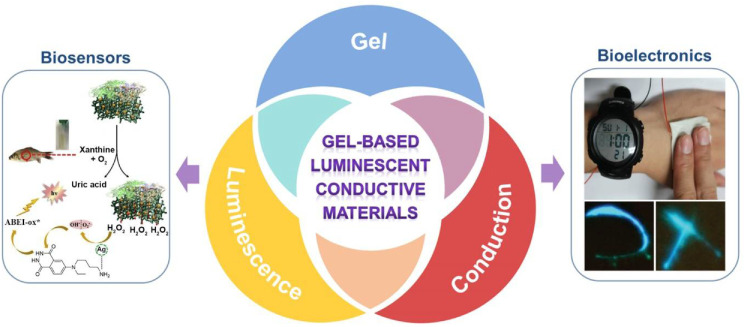
The gel is an ideal platform for fabricating materials for bio-related applications due to its good biocompatibility, adjustable mechanical strength, and flexible and diversified functionalization. In recent decades, gel-based luminescent conductive materials that possess additional luminescence and conductivity simultaneously advanced applications in biosensors and bioelectronics. Herein, a comprehensive overview of gel-based luminescent conductive materials is summarized in this review. Gel-based luminescent conductive materials are firstly outlined, highlighting their fabrication methods, network structures, and functions. Then, their applications in biosensors and bioelectronics fields are illustrated. Finally, challenges and future perspectives of this emerging field are discussed with the hope of inspire additional ideas.
由于具有良好的生物相容性、可调节的机械强度以及灵活多样的功能化特性,该凝胶是制造生物相关应用材料的理想平台。近几十年来,同时具备额外发光和导电性能的基于凝胶的发光导电材料在生物传感器和生物电子学领域取得了先进的应用。在此综述中,对基于凝胶的发光导电材料进行了全面概述。首先概述了基于凝胶的发光导电材料,重点介绍了它们的制备方法、网络结构和功能。然后,阐述了它们在生物传感器和生物电子学领域的应用。最后,讨论了这一新兴领域的挑战和未来前景,希望能激发更多的想法。