Yoo Hee-Jeong, Yoon Ha-Young, Yee Jeong, Gwak Hye-Sun
College of Pharmacy and Graduate School of Pharmaceutical Sciences, Ewha Womans University, Seoul 03760, Korea.
Department of Pharmacy, National Medical Center, Seoul 04564, Korea.
Pharmaceuticals (Basel). 2021 Nov 22;14(11):1198. doi: 10.3390/ph14111198.
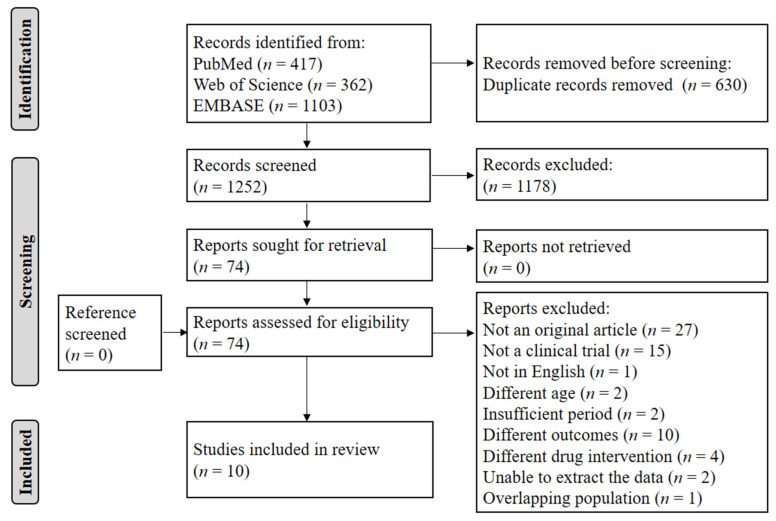
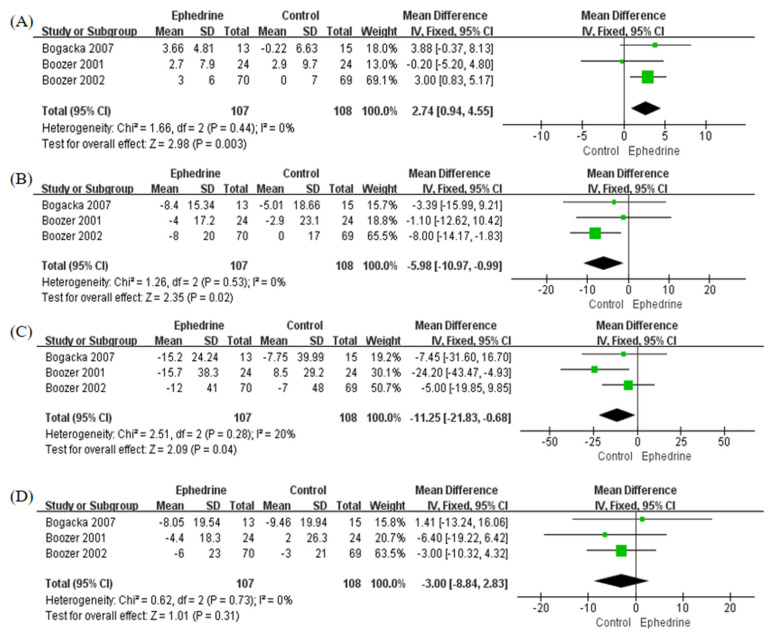
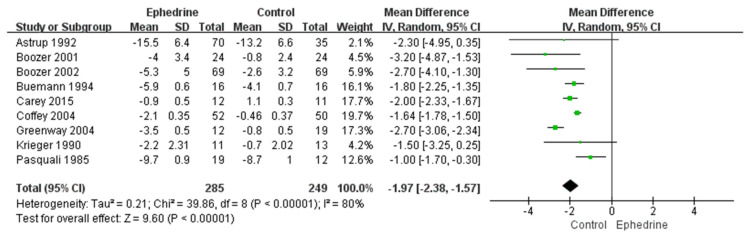
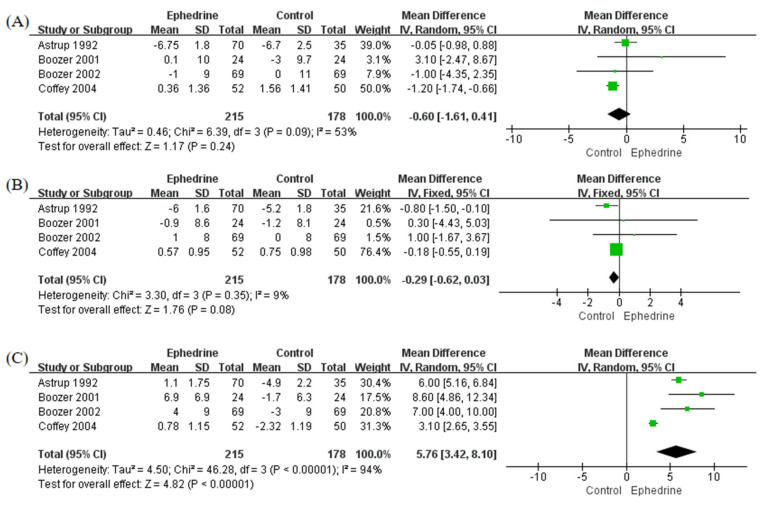
Ephedrine, the main active ingredient of mahuang, may lead to weight loss; however, it can also induce cardiovascular side effects. As ephedrine use remains controversial, this study aimed to systematically review previous studies on ephedrine-containing products and perform meta-analysis of the existing evidence on weight, blood pressure (BP), heart rate, and lipid change effects of ephedrine-containing products. We searched for placebo-controlled randomized studies in PubMed, Web of Science, and EMBASE until July 2021 using the following search terms: (ephedr* OR mahuang) AND ("weight loss" OR obes* OR overweight). Mean differences (MDs) and 95% confidence intervals (CIs) were calculated to evaluate the effects of ephedrine-containing products on weight, BP, heart rate, and lipid profiles. A total of 10 articles were included. Compared with the placebo group, the ephedrine-containing product group was associated with greater weight loss, with an MD of -1.97 kg (95% CI: -2.38, -1.57). In the ephedrine-containing product group, the mean heart rate was 5.76 beats/min higher than in the placebo group (95% CI: 3.42, 8.10), whereas intergroup differences in systolic and diastolic BP were not statistically significant. The ephedrine-containing product group had a significantly higher mean high-density lipoprotein cholesterol level (MD: 2.74 mg/dL; 95% CI: 0.94, 4.55), lower mean low-density lipoprotein cholesterol level (MD: -5.98 mg/dL; 95% CI: -10.97, -0.99), and lower mean triglyceride level (MD: -11.25 mg/dL; 95% CI: -21.83, -0.68) than the placebo group. Compared with placebo, the ephedrine-containing products showed better effects on weight loss and lipid profiles, whereas they caused increased heart rate. The ephedrine-containing products may be beneficial to obese or overweight patients; however, close monitoring is needed, especially heart rate monitoring.
麻黄碱是麻黄的主要活性成分,可能导致体重减轻;然而,它也会引发心血管副作用。由于麻黄碱的使用仍存在争议,本研究旨在系统回顾以往关于含麻黄碱产品的研究,并对现有证据进行荟萃分析,以探讨含麻黄碱产品对体重、血压(BP)、心率和血脂变化的影响。我们在PubMed、Web of Science和EMBASE中检索截至2021年7月的安慰剂对照随机研究,使用以下检索词:(麻黄碱或麻黄)AND(“体重减轻”或肥胖或超重)。计算平均差(MDs)和95%置信区间(CIs),以评估含麻黄碱产品对体重、血压、心率和血脂谱的影响。共纳入10篇文章。与安慰剂组相比,含麻黄碱产品组的体重减轻更明显,平均差为-1.97 kg(95%置信区间:-2.38,-1.57)。在含麻黄碱产品组中,平均心率比安慰剂组高5.76次/分钟(95%置信区间:3.42,8.10),而收缩压和舒张压的组间差异无统计学意义。含麻黄碱产品组的平均高密度脂蛋白胆固醇水平显著更高(平均差:2.74 mg/dL;95%置信区间:0.94,4.55),平均低密度脂蛋白胆固醇水平更低(平均差:-5.98 mg/dL;95%置信区间:-10.97,-0.99),平均甘油三酯水平也比安慰剂组更低(平均差:-11.25 mg/dL;95%置信区间:-21.83,-0.68)。与安慰剂相比,含麻黄碱产品在体重减轻和血脂谱方面显示出更好的效果,但会导致心率增加。含麻黄碱产品可能对肥胖或超重患者有益;然而,需要密切监测,尤其是心率监测。