Department of Electrical Engineering, Gonabad Branch, Islamic Azad University, Gonabad 6518115743, Iran.
Department of Electrical Engineering, Mashhad Branch, Islamic Azad University, Mashhad 9187147578, Iran.
Sensors (Basel). 2021 Nov 19;21(22):7710. doi: 10.3390/s21227710.
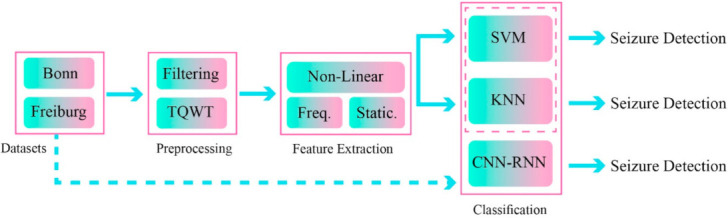
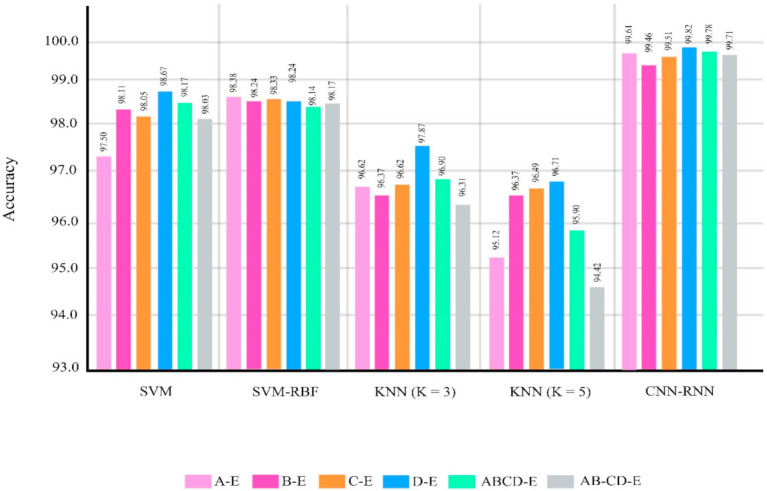
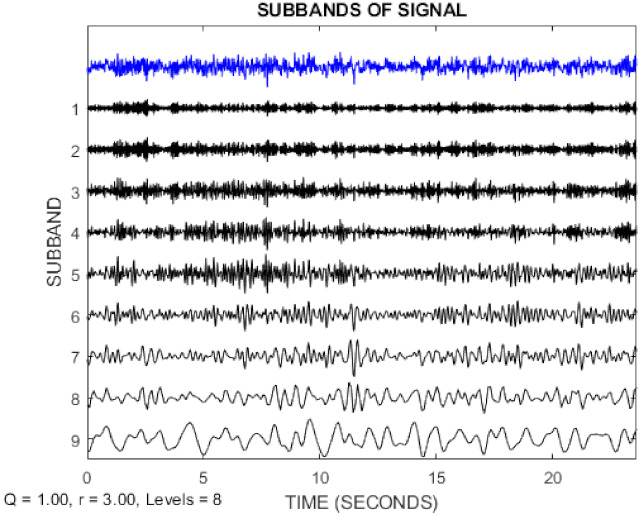
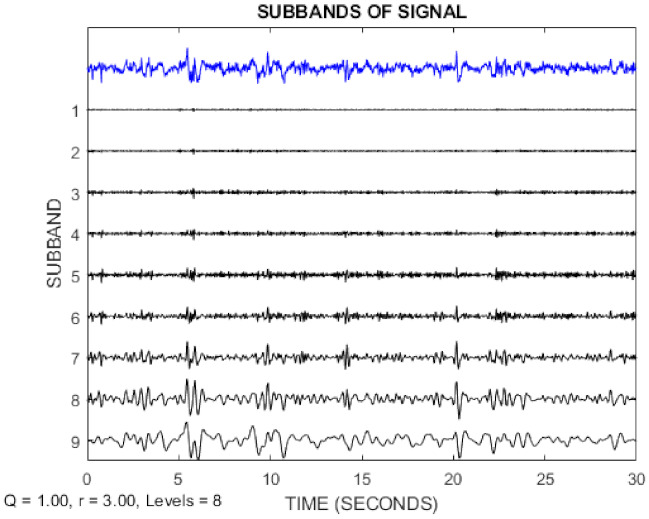
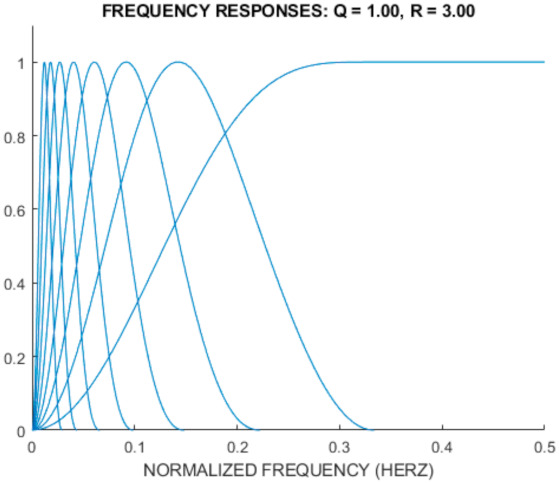
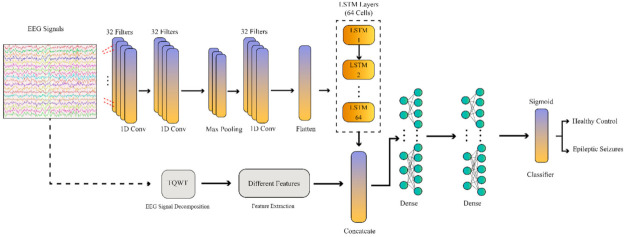
Epilepsy is a brain disorder disease that affects people's quality of life. Electroencephalography (EEG) signals are used to diagnose epileptic seizures. This paper provides a computer-aided diagnosis system (CADS) for the automatic diagnosis of epileptic seizures in EEG signals. The proposed method consists of three steps, including preprocessing, feature extraction, and classification. In order to perform the simulations, the Bonn and Freiburg datasets are used. Firstly, we used a band-pass filter with 0.5-40 Hz cut-off frequency for removal artifacts of the EEG datasets. Tunable-Q Wavelet Transform (TQWT) is used for EEG signal decomposition. In the second step, various linear and nonlinear features are extracted from TQWT sub-bands. In this step, various statistical, frequency, and nonlinear features are extracted from the sub-bands. The nonlinear features used are based on fractal dimensions (FDs) and entropy theories. In the classification step, different approaches based on conventional machine learning (ML) and deep learning (DL) are discussed. In this step, a CNN-RNN-based DL method with the number of layers proposed is applied. The extracted features have been fed to the input of the proposed CNN-RNN model, and satisfactory results have been reported. In the classification step, the K-fold cross-validation with k = 10 is employed to demonstrate the effectiveness of the proposed CNN-RNN classification procedure. The results revealed that the proposed CNN-RNN method for Bonn and Freiburg datasets achieved an accuracy of 99.71% and 99.13%, respectively.
癫痫是一种影响人们生活质量的脑部疾病。脑电图(EEG)信号用于诊断癫痫发作。本文提出了一种用于 EEG 信号中癫痫自动诊断的计算机辅助诊断系统(CADS)。所提出的方法包括三个步骤,包括预处理、特征提取和分类。为了进行模拟,使用了波恩和弗赖堡数据集。首先,我们使用截止频率为 0.5-40 Hz 的带通滤波器去除 EEG 数据集的伪影。可调 Q 小波变换(TQWT)用于 EEG 信号分解。在第二步中,从 TQWT 子带中提取各种线性和非线性特征。在此步骤中,从子带中提取各种统计、频率和非线性特征。使用的非线性特征基于分形维数(FD)和熵理论。在分类步骤中,讨论了基于传统机器学习(ML)和深度学习(DL)的不同方法。在此步骤中,应用了具有所提出的层数的基于 CNN-RNN 的 DL 方法。将提取的特征馈送到所提出的 CNN-RNN 模型的输入中,并报告了令人满意的结果。在分类步骤中,采用 K 折交叉验证(k = 10)来证明所提出的 CNN-RNN 分类过程的有效性。结果表明,所提出的用于波恩和弗赖堡数据集的 CNN-RNN 方法的准确率分别为 99.71%和 99.13%。