Esparbès Pauline, Legrand Arnaud, Bandiaky Octave Nadile, Chéraud-Carpentier Marjorie, Martin Hamida, Montassier Emmanuel, Soueidan Assem
Department of Periodontology, Faculty of Dental Surgery, UIC 11, Rmes U1229, CHU de Nantes, 44000 Nantes, France.
National Institutes of Health and Medical Research, CIC 1413, CHU de Nantes, 44000 Nantes, France.
Microorganisms. 2021 Nov 16;9(11):2364. doi: 10.3390/microorganisms9112364.
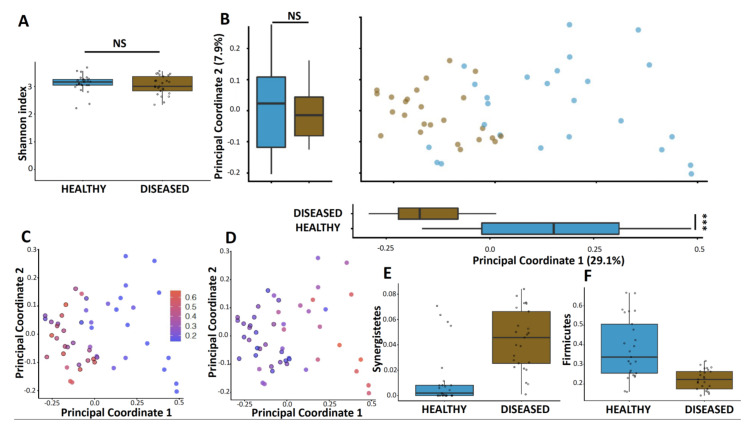
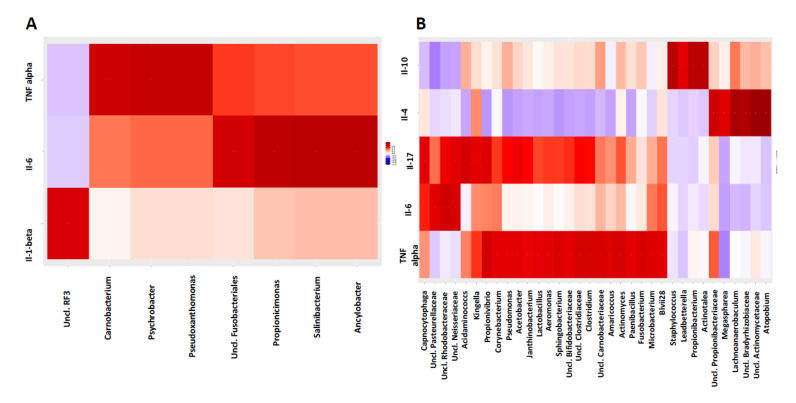
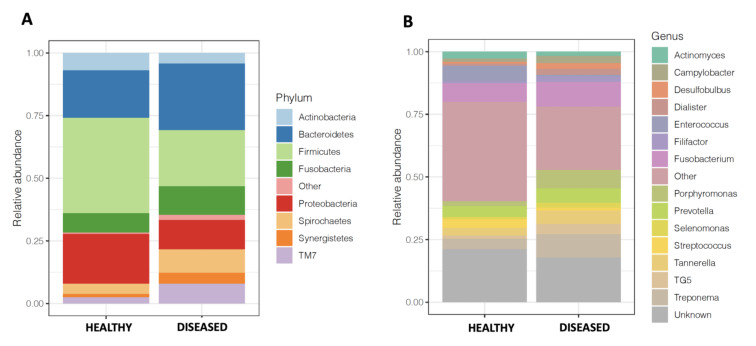
Periodontitis is a common condition characterized by an exacerbated pro-inflammatory response, which leads to tissue destruction and, ultimately, alveolar bone loss. In this pilot study, we assess the microbiota composition and cytokine profile changes in patients with stage III/IV, grade B/C periodontitis, specifically by comparing healthy and diseased sites in the same oral cavity. Overall, we found that microbiota architecture was significantly disrupted between diseased and healthy sites, and that the clustering was driven, in part, by the increased relative abundances of Synergistetes in diseased sites, as well as the increased abundances of Firmicutes in healthy sites. We also observed that diseased sites were enriched in Synergistetes, TM7, SR1, Spirochaetes, Bacteroidetes and Fusobacteria, and depleted in Firmicutes, Proteobacteria, Tenericutes and Actinobacteria compared to healthy sites. We found that Interleukin-1b, Interleukin-4, Interleukin-10, and Interleukin-17A were significantly overexpressed in diseased sites, whereas Interleukin-6 and TNF-alpha do not differ significantly between healthy and diseased sites. Here, we observed concomitant changes in the subgingival plaque microbiota and cytokines profile, suggesting that this combined alteration could contribute to the pathobiology of periodontitis.
牙周炎是一种常见病症,其特征为促炎反应加剧,会导致组织破坏,并最终导致牙槽骨丧失。在这项初步研究中,我们评估了III/IV期、B/C级牙周炎患者的微生物群组成和细胞因子谱变化,具体方法是比较同一口腔中的健康部位和患病部位。总体而言,我们发现患病部位和健康部位之间的微生物群结构被显著破坏,这种聚类部分是由患病部位中协同菌门相对丰度的增加以及健康部位中厚壁菌门丰度的增加所驱动的。我们还观察到,与健康部位相比,患病部位富含协同菌门、TM7、SR1、螺旋体门、拟杆菌门和梭杆菌门,而厚壁菌门、变形菌门、柔膜菌门和放线菌门则减少。我们发现白细胞介素-1β、白细胞介素-4、白细胞介素-10和白细胞介素-17A在患病部位显著过表达,而白细胞介素-6和肿瘤坏死因子-α在健康部位和患病部位之间没有显著差异。在此,我们观察到龈下菌斑微生物群和细胞因子谱的伴随变化,表明这种联合改变可能有助于牙周炎的病理生物学过程。