Canadian Sport Institute Pacific, Victoria, BC V9E 2C5, Canada.
Wake Forest School of Medicine, Winston-Salem, NC 27101, USA.
Nutrients. 2021 Oct 25;13(11):3777. doi: 10.3390/nu13113777.
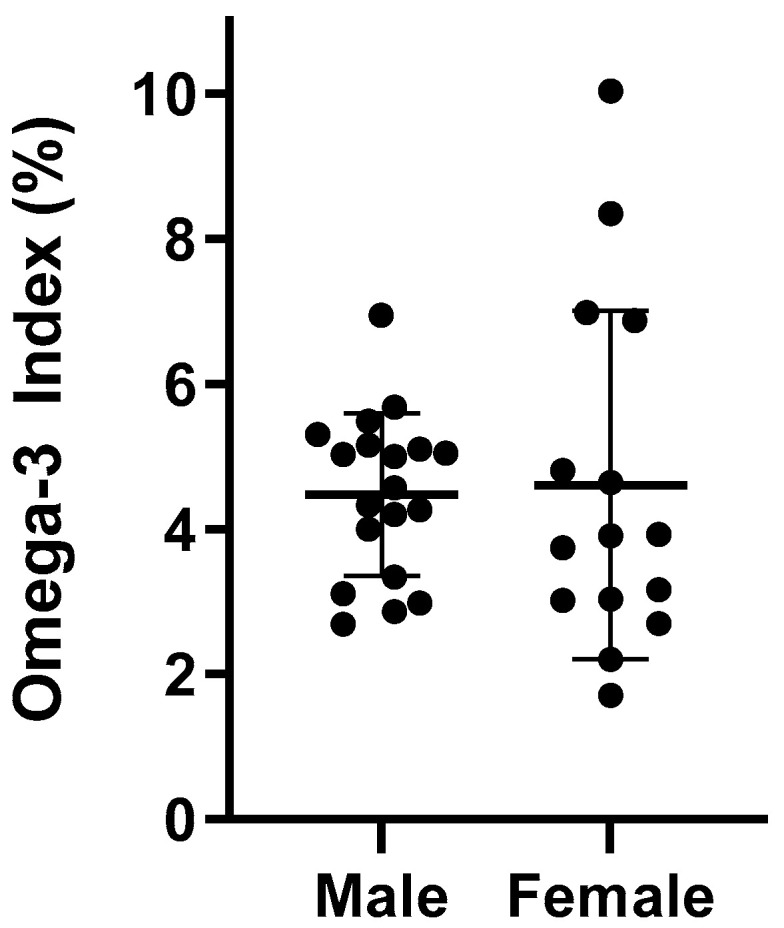
EPA and DHA n-3 FA play crucial roles in both neurological and cardiovascular health and high dietary intakes along with supplementation suggest potential neuroprotection and concussion recovery support. Rugby athletes have a high risk of repetitive sub-concussive head impacts which may lead to long-term neurological deficits, but there is a lack of research looking into n-3 FA status in rugby players. We examined the dietary n-3 FA intake through a FFQ and n-3 FA status by measuring the percentage of n-3 FA and O3I in elite Canadian Rugby 7s players to show distribution across O3I risk zones; high risk, <4%; intermediate risk, 4 to 8%; and low risk, >8%.
n-3 FA profile and dietary intake as per FFQ were collected at the beginning of the 2017-2018 Rugby 7s season in male ( = 19; 24.84 ± 2.32 years; 95.23 ± 6.93 kg) and female ( = 15; 23.45 ± 3.10 years; 71.21 ± 5.79 kg) athletes.
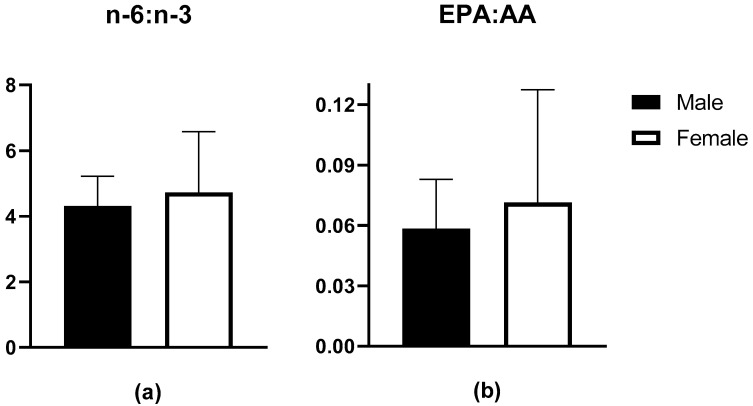
O3I averaged 4.54% ± 1.77, with female athlete scores slightly higher, and higher O3I scores in supplemented athletes (4.82% vs. 3.94%, = 0.183), with a greater proportion of non-supplemented athletes in the high-risk category (45.5% vs. 39.1%). Dietary intake in non-supplemented athletes did not meet daily dietary recommendations for ALA or EPA + DHA compared to supplemented athletes.
Overall, despite supplementation, O3I score remained in the high-risk category in a proportion of athletes who met recommended n-3 FA dietary intakes, and non-supplemented athletes had a higher proportion of O3I scores in the high-risk category, suggesting that dietary intake alone may not be enough and athletes may require additional dietary and n-3 FA supplementation to reduce neurological and cardiovascular risk.
EPA 和 DHA n-3 FA 在神经和心血管健康中都起着至关重要的作用,高摄入量的摄入以及补充表明具有潜在的神经保护和脑震荡恢复支持作用。橄榄球运动员头部反复受到亚脑震荡冲击的风险很高,这可能导致长期的神经缺陷,但目前缺乏对橄榄球运动员 n-3 FA 状况的研究。我们通过 FFQ 检查了饮食中 n-3 FA 的摄入量,并通过测量加拿大精英 7 人制橄榄球运动员的 n-3 FA 和 O3I 的百分比来显示其在 O3I 风险区域的分布;高风险,<4%;中风险,4 到 8%;低风险,>8%。
在 2017-2018 年橄榄球 7 人制赛季开始时,收集了男性(= 19;24.84 ± 2.32 岁;95.23 ± 6.93 公斤)和女性(= 15;23.45 ± 3.10 岁;71.21 ± 5.79 公斤)运动员的 n-3 FA 概况和根据 FFQ 进行的饮食摄入。
O3I 的平均值为 4.54% ± 1.77,女性运动员的得分略高,补充剂运动员的 O3I 得分较高(4.82% 对 3.94%,= 0.183),非补充剂运动员中高风险类别比例较大(45.5% 对 39.1%)。与补充剂运动员相比,非补充剂运动员的饮食摄入量未达到每日 ALA 或 EPA+DHA 的膳食推荐量。
尽管补充了 n-3 FA,但在符合推荐 n-3 FA 饮食摄入量的运动员中,仍有一部分运动员的 O3I 评分仍处于高风险类别,而非补充剂运动员的 O3I 评分中高风险类别的比例较高,这表明仅通过饮食摄入可能还不够,运动员可能需要额外的饮食和 n-3 FA 补充剂来降低神经和心血管风险。