Department of Pharmacy, University of Nairobi, Nairobi P.O. Box 19676-00202, Kenya.
Chemisches und Veterinäruntersuchungsamt (CVUA) Karlsruhe, Weissenburger Straße 3, 76187 Karlsruhe, Germany.
Nutrients. 2021 Oct 25;13(11):3785. doi: 10.3390/nu13113785.
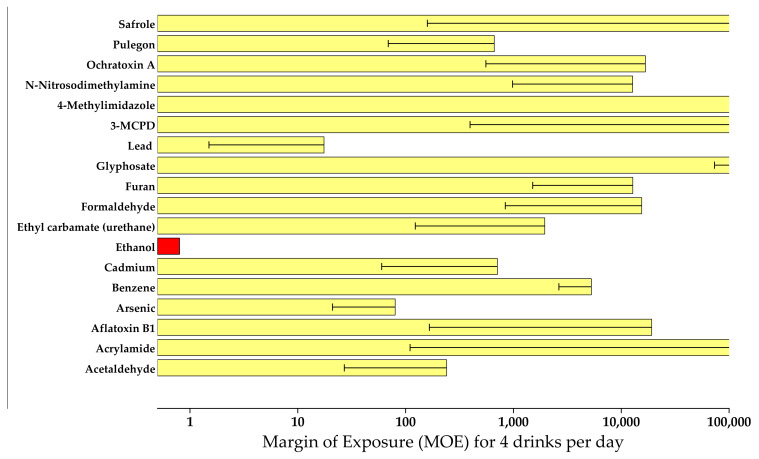
Quantitative assessments of the health risk of the constituents of alcoholic beverages including ethanol are reported in the literature, generally with hepatotoxic effects considered as the endpoint. Risk assessment studies on minor compounds such as mycotoxins, metals, and other contaminants are also available on carcinogenicity as the endpoint. This review seeks to highlight population cancer risks due to alcohol consumption using the margin of exposure methodology. The individual and cumulative health risk contribution of each component in alcoholic beverages is highlighted. Overall, the results obtained consistently show that the ethanol contributes the bulk of harmful effects of alcoholic beverages, while all other compounds only contribute in a minor fashion (less than 1% compared to ethanol). Our data provide compelling evidence that policy should be focused on reducing total alcohol intake (recorded and unrecorded), while measures on other compounds should be only secondary to this goal.
关于包括乙醇在内的酒精饮料成分的健康风险的定量评估在文献中有报道,通常以肝毒性作用作为终点。关于真菌毒素、金属和其他污染物等微量化合物的风险评估研究也以致癌性作为终点。本综述旨在使用暴露边际方法强调由于饮酒导致的人群癌症风险。突出了酒精饮料中每种成分的个体和累积健康风险贡献。总的来说,所获得的结果一致表明,乙醇是酒精饮料有害作用的主要来源,而所有其他化合物的贡献很小(与乙醇相比,不到 1%)。我们的数据提供了有力的证据,表明政策应侧重于减少总酒精摄入量(有记录和无记录的),而其他化合物的措施应次要于此目标。