Institute of Nutritional Sciences, Department of Nutritional Biochemistry, University of Hohenheim, 70599 Stuttgart, Germany.
Institute of Physiology, Department of Vegetative and Clinical Physiology, University of Tuebingen, 72074 Tuebingen, Germany.
Nutrients. 2021 Nov 1;13(11):3914. doi: 10.3390/nu13113914.
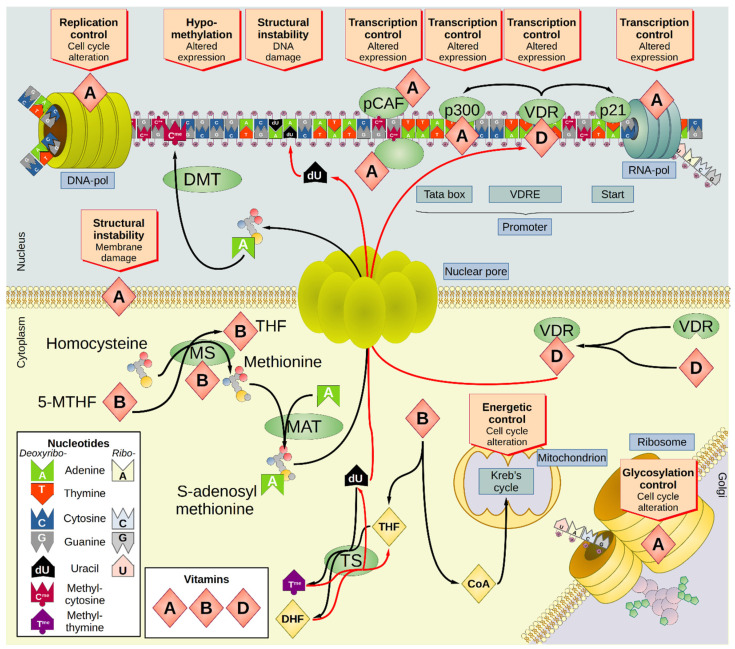
The Western-style diet, which is common in developed countries and spreading into developing countries, is unbalanced in many respects. For instance, micronutrients (vitamins A, B complex, C, D, E, and K plus iron, zinc, selenium, and iodine) are generally depleted in Western food (causing what is known as 'hidden hunger'), whereas some others (such as phosphorus) are added beyond the daily allowance. This imbalance in micronutrients can induce cellular damage that can increase the risk of cancer. Interestingly, there is a large body of evidence suggesting a strong correlation between vitamin intake as well as vitamin blood concentrations with the occurrence of certain types of cancer. The direction of association between the concentration of a given vitamin and cancer risk is tumor specific. The present review summarized the literature regarding vitamins and cancer risk to assess whether these could be used as diagnostic or prognostic markers, thus confirming their potential as biomarkers. Despite many studies that highlight the importance of monitoring vitamin blood or tissue concentrations in cancer patients and demonstrate the link between vitamin intake and cancer risk, there is still an urgent need for more data to assess the effectiveness of vitamins as biomarkers in the context of cancer. Therefore, this review aims to provide a solid basis to support further studies on this promising topic.
西方饮食在发达国家很常见,现在也正在向发展中国家传播,在很多方面都不均衡。例如,西方食物中的微量营养素(维生素 A、B 复合物、C、D、E、K 以及铁、锌、硒和碘)普遍缺乏(导致所谓的“隐性饥饿”),而其他一些营养素(如磷)则超出了日常允许摄入量。这种微量营养素的不平衡会导致细胞损伤,从而增加癌症的风险。有趣的是,有大量证据表明维生素摄入量和血液中维生素浓度与某些类型癌症的发生之间存在很强的相关性。特定维生素浓度与癌症风险之间的关联方向因肿瘤而异。本综述总结了关于维生素与癌症风险的文献,以评估它们是否可用作诊断或预后标志物,从而证实它们作为生物标志物的潜力。尽管许多研究强调了监测癌症患者血液或组织中维生素浓度以及维生素摄入与癌症风险之间联系的重要性,但仍迫切需要更多数据来评估维生素作为癌症生物标志物的有效性。因此,本综述旨在为进一步研究这一有前途的课题提供坚实的基础。