Turck Dominique, Bresson Jean-Louis, Burlingame Barbara, Dean Tara, Fairweather-Tait Susan, Heinonen Marina, Hirsch-Ernst Karen Ildico, Mangelsdorf Inge, McArdle Harry J, Naska Androniki, Nowicka Grażyna, Pentieva Kristina, Sanz Yolanda, Siani Alfonso, Sjödin Anders, Stern Martin, Tomé Daniel, Van Loveren Henk, Vinceti Marco, Willatts Peter, Lamberg-Allardt Christel, Przyrembel Hildegard, Tetens Inge, Dumas Céline, Fabiani Lucia, Ioannidou Sofia, Neuhäuser-Berthold Monika
EFSA J. 2017 May 22;15(5):e04780. doi: 10.2903/j.efsa.2017.4780. eCollection 2017 May.
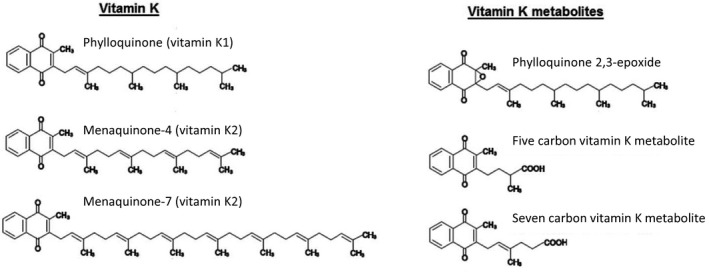
Following a request from the European Commission, the EFSA Panel on Dietetic Products, Nutrition and Allergies (NDA) derives dietary reference values (DRVs) for vitamin K. In this Opinion, the Panel considers vitamin K to comprise both phylloquinone and menaquinones. The Panel considers that none of the biomarkers of vitamin K intake or status is suitable by itself to derive DRVs for vitamin K. Several health outcomes possibly associated with vitamin K intake were also considered but data could not be used to establish DRVs. The Panel considers that average requirements and population reference intakes for vitamin K cannot be derived for adults, infants and children, and therefore sets adequate intakes (AIs). The Panel considers that available evidence on occurrence, absorption, function and content in the body or organs of menaquinones is insufficient, and, therefore, sets AIs for phylloquinone only. Having assessed additional evidence available since 1993 in particular related to biomarkers, intake data and the factorial approach, which all are associated with considerable uncertainties, the Panel maintains the reference value proposed by the Scientific Committee for Food (SCF) in 1993. An AI of 1 μg phylloquinone/kg body weight per day is set for all age and sex population groups. Considering the respective reference body weights, AIs for phylloquinone are set at 70 μg/day for all adults including pregnant and lactating women, at 10 μg/day for infants aged 7-11 months, and between 12 μg/day for children aged 1-3 years and 65 μg/day for children aged 15-17 years.
应欧盟委员会要求,欧洲食品安全局(EFSA)的营养产品、营养与过敏专家组(NDA)制定了维生素K的膳食参考值(DRV)。在本意见中,专家组认为维生素K包括叶绿醌和甲基萘醌。专家组认为,维生素K摄入量或状态的生物标志物单独都不适用于推导维生素K的膳食参考值。还考虑了一些可能与维生素K摄入量相关的健康结果,但这些数据无法用于确定膳食参考值。专家组认为,无法得出成人、婴儿和儿童维生素K的平均需求量和人群参考摄入量,因此设定了适宜摄入量(AI)。专家组认为,关于甲基萘醌在体内或器官中的存在、吸收、功能和含量的现有证据不足,因此仅为叶绿醌设定了适宜摄入量。在评估了1993年以来可得的额外证据,特别是与生物标志物、摄入量数据和析因法相关的证据(所有这些都存在相当大的不确定性)之后,专家组维持了食品科学委员会(SCF)1993年提出的参考值。为所有年龄和性别人群组设定的叶绿醌适宜摄入量为每天1μg/千克体重。考虑到各自的参考体重,叶绿醌的适宜摄入量设定为:所有成年人(包括孕妇和哺乳期妇女)为70μg/天,7至11个月大的婴儿为10μg/天,1至3岁儿童为12μg/天,15至17岁儿童为65μg/天。