Tianjin Key Laboratory of Food Science and Health, School of Medicine, Nankai University, Tianjin 300071, China.
Abbott Nutrition Research & Development Center, Abbott Ltd., Shanghai 200233, China.
Nutrients. 2021 Nov 11;13(11):4017. doi: 10.3390/nu13114017.
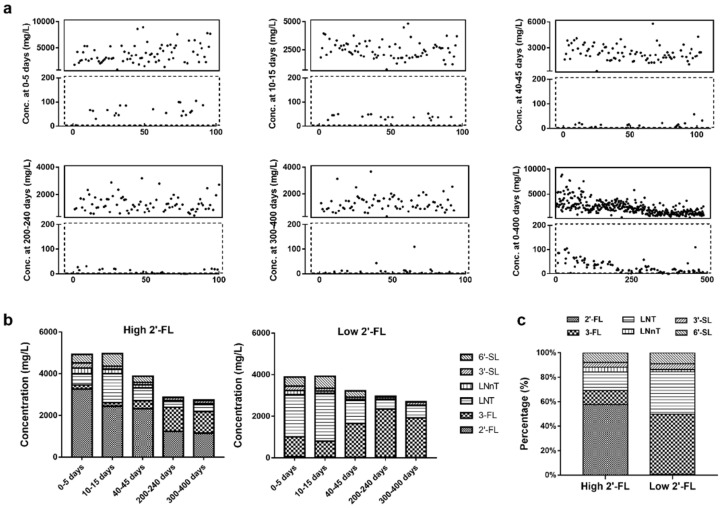
This study investigated the variation in oligosaccharide levels in the breast milk of south Chinese mothers in a prolonged breastfeeding period of up to 400 days postpartum. A total of 488 breast milk samples were collected from 335 healthy mothers at five different time points: 0-5 days, 10-15 days, 40-45 days, 200-240 days, and 300-400 days postpartum. A high-performance anion-exchange chromatography-pulsed amperometric detector (HPAEC-PAD) was used to quantify 2'-fucosyllactose (2'-FL), 3-fucosyllactose (3-FL), lacto-N-tetraose (LNT), lacto-N-neotetraose (LNnT), 3'-sialyllactose (3'-SL) and 6'-sialyllactose (6'-SL). In this study, we found six oligosaccharides that were present in breast milk from 0 to 400 days postpartum. The median value ranges of individual oligosaccharide components in this study were 1013-2891 mg/L 2'-FL, 193-1421 mg/L 3-FL, 314-1478 mg/L LNT, 44-255 mg/L LNnT, 111-241 mg/L 3'-SL, and 23-602 mg/L6'-SL. HMO levels decreased over the lactation periods, except for 3-FL, which increased throughout lactation. The predominant fucosylated and sialylated HMOs were 2'-FL and 6'-SL at 40-45 days postpartum and changed to 3-FL and 3'-SL at 200-240 days postpartum. Results from this study showed that lactating women continue to provide their offspring with a high level of 2'-FL one year after delivery, suggesting that 2'-FL may play an important role for infants in early life. Our findings also provide further evidence in support of breastfeeding after one-year postpartum.
本研究调查了中国南方母亲在长达 400 天的哺乳期内母乳中寡糖水平的变化。在五个不同时间点(产后 0-5 天、10-15 天、40-45 天、200-240 天和 300-400 天),从 335 位健康母亲中收集了总共 488 份母乳样本。使用高效阴离子交换色谱-脉冲安培检测器(HPAEC-PAD)定量 2'-岩藻糖基乳糖(2'-FL)、3-岩藻糖基乳糖(3-FL)、乳-N-四糖(LNT)、乳-N-新四糖(LNnT)、3'-唾液酸乳糖(3'-SL)和 6'-唾液酸乳糖(6'-SL)。在这项研究中,我们发现了六种在产后 0 至 400 天的母乳中存在的寡糖。在本研究中,个体寡糖成分的中位数范围为 1013-2891mg/L 的 2'-FL、193-1421mg/L 的 3-FL、314-1478mg/L 的 LNT、44-255mg/L 的 LNnT、111-241mg/L 的 3'-SL 和 23-602mg/L 的 6'-SL。HMO 水平在哺乳期逐渐下降,除了 3-FL 在整个哺乳期都在增加。在产后 40-45 天,主要的岩藻糖基化和唾液酸化的 HMO 是 2'-FL 和 6'-SL,而在产后 200-240 天,主要的是 3-FL 和 3'-SL。本研究结果表明,哺乳期妇女在产后一年仍为其婴儿提供高水平的 2'-FL,这表明 2'-FL 可能在婴儿早期生活中发挥重要作用。我们的研究结果还进一步证明了产后一年以上母乳喂养的支持。