Sprenger Norbert, Lee Le Ye, De Castro Carlos Antonio, Steenhout Philippe, Thakkar Sagar K
Nestlé Research Center, Nestec Ltd., Vers-chez-les-Blanc, Switzerland.
Consultant Neonatologist, Department of Neonatology, Khoo Teck Puat-National University Children's Medical Institute, National University Hospital, Singapore.
PLoS One. 2017 Feb 9;12(2):e0171814. doi: 10.1371/journal.pone.0171814. eCollection 2017.
Human milk is the recommended and sole nutrient source for newborns. One of the largest components of human milk is oligosaccharides (HMOs) with major constituents determined by the mother genotype for the fucosyltransferase 2 (FUT2, secretor) gene. HMO variation has been related with infant microbiota establishment, diarrhea incidence, morbidity and mortality, IgE associated eczema and body composition.
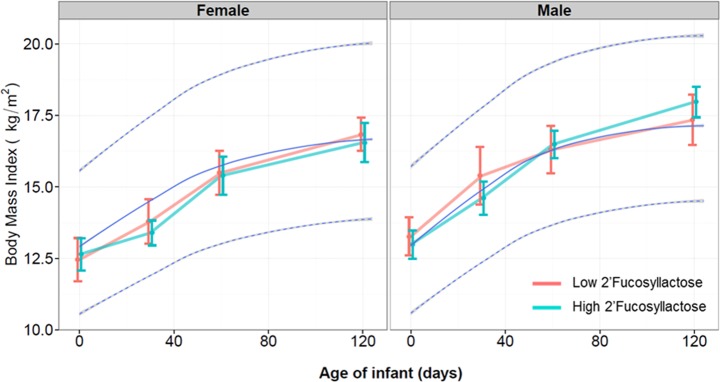
We investigated the (i) dependence of several major representative HMOs on the FUT2 status assessed through breast milk 2'Fucosyllactose (2'FL) and (ii) the relation of the 2'FL status with infant growth up to 4 months of life.
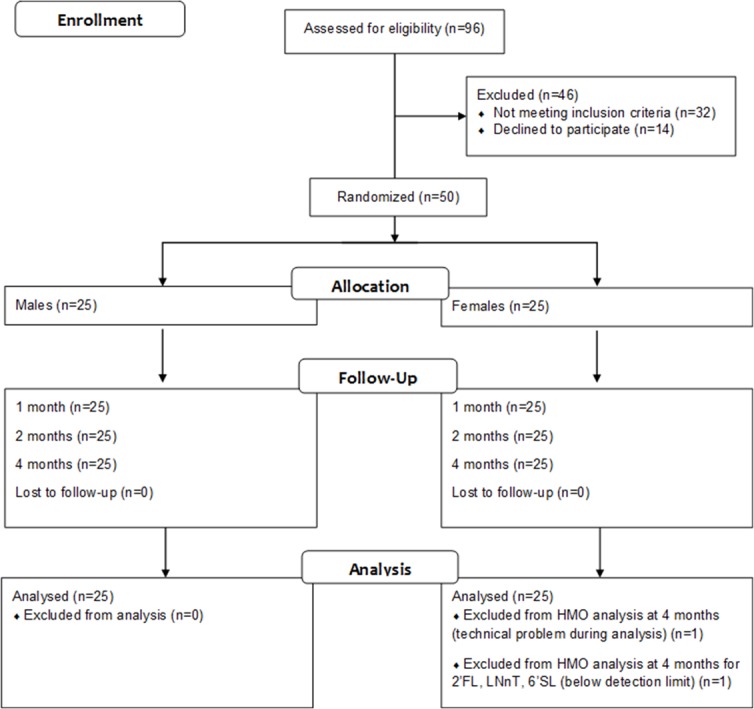
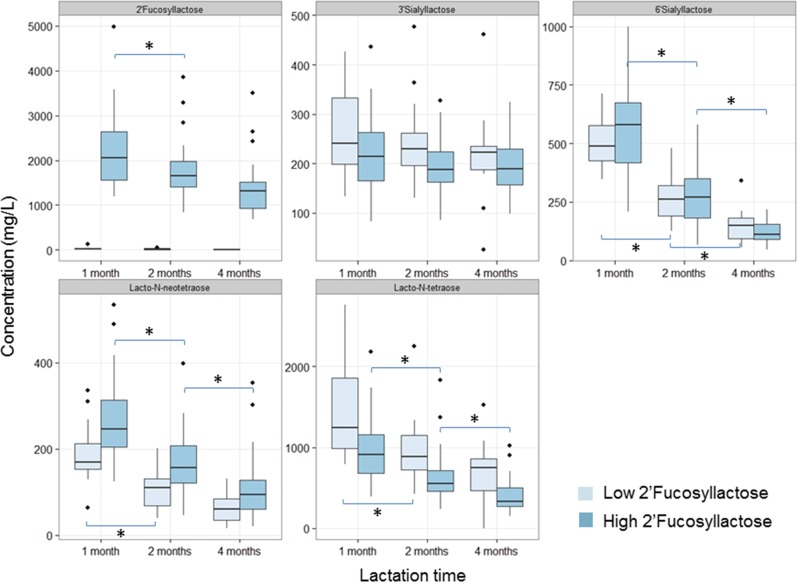
From an open observatory, single center, longitudinal cohort study with quantitative human milk collection at 30, 60, and 120 days postpartum from 50 mothers, who gave birth to 25 female and 25 male singleton infants, we collected a representative sample of human milk. We quantified the following 5 representative HMOs: 2'FL, Lacto-N-tetraose (LNT), Lacto-N-neotetraose (LNnT), 3'Sialyllactose (3'SL) and 6'Sialyllactose (6'SL). We grouped the milk samples and corresponding infants according to the measured milk 2'FL concentrations at 30 days of lactation, which clustered around low concentrations (95% CI of mean 12-42 mg/L) and high concentrations (95% CI of mean 1880-2460 mg/L) with the former likely representing Secretor negative mothers. Infant anthropometric measures were recorded at birth, 1, 2 and 4 months of age. Relations among the quantified HMOs and the relation of the high and low 2'FL HMOs groups with infant growth parameters were investigated via linear mixed models.
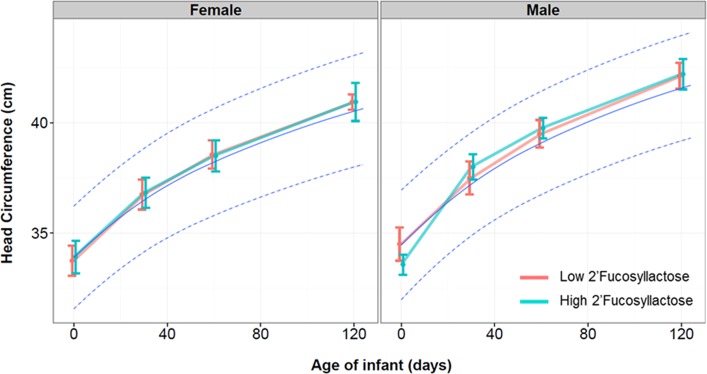
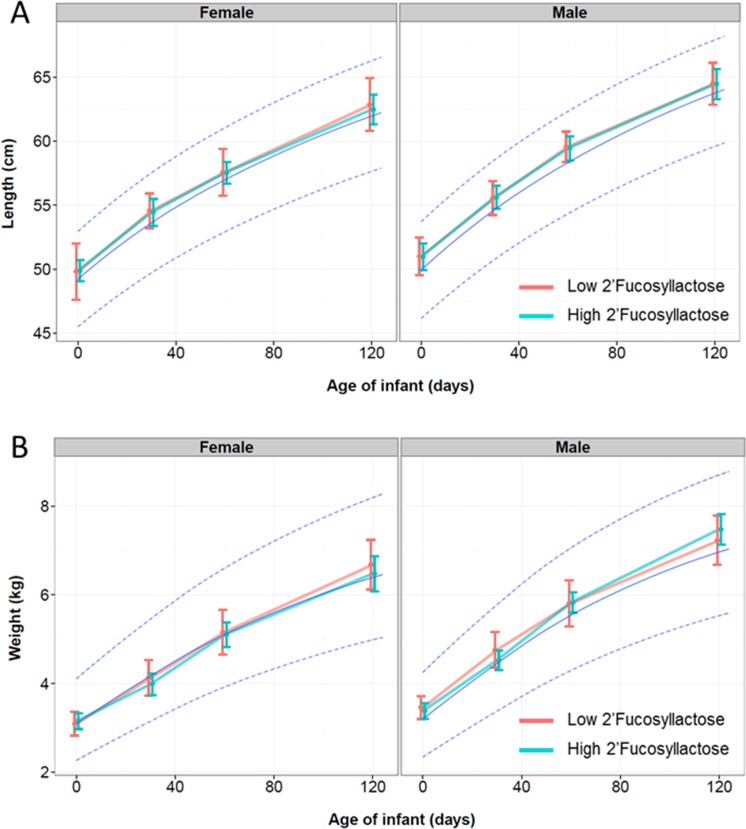
The milk samples with low 2'FL concentration had higher LNT and lower LNnT concentrations compared to the samples with high 2'FL. The milk 3'- and 6'SL concentrations were independent of 2'FL. Over lactation time we observed a drop in the concentration of 2'FL, LNT, LNnT and 6'SL, especially from 1 to 2 months, while 3'SL remained at relatively constant concentration from 1 month onwards. Up to 4 months of age, we did not observe significant differences in body weight, body length, body mass index and head circumference of the infants who consumed breast milk with low or high FUT2 associated HMO concentrations and composition.
Our findings on HMO concentrations over time of lactation and clusters based on 2'FL concentrations confirm previous observations and suggest that LNnT and LNT are 'co-regulated' with the FUT2 dependent 2'FL concentration, with LNnT showing a positive and LNT a negative relation. Further, our findings also suggest that the relatively substantial variation in HMOs between the high and low 2'FL clusters do not impact infant growth of either sex up to 4 months of age. The study was registered in www.ClinicalTrial.gov (NCT01805011).
母乳是新生儿推荐的唯一营养来源。母乳中最大的成分之一是低聚糖(HMOs),其主要成分由母亲的岩藻糖基转移酶2(FUT2,分泌型)基因的基因型决定。HMOs的变异与婴儿微生物群的建立、腹泻发生率、发病率和死亡率、与IgE相关的湿疹以及身体组成有关。
我们研究了(i)几种主要代表性HMOs对通过母乳2'-岩藻糖基乳糖(2'FL)评估的FUT2状态的依赖性,以及(ii)2'FL状态与4个月龄内婴儿生长的关系。
在一项开放观察性单中心纵向队列研究中,我们从50名母亲产后30、60和120天定量采集母乳,这些母亲分别产下25名女婴和25名男婴单胎。我们收集了具有代表性的母乳样本。我们对以下5种代表性HMOs进行了定量:2'FL、乳糖-N-四糖(LNT)、乳糖-N-新四糖(LNnT)、3'-唾液酸乳糖(3'SL)和6'-唾液酸乳糖(6'SL)。我们根据哺乳期第30天测得的母乳2'FL浓度对母乳样本和相应婴儿进行分组,浓度集中在低浓度(平均95%CI为12 - 42mg/L)和高浓度(平均95%CI为1880 - 2460mg/L),前者可能代表分泌型阴性母亲。在婴儿出生时、1、2和4个月龄时记录其人体测量指标。通过线性混合模型研究定量HMOs之间的关系以及高、低2'FL HMOs组与婴儿生长参数的关系。
与2'FL浓度高的样本相比,2'FL浓度低的母乳样本LNT浓度较高,LNnT浓度较低。母乳中3'SL和6'SL的浓度与2'FL无关。在整个哺乳期,我们观察到尤其是从1到2个月,2'FL、LNT、LNnT和6'SL的浓度下降,而3'SL从1个月起保持相对稳定的浓度。在4个月龄之前,食用FUT2相关HMO浓度和组成低或高的母乳的婴儿,其体重、身长、体重指数和头围没有显著差异。
我们关于哺乳期不同时间HMO浓度以及基于2'FL浓度分组的研究结果证实了先前的观察结果,并表明LNnT和LNT与FUT2依赖性2'FL浓度“共同调节”,LNnT呈正相关,LNT呈负相关。此外,我们的研究结果还表明,高、低2'FL组之间HMOs的相对较大差异在4个月龄之前对任何性别的婴儿生长均无影响。该研究已在www.ClinicalTrial.gov(NCT01805011)注册。