Department of Diagnostics and Public Health, Section of Pathology, University and Hospital Trust of Verona, 37134, Verona, Italy.
ARC-Net Research Center, University and Hospital Trust of Verona, 37134, Verona, Italy.
Br J Cancer. 2022 Jan;126(1):4-9. doi: 10.1038/s41416-021-01633-1. Epub 2021 Nov 26.
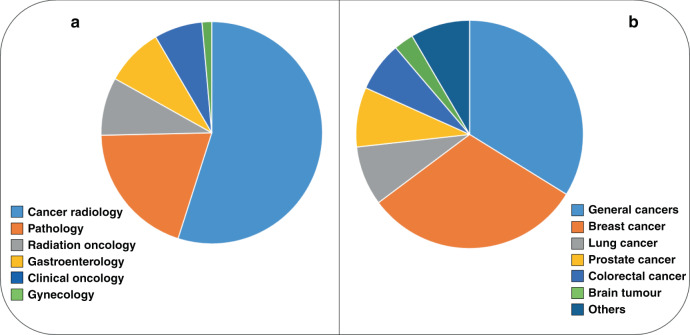
Artificial intelligence (AI) is concretely reshaping the landscape and horizons of oncology, opening new important opportunities for improving the management of cancer patients. Analysing the AI-based devices that have already obtained the official approval by the Federal Drug Administration (FDA), here we show that cancer diagnostics is the oncology-related area in which AI is already entered with the largest impact into clinical practice. Furthermore, breast, lung and prostate cancers represent the specific cancer types that now are experiencing more advantages from AI-based devices. The future perspectives of AI in oncology are discussed: the creation of multidisciplinary platforms, the comprehension of the importance of all neoplasms, including rare tumours and the continuous support for guaranteeing its growth represent in this time the most important challenges for finalising the 'AI-revolution' in oncology.
人工智能(AI)正在具体地重塑肿瘤学的格局和视野,为改善癌症患者的管理带来新的重要机遇。通过分析已经获得美国食品和药物管理局(FDA)官方批准的基于人工智能的设备,我们在这里表明,癌症诊断是人工智能已经对临床实践产生最大影响的肿瘤学相关领域。此外,乳腺癌、肺癌和前列腺癌是目前从人工智能设备中获得更多优势的特定癌症类型。讨论了人工智能在肿瘤学中的未来展望:创建多学科平台、理解所有肿瘤的重要性,包括罕见肿瘤,并持续支持保证其发展,这在当前是使肿瘤学中的“人工智能革命”最终完成的最重要挑战。