Health and Rehabilitation Sciences, Elborn College, Western University, London, ON, Canada.
Windsor University School of Medicine, Cayon, St. Kitts.
Womens Health (Lond). 2021 Jan-Dec;17:17455065211062964. doi: 10.1177/17455065211062964.
Several studies have assessed the impact of the COVID-19 pandemic on anxiety and depression, but have not focused on the role of sex and gender. This study compared changes in the levels of anxiety and depression (pre- and post-COVID) experienced by individuals of various sexes and genders.
We used a cross-sectional online survey that assessed pre- and post-COVID symptoms of anxiety (Generalized Anxiety Disorder-2) and depression (Patient Health Questionnaire-9). General linear modeling (fixed model factorial analysis of variance) was used to evaluate changes in anxiety and depression between pre- and post-pandemic periods and explore differential effects of sex and gender on those changes.
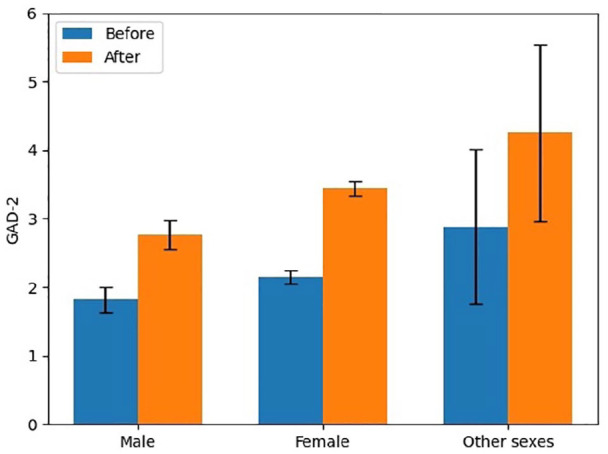
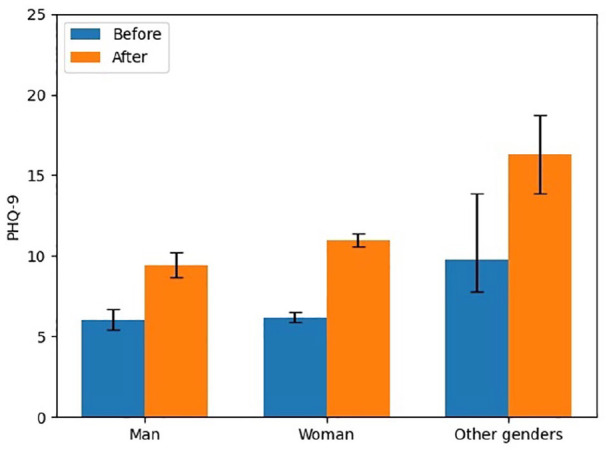
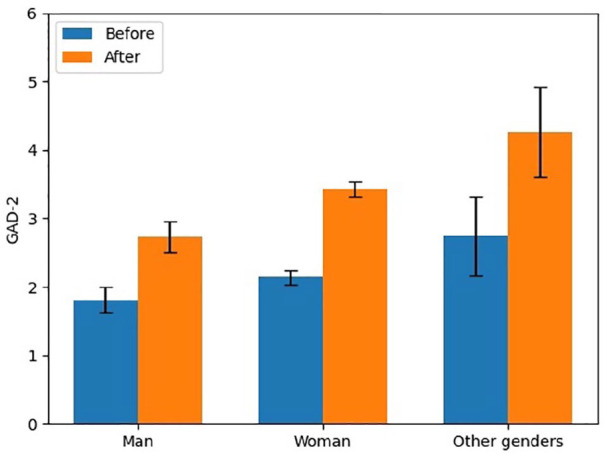
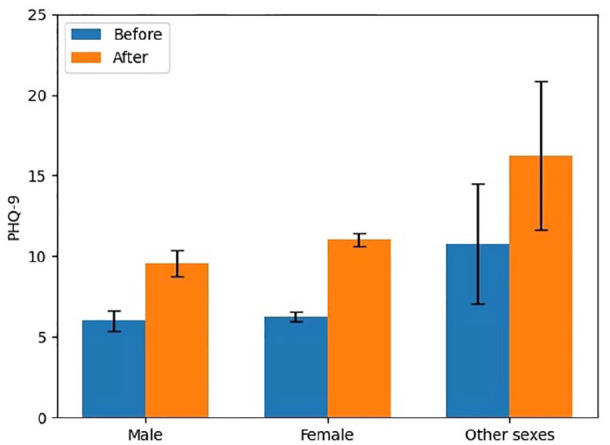
Our study included 1847 participants from 43 countries and demonstrated a percentage increase of 57.1% and 74.2% in anxiety and depression, respectively. For the Generalized Anxiety Disorder-2 scale (maximum score 6), there was a mean increase in anxiety by sex for male, female, and other of 1.0, 1.2, and 1.4, respectively; and by gender for man, woman, and others of 0.9, 1.3, and 1.6, respectively. For the Patient Health Questionnaire-9 (maximum score 27), there was a mean increase in depressive symptoms by sex for male, female, and other of 3.6, 4.7, and 5.5 respectively; and by gender for man, woman, and others of 3.3, 4.8, and 6.5, respectively.
During COVID-19, there was an increase in anxiety and depressive symptoms for all sexes and genders, with the greatest increases reported by those identifying as non-male and non-men.
多项研究评估了 COVID-19 大流行对焦虑和抑郁的影响,但并未关注性别差异。本研究比较了不同性别个体在大流行前后经历的焦虑和抑郁水平的变化。
我们使用了一项横断面在线调查,评估了 COVID-19 前后的焦虑(广泛性焦虑障碍-2)和抑郁(患者健康问卷-9)症状。采用一般线性模型(固定模型析因方差分析)评估了大流行前后焦虑和抑郁的变化,并探讨了性别的差异对这些变化的影响。
我们的研究共纳入了来自 43 个国家的 1847 名参与者,结果显示焦虑和抑郁的百分比分别增加了 57.1%和 74.2%。对于广泛性焦虑障碍-2 量表(最高得分为 6 分),男性、女性和其他性别的焦虑平均增加分别为 1.0、1.2 和 1.4 分;男性、女性和其他性别的性别焦虑平均增加分别为 0.9、1.3 和 1.6 分。对于患者健康问卷-9(最高得分为 27 分),男性、女性和其他性别的抑郁症状平均增加分别为 3.6、4.7 和 5.5 分;男性、女性和其他性别的性别抑郁平均增加分别为 3.3、4.8 和 6.5 分。
在 COVID-19 期间,所有性别个体的焦虑和抑郁症状均有所增加,其中非男性和非男性性别个体的增加幅度最大。