Wahid Kareem A, He Renjie, McDonald Brigid A, Anderson Brian M, Salzillo Travis, Mulder Sam, Wang Jarey, Sharafi Christina Setareh, McCoy Lance A, Naser Mohamed A, Ahmed Sara, Sanders Keith L, Mohamed Abdallah S R, Ding Yao, Wang Jihong, Hutcheson Kate, Lai Stephen Y, Fuller Clifton D, van Dijk Lisanne V
Departments of Radiation Oncology, The University of Texas MD Anderson Cancer Center, Houston, TX, United States.
Imaging Physics, The University of Texas MD Anderson Cancer Center, Houston, TX, United States.
Phys Imaging Radiat Oncol. 2021 Nov 20;20:88-93. doi: 10.1016/j.phro.2021.11.001. eCollection 2021 Oct.
Conventional magnetic resonance imaging (MRI) poses challenges in quantitative analysis because voxel intensity values lack physical meaning. While intensity standardization methods exist, their effects on head and neck MRI have not been investigated. We developed a workflow based on healthy tissue region of interest (ROI) analysis to determine intensity consistency within a patient cohort. Through this workflow, we systematically evaluated intensity standardization methods for MRI of head and neck cancer (HNC) patients.
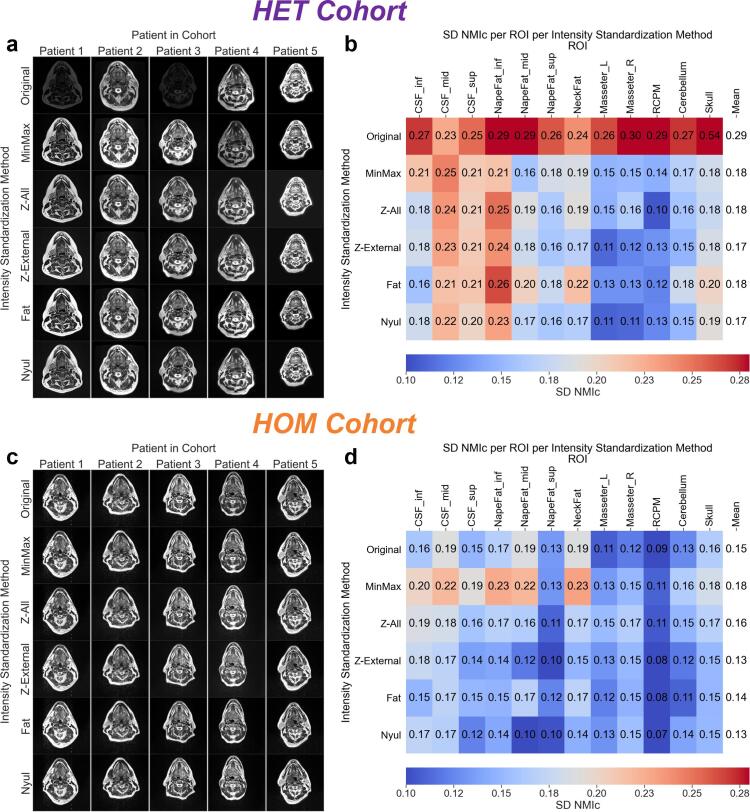
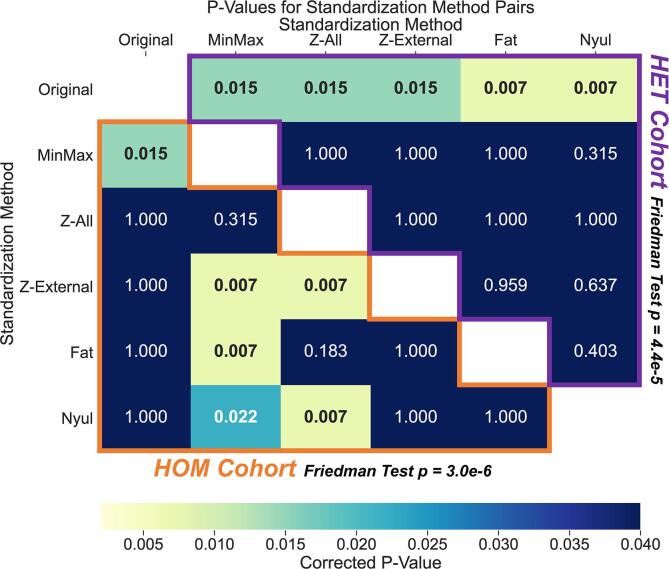
Two HNC cohorts (30 patients total) were retrospectively analyzed. One cohort was imaged with heterogenous acquisition parameters (HET cohort), whereas the other was imaged with homogenous acquisition parameters (HOM cohort). The standard deviation of cohort-level normalized mean intensity (SD NMI), a metric of intensity consistency, was calculated across ROIs to determine the effect of five intensity standardization methods on T2-weighted images. For each cohort, a Friedman test followed by a post-hoc Bonferroni-corrected Wilcoxon signed-rank test was conducted to compare SD NMI among methods.
Consistency (SD NMI across ROIs) between unstandardized images was substantially more impaired in the HET cohort (0.29 ± 0.08) than in the HOM cohort (0.15 ± 0.03). Consequently, corrected p-values for intensity standardization methods with lower SD NMI compared to unstandardized images were significant in the HET cohort (p < 0.05) but not significant in the HOM cohort (p > 0.05). In both cohorts, differences between methods were often minimal and nonsignificant.
Our findings stress the importance of intensity standardization, either through the utilization of uniform acquisition parameters or specific intensity standardization methods, and the need for testing intensity consistency before performing quantitative analysis of HNC MRI.
传统磁共振成像(MRI)在定量分析方面存在挑战,因为体素强度值缺乏物理意义。虽然存在强度标准化方法,但它们对头颈部MRI的影响尚未得到研究。我们开发了一种基于健康组织感兴趣区域(ROI)分析的工作流程,以确定患者队列中的强度一致性。通过此工作流程,我们系统地评估了头颈部癌(HNC)患者MRI的强度标准化方法。
回顾性分析了两个HNC队列(共30例患者)。一个队列采用异质采集参数成像(HET队列),而另一个队列采用同质采集参数成像(HOM队列)。计算整个ROI的队列水平归一化平均强度标准差(SD NMI),这是一种强度一致性指标,以确定五种强度标准化方法对T2加权图像的影响。对于每个队列,进行Friedman检验,然后进行事后Bonferroni校正的Wilcoxon符号秩检验,以比较各方法之间的SD NMI。
未标准化图像之间的一致性(整个ROI的SD NMI)在HET队列(0.29±0.08)中比在HOM队列(0.15±0.03)中受损程度大得多。因此,与未标准化图像相比,SD NMI较低的强度标准化方法的校正p值在HET队列中具有统计学意义(p<0.05),而在HOM队列中无统计学意义(p>0.05)。在两个队列中,各方法之间的差异通常很小且无统计学意义。
我们的研究结果强调了通过使用统一采集参数或特定强度标准化方法进行强度标准化的重要性,以及在对头颈部癌MRI进行定量分析之前测试强度一致性的必要性。