Degani Matteo, An Qingzhi, Albaladejo-Siguan Miguel, Hofstetter Yvonne J, Cho Changsoon, Paulus Fabian, Grancini Giulia, Vaynzof Yana
Department of Chemistry and INSTM, University of Pavia, Via T. Taramelli 14, 27100 Pavia, Italy.
Dresden Integrated Center for Applied Physics and Photonic Materials (IAPP) and Center for Advancing Electronics Dresden (cfaed), Technische Universität Dresden, 01062 Dresden, Germany.
Sci Adv. 2021 Dec 3;7(49):eabj7930. doi: 10.1126/sciadv.abj7930. Epub 2021 Dec 1.
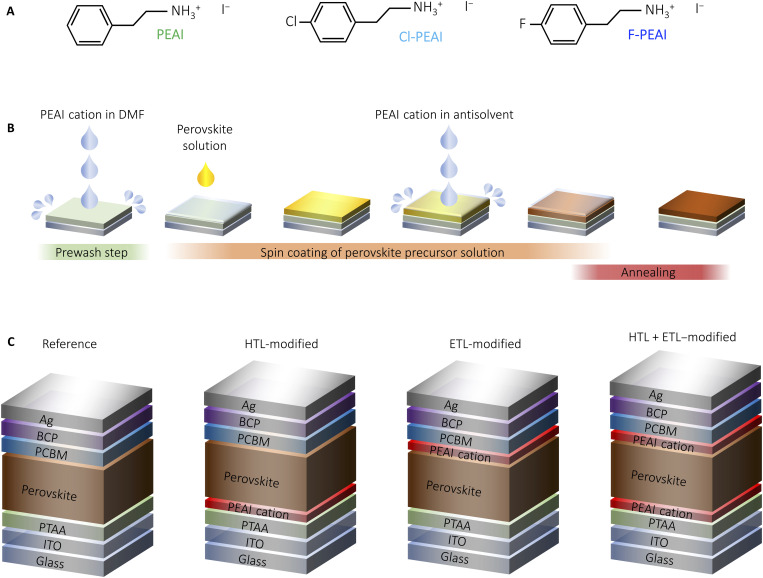
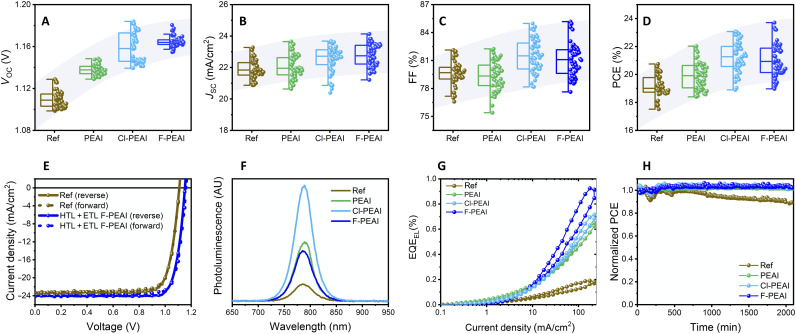
Despite remarkable progress, the performance of lead halide perovskite solar cells fabricated in an inverted structure lags behind that of standard architecture devices. Here, we report on a dual interfacial modification approach based on the incorporation of large organic cations at both the bottom and top interfaces of the perovskite active layer. Together, this leads to a simultaneous improvement in both the open-circuit voltage and fill factor of the devices, reaching maximum values of 1.184 V and 85%, respectively, resulting in a champion device efficiency of 23.7%. This dual interfacial modification is fully compatible with a bulk modification of the perovskite active layer by ionic liquids, leading to both efficient and stable inverted architecture devices.
尽管取得了显著进展,但采用倒置结构制造的卤化铅钙钛矿太阳能电池的性能仍落后于标准结构器件。在此,我们报告一种基于在钙钛矿活性层的底部和顶部界面均引入大有机阳离子的双界面修饰方法。这共同导致器件的开路电压和填充因子同时得到改善,分别达到1.184 V和85%的最大值,从而使冠军器件效率达到23.7%。这种双界面修饰与通过离子液体对钙钛矿活性层进行体相修饰完全兼容,从而实现了高效且稳定的倒置结构器件。