Department of Microbiology (Virology Research), Lagos State University, Lagos, Nigeria.
Department of Veterinary Public Health & Preventive Medicine, University of Ilorin, Ilorin, Nigeria.
PLoS One. 2021 Dec 1;16(12):e0260575. doi: 10.1371/journal.pone.0260575. eCollection 2021.
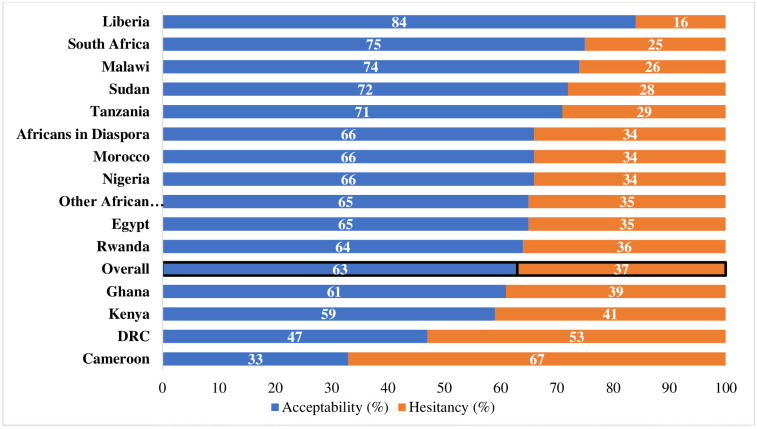
The economic and humanistic impact of COVID-19 pandemic is enormous globally. No definitive treatment exists, hence accelerated development and approval of COVID-19 vaccines, offers a unique opportunity for COVID-19 prevention and control. Vaccine hesitancy may limit the success of vaccine distribution in Africa, therefore we assessed the potentials for coronavirus vaccine hesitancy and its determinants among Africans. An online cross-sectional African-wide survey was administered in Arabic, English, and French languages. Questions on demographics, self-reported health status, vaccine literacy, knowledge and perception on vaccines, past experience, behavior, infection risk, willingness to receive and affordability of the SARS-COV-2 vaccine were asked. Data were subjected to descriptive and inferential statistics. A total of 5,416 individuals completed the survey. Approximately, 94% were residents of 34 African countries while the other Africans live in the Diaspora. Only 63% of all participants surveyed were willing to receive the COVID-19 vaccination as soon as possible and 79% were worried about its side effects. Thirty-nine percent expressed concerns of vaccine-associated infection. The odds of vaccine hesitancy was 0.28 (95% CI: 0.22, 0.30) among those who believed their risk of infection was very high, compared to those who believed otherwise. The odds of vaccine hesitancy was one-fifth (OR = 0.21, 95% CI: 0.16, 0.28) among those who believed their risk of falling sick was very high, compared to those who believed their risk of falling very sick was very low. The OR of vaccine hesitancy was 2.72 (95% CI: 2.24, 3.31) among those who have previously refused a vaccine for themselves or their child compared to counterparts with no self-reported history of vaccine hesitancy. Participants want the vaccines to be mandatory (40%), provided free of charge (78%) and distributed in homes and offices (44%). COVID-19 vaccine hesitancy is substantial among Africans based on perceived risk of coronavirus infection and past experiences.
新冠疫情在全球范围内造成了巨大的经济和人文影响。目前尚无明确的治疗方法,因此加速开发和批准新冠疫苗为新冠防控提供了独特的机会。疫苗犹豫可能会限制疫苗在非洲的分发效果,因此我们评估了非洲人对冠状病毒疫苗犹豫的可能性及其决定因素。我们以阿拉伯语、英语和法语进行了一项在线的全非范围的横断面调查。问题包括人口统计学、自我报告的健康状况、疫苗知识、对疫苗的认识和经验、行为、感染风险、接受疫苗的意愿和 SARS-COV-2 疫苗的负担能力。数据进行了描述性和推断性统计分析。共有 5416 人完成了调查。大约 94%的参与者居住在 34 个非洲国家,而其他非洲人居住在海外。只有 63%的受访者表示愿意尽快接种新冠疫苗,79%的人担心其副作用。39%的人对疫苗相关感染表示担忧。与认为感染风险非常高的人相比,认为自己感染风险高的人疫苗犹豫的可能性低 0.28(95%CI:0.22,0.30)。与认为自己生病风险非常低的人相比,认为自己生病风险高的人疫苗犹豫的可能性低五分之一(OR=0.21,95%CI:0.16,0.28)。与没有报告自己曾有过疫苗犹豫史的人相比,以前曾为自己或孩子拒绝过疫苗的人疫苗犹豫的可能性高 2.72(95%CI:2.24,3.31)。参与者希望疫苗强制接种(40%)、免费提供(78%),并在家庭和办公室分发(44%)。根据对冠状病毒感染风险和以往经验的认知,非洲人对新冠疫苗的犹豫程度较大。