• 文献检索
  • 文档翻译
  • 深度研究
  • 学术资讯
  • Suppr Zotero 插件Zotero 插件
  • 邀请有礼
  • 套餐&价格
  • 历史记录
应用&插件
Suppr Zotero 插件Zotero 插件浏览器插件Mac 客户端Windows 客户端微信小程序
定价
高级版会员购买积分包购买API积分包
服务
文献检索文档翻译深度研究API 文档MCP 服务
关于我们
关于 Suppr公司介绍联系我们用户协议隐私条款
关注我们

Suppr 超能文献

核心技术专利:CN118964589B侵权必究
粤ICP备2023148730 号-1Suppr @ 2026

文献检索

告别复杂PubMed语法,用中文像聊天一样搜索,搜遍4000万医学文献。AI智能推荐,让科研检索更轻松。

立即免费搜索

文件翻译

保留排版,准确专业,支持PDF/Word/PPT等文件格式,支持 12+语言互译。

免费翻译文档

深度研究

AI帮你快速写综述,25分钟生成高质量综述,智能提取关键信息,辅助科研写作。

立即免费体验

芬兰青少年在 2020 年新冠疫情春假封锁期间的身体活动情况。

Finnish late adolescents' physical activity during COVID-19 spring 2020 lockdown.

机构信息

School of Educational Sciences and Psychology, University of Eastern Finland, Joensuu, Finland.

Physical Activity for Health Research Cluster, Department of Physical Education and Sport Sciences, University of Limerick, Limerick, Ireland.

出版信息

BMC Public Health. 2021 Dec 1;21(1):2197. doi: 10.1186/s12889-021-12263-w.

DOI:10.1186/s12889-021-12263-w
PMID:34852807
原文链接:https://pmc.ncbi.nlm.nih.gov/articles/PMC8635322/
Abstract

BACKGROUND

Physical activity (PA) is recognised as one of the leading and effective strategies to prevent non-communicable diseases that boosts the immune system to fight against diseases. Closures of schools, sport clubs and facilities because of COVID-19 reduced the opportunities to participate in PA. We aimed to examine physical activity levels of late adolescents, the contexts to be physical active and its changes during the spring 2020 lockdown.

METHODS

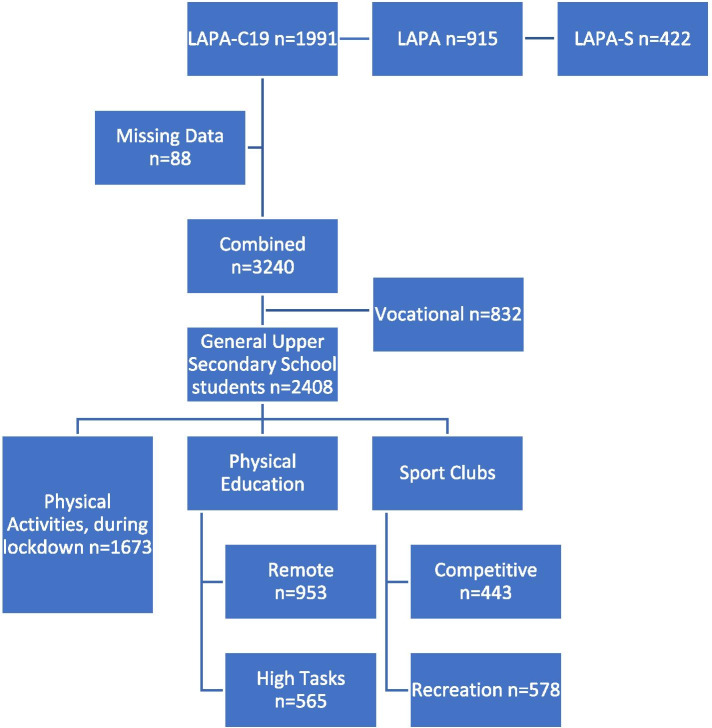
A national representative sample of late adolescents in general upper secondary school (n = 2408, females = 64%, mean age = 17.2y, SD = 0.63) completed self-report online surveys on PA behaviours between March and June 2020. Multinominal logistic regression analyses were performed to identify correlates with PA, and decision tree analyses to ascertain the perceived changes on PA during lockdown based on sport club aspirations and levels of PA.

RESULTS

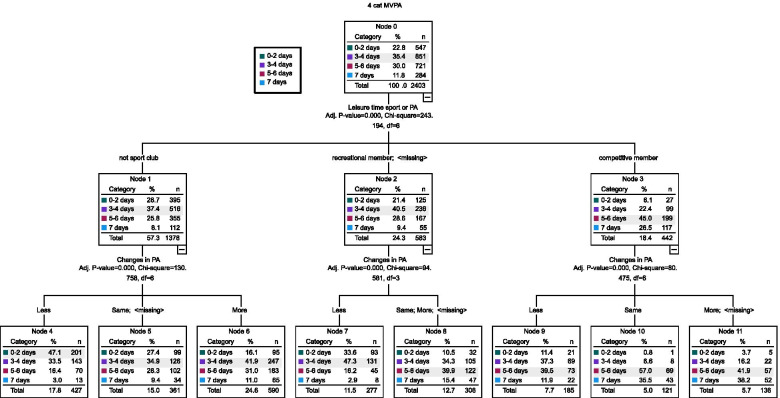
Among the late adolescents, the distribution of PA frequency was 23% (0-2 days/week), 35% (3-4 days/week), 30% (5-6 days/week) and 12% (7 days/week), and differences between males and females were not statistically significant. Participation in both indoor and outdoor PA were 50 times more likely to report daily PA (OR = 54.28, CI = 15.16-194.37) than non-participation. A quarter of late adolescents were not part of a sports club, yet their PA levels increased. Although sports club members generally perceived they did less PA during lockdown, over a third of sport club members with competitive aspirations reported daily PA.

CONCLUSIONS

Overall, most late adolescents reported their PA levels decreased during lockdown. Findings from this study continue to demonstrate factors associated with PA in the context of the COVID-19 lockdown.

摘要

背景

身体活动(PA)被认为是预防非传染性疾病的主要和有效策略之一,可增强免疫系统以抵抗疾病。由于 COVID-19,学校、体育俱乐部和设施关闭,减少了参与身体活动的机会。我们旨在检查青少年后期的身体活动水平、积极参与身体活动的背景以及 2020 年春季封锁期间的变化。

方法

一项针对普通高中高年级青少年(n=2408 名,女性占 64%,平均年龄 17.2 岁,标准差 0.63)的全国代表性样本在 2020 年 3 月至 6 月期间在线完成了关于身体活动行为的自我报告调查。使用多项逻辑回归分析来确定与身体活动相关的因素,并使用决策树分析根据体育俱乐部愿望和身体活动水平来确定封锁期间对身体活动的感知变化。

结果

在青少年后期,身体活动频率的分布为 23%(0-2 天/周)、35%(3-4 天/周)、30%(5-6 天/周)和 12%(7 天/周),男女之间的差异无统计学意义。与非参与者相比,参与室内和室外身体活动的可能性是报告日常身体活动的可能性的 50 倍(OR=54.28,CI=15.16-194.37)。四分之一的青少年没有参加体育俱乐部,但他们的身体活动水平有所提高。尽管体育俱乐部成员通常认为他们在封锁期间的身体活动减少了,但超过三分之一有竞技愿望的体育俱乐部成员报告了日常身体活动。

结论

总体而言,大多数青少年在封锁期间报告他们的身体活动水平下降。本研究的结果继续证明了 COVID-19 封锁背景下与身体活动相关的因素。
https://cdn.ncbi.nlm.nih.gov/pmc/blobs/2e7a/8638254/92fc940a45a8/12889_2021_12263_Fig3_HTML.jpg
https://cdn.ncbi.nlm.nih.gov/pmc/blobs/2e7a/8638254/f78358efbe06/12889_2021_12263_Fig1_HTML.jpg
https://cdn.ncbi.nlm.nih.gov/pmc/blobs/2e7a/8638254/d2f55c30f094/12889_2021_12263_Fig2_HTML.jpg
https://cdn.ncbi.nlm.nih.gov/pmc/blobs/2e7a/8638254/92fc940a45a8/12889_2021_12263_Fig3_HTML.jpg
https://cdn.ncbi.nlm.nih.gov/pmc/blobs/2e7a/8638254/f78358efbe06/12889_2021_12263_Fig1_HTML.jpg
https://cdn.ncbi.nlm.nih.gov/pmc/blobs/2e7a/8638254/d2f55c30f094/12889_2021_12263_Fig2_HTML.jpg
https://cdn.ncbi.nlm.nih.gov/pmc/blobs/2e7a/8638254/92fc940a45a8/12889_2021_12263_Fig3_HTML.jpg

相似文献

1
Finnish late adolescents' physical activity during COVID-19 spring 2020 lockdown.芬兰青少年在 2020 年新冠疫情春假封锁期间的身体活动情况。
BMC Public Health. 2021 Dec 1;21(1):2197. doi: 10.1186/s12889-021-12263-w.
2
Covid-19 lockdown: Ethnic differences in children's self-reported physical activity and the importance of leaving the home environment; a longitudinal and cross-sectional study from the Born in Bradford birth cohort study.Covid-19 封锁:儿童自我报告的体力活动中的种族差异,以及离开家庭环境的重要性;来自布拉德福德出生队列研究的纵向和横断面研究。
Int J Behav Nutr Phys Act. 2021 Sep 6;18(1):117. doi: 10.1186/s12966-021-01183-y.
3
Changes to Physical Activity, Sitting Time, Eating Behaviours and Barriers to Exercise during the First COVID-19 'Lockdown' in an English Cohort.在英国队列中,COVID-19 首次“封锁”期间身体活动、久坐时间、饮食行为和运动障碍的变化。
Int J Environ Res Public Health. 2021 Sep 24;18(19):10025. doi: 10.3390/ijerph181910025.
4
Physical activity and active recreation before and during COVID-19: The Our Life at Home study.体力活动和新冠疫情前后的积极娱乐活动:我们的居家生活研究。
J Sci Med Sport. 2022 Mar;25(3):235-241. doi: 10.1016/j.jsams.2021.10.004. Epub 2021 Oct 14.
5
Physical Activity Knowledge, Attitude, and Behaviours Among Adolescents in the Kingdom of Saudi Arabia Prior to and during COVID-19 Restrictions.沙特阿拉伯青少年在 COVID-19 限制之前和期间的身体活动知识、态度和行为。
J Obes. 2022 Aug 2;2022:1892017. doi: 10.1155/2022/1892017. eCollection 2022.
6
Determinants of physical activity among adults in the United Kingdom during the COVID-19 pandemic: The DUK-COVID study.英国 COVID-19 大流行期间成年人身体活动的决定因素:DUK-COVID 研究。
Br J Health Psychol. 2021 May;26(2):588-605. doi: 10.1111/bjhp.12497. Epub 2020 Dec 17.
7
Differential impact of COVID-19 lockdown on physical activity in younger and older adolescents - prospective study.COVID-19 封锁对青少年和老年青少年体育活动的差异影响 - 前瞻性研究。
Med Pr. 2021 Dec 22;72(6):633-643. doi: 10.13075/mp.5893.01180. Epub 2021 Nov 26.
8
Physical Activity Behavior Before, During, and After COVID-19 Restrictions: Longitudinal Smartphone-Tracking Study of Adults in the United Kingdom.新冠疫情限制前后的身体活动行为:英国成年人的纵向智能手机追踪研究。
J Med Internet Res. 2021 Feb 3;23(2):e23701. doi: 10.2196/23701.
9
Clusters of Adolescent Physical Activity Tracker Patterns and Their Associations With Physical Activity Behaviors in Finland and Ireland: Cross-Sectional Study.青少年身体活动追踪器模式聚类及其与芬兰和爱尔兰身体活动行为的关联:横断面研究。
J Med Internet Res. 2020 Sep 1;22(9):e18509. doi: 10.2196/18509.
10
Physical activity levels before and after the COVID-19 restrictions among Danish adolescents: a retrospective cohort study.丹麦青少年在 COVID-19 限制前后的身体活动水平:一项回顾性队列研究。
Scand J Public Health. 2024 May;52(3):284-289. doi: 10.1177/14034948231201690. Epub 2023 Oct 10.

引用本文的文献

1
Associations of step accelerations and cardiometabolic risk markers in early adulthood.成年早期步数加速度与心脏代谢风险标志物的关联。
Eur J Public Health. 2025 Feb 1;35(1):128-133. doi: 10.1093/eurpub/ckae199.
2
Physical activity and mental health in children and youth during COVID-19: a systematic review and meta-analysis.新冠疫情期间儿童和青少年的身体活动与心理健康:一项系统综述和荟萃分析
Child Adolesc Psychiatry Ment Health. 2023 Jul 19;17(1):92. doi: 10.1186/s13034-023-00629-4.
3
Predicting Adolescents' Physical Activity Intentions: Testing an Integrated Social Cognition Model.

本文引用的文献

1
Changes in physical activity and sedentary behaviours from before to during the COVID-19 pandemic lockdown: a systematic review.2019冠状病毒病疫情封锁期间身体活动和久坐行为的变化:一项系统综述
BMJ Open Sport Exerc Med. 2021 Feb 1;7(1):e000960. doi: 10.1136/bmjsem-2020-000960. eCollection 2021.
2
Covid-19 and the impact on young athletes.Covid-19 与年轻运动员。
Paediatr Respir Rev. 2021 Sep;39:9-15. doi: 10.1016/j.prrv.2021.04.005. Epub 2021 May 1.
3
Understanding the impact of COVID-19 on youth sport in Australia and consequences for future participation and retention.
预测青少年的身体活动意向:检验一个综合社会认知模型。
Int J Behav Med. 2024 Feb;31(1):41-54. doi: 10.1007/s12529-023-10156-3. Epub 2023 Mar 22.
了解 COVID-19 对澳大利亚青年体育的影响及其对未来参与和保留的后果。
BMC Public Health. 2021 Mar 5;21(1):448. doi: 10.1186/s12889-021-10505-5.
4
The Impact of COVID-19 and Homeschooling on Students' Engagement With Physical Activity.新冠疫情和居家上学对学生体育活动参与度的影响。
Front Sports Act Living. 2021 Jan 26;2:589227. doi: 10.3389/fspor.2020.589227. eCollection 2020.
5
Physical education class participation is associated with physical activity among adolescents in 65 countries.体育课程参与度与 65 个国家青少年的身体活动相关。
Sci Rep. 2020 Dec 17;10(1):22128. doi: 10.1038/s41598-020-79100-9.
6
Barriers and facilitators to changes in adolescent physical activity during COVID-19.新冠疫情期间青少年身体活动变化的障碍与促进因素
BMJ Open Sport Exerc Med. 2020 Nov 5;6(1):e000919. doi: 10.1136/bmjsem-2020-000919. eCollection 2020.
7
World Health Organization 2020 guidelines on physical activity and sedentary behaviour.世界卫生组织 2020 年关于身体活动和 sedentary behaviour 的指南。
Br J Sports Med. 2020 Dec;54(24):1451-1462. doi: 10.1136/bjsports-2020-102955.
8
Intra-Rater Test-Retest Reliability of a Modified Child Functioning Module, Self-Report Version.自评版改良儿童功能模块的组内重测信度。
Int J Environ Res Public Health. 2020 Sep 23;17(19):6958. doi: 10.3390/ijerph17196958.
9
Individual- and environmental-related correlates of moderate-to-vigorous physical activity in 11-, 13-, and 15-year-old Finnish children.11、13 和 15 岁芬兰儿童中中高强度身体活动的个体和环境相关因素。
PLoS One. 2020 Jun 18;15(6):e0234686. doi: 10.1371/journal.pone.0234686. eCollection 2020.
10
Physical activity: Benefits and challenges during the COVID-19 pandemic.体育活动:新冠疫情期间的益处与挑战
Scand J Med Sci Sports. 2020 Jul;30(7):1291-1294. doi: 10.1111/sms.13710.