Max Planck Tandem Group in Mosquito Reproductive Biology, Universidad de Antioquia, Medellín, 050010, Antioquia, Colombia.
Parasit Vectors. 2021 Dec 1;14(1):592. doi: 10.1186/s13071-021-05093-7.
Aedes aegypti and Ae. albopictus are vectors of numerous arboviruses that adversely affect human health. In mosquito vectors of disease, the bacterial microbiota influence several physiological processes, including fertility and vector competence, making manipulation of the bacterial community a promising method to control mosquito vectors. In this study, we describe the reproductive tract tissue microbiota of lab-reared virgin Ae. aegypti and Ae. albopictus males, and virgin, mated, and mated + blood-fed females of each species, comparing the bacterial composition found there to the well-described gut microbiota.
We performed metabarcoding of the 16S rRNA isolated from the gut, upper reproductive tract (URT; testes or ovaries), and lower reproductive tract (LRT; males: seminal vesicles and accessory glands; females: oviduct, spermathecae, and bursa) for each species, and evaluated the influence of host species, tissue, nutritional status, and reproductive status on microbiota composition. Finally, based on the identified taxonomic profiles of the tissues assessed, bacterial metabolic pathway abundance was predicted.
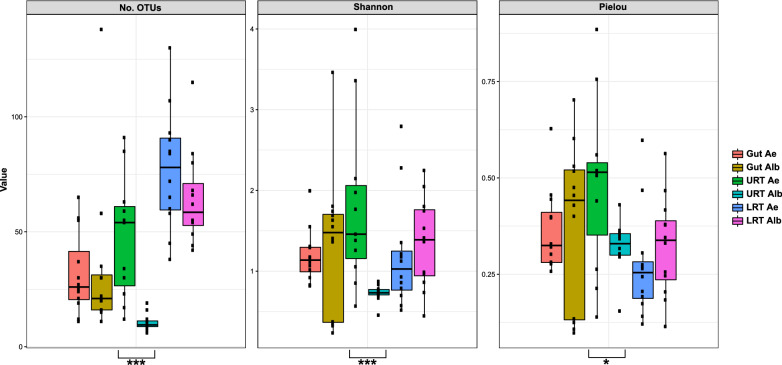
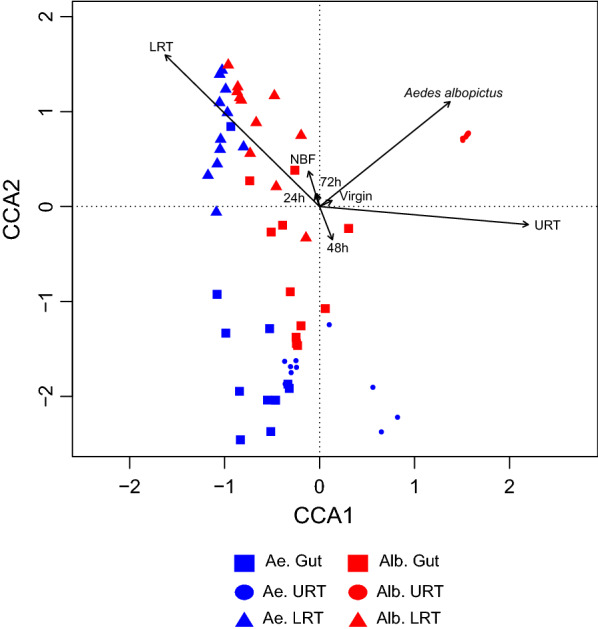
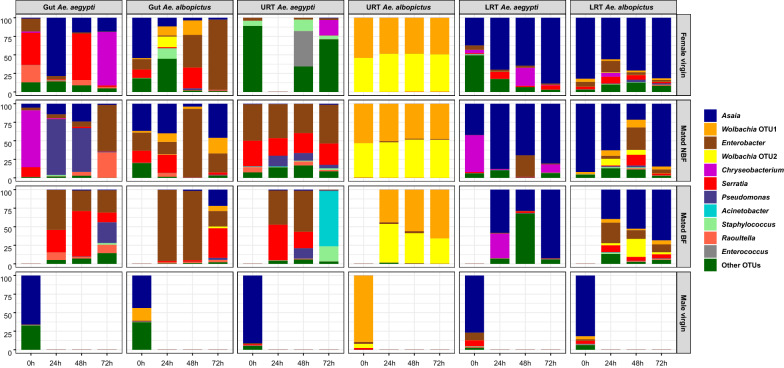
The community structure of the reproductive tract is unique compared to the gut. Asaia is the most prevalent OTU in the LRTs of both Ae. aegypti and Ae. albopictus. In the URT, we observed differences between species, with Wolbachia OTUs being dominant in the Ae. albopictus URT, while Enterobacter and Serratia were dominant in Ae. aegypti URT. Host species and tissue were the best predictors of the community composition compared to reproductive status (i.e., virgin or mated) and nutritional status (i.e., sugar or blood-fed). The predicted functional profile shows changes in the abundance of specific microbial pathways that are associated with mating and blood-feeding, like energy production in mated tissues and siderophore synthesis in blood-fed female tissues.
Aedes aegypti and Ae. albopictus have distinct differences in the composition of microbiota found in the reproductive tract. The distribution of the bacterial taxonomic groups indicates that some bacteria have tissue-specific tropism for reproductive tract tissue, such as Asaia and Wolbachia. No significant differences in the taxonomic composition were observed in the reproductive tract between virgin, mated, and mated + blood-fed females, but changes in the abundance of specific metabolic pathways were found in the predicted microbial functional profiles in mated and blood-fed females.
埃及伊蚊和白纹伊蚊是多种虫媒病毒的传播媒介,这些病毒对人类健康有不利影响。在疾病传播媒介蚊子中,细菌菌群会影响包括繁殖力和媒介能力在内的多种生理过程,这使得操纵细菌群落成为控制蚊子媒介的一种有前途的方法。在这项研究中,我们描述了实验室饲养的处女埃及伊蚊和白纹伊蚊雄蚊的生殖道组织微生物群,以及每个物种的处女、交配和交配+吸血雌蚊的生殖道组织微生物群,并将那里发现的细菌组成与描述良好的肠道微生物群进行了比较。
我们对每个物种的肠道、上生殖道(URT;睾丸或卵巢)和下生殖道(雄性:精囊和附属腺;雌性:输卵管、受精囊和囊)中分离出的 16S rRNA 进行了 metabarcoding,并评估了宿主物种、组织、营养状态和生殖状态对微生物群落组成的影响。最后,根据评估组织的鉴定分类群概况,预测了细菌代谢途径的丰度。
与肠道相比,生殖道的群落结构是独特的。A saia 是埃及伊蚊和白纹伊蚊 LRT 中最普遍的 OTU。在 URT 中,我们观察到了物种之间的差异,沃尔巴克氏体 OTU 在白纹伊蚊 URT 中占优势,而肠杆菌属和沙雷氏菌属在埃及伊蚊 URT 中占优势。与生殖状态(即处女或交配)和营养状态(即糖或吸血)相比,宿主物种和组织是群落组成的最佳预测因子。预测的功能谱显示了与交配和吸血相关的特定微生物途径丰度的变化,例如交配组织中的能量产生和吸血雌性组织中的铁载体合成。
埃及伊蚊和白纹伊蚊在生殖道组织中发现的微生物群组成存在明显差异。细菌分类群的分布表明,一些细菌对生殖道组织具有组织特异性趋向性,如 Asaia 和 Wolbachia。在处女、交配和交配+吸血的雌性生殖道组织中,未观察到生殖组织中细菌分类组成的显著差异,但在交配和吸血的雌性微生物功能预测谱中发现了特定代谢途径丰度的变化。