Department of Research, Fondazione IRCCS Istituto Nazionale dei Tumori, Via Amadeo 42, 20133, Milan, Italy.
J Exp Clin Cancer Res. 2021 Dec 1;40(1):376. doi: 10.1186/s13046-021-02192-2.
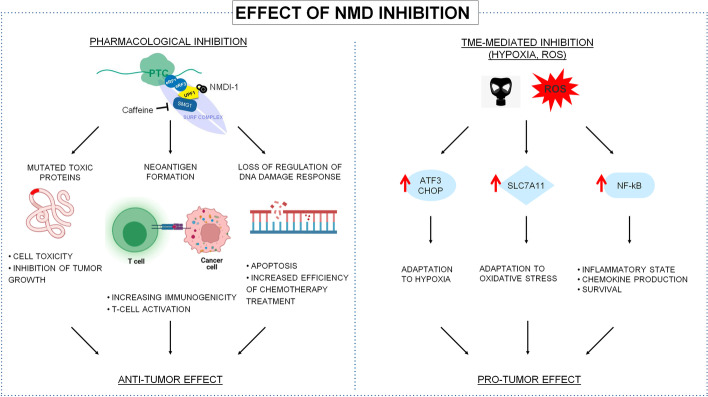
Nonsense-mediated mRNA decay (NMD) is a highly conserved cellular surveillance mechanism, commonly studied for its role in mRNA quality control because of its capacity of degrading mutated mRNAs that would produce truncated proteins. However, recent studies have proven that NMD hides more complex tasks involved in a plethora of cellular activities. Indeed, it can control the stability of mutated as well as non-mutated transcripts, tuning transcriptome regulation. NMD not only displays a pivotal role in cell physiology but also in a number of genetic diseases. In cancer, the activity of this pathway is extremely complex and it is endowed with both pro-tumor and tumor suppressor functions, likely depending on the genetic context and tumor microenvironment. NMD inhibition has been tested in pre-clinical studies showing favored production of neoantigens by cancer cells, which can stimulate the triggering of an anti-tumor immune response. At the same time, NMD inhibition could result in a pro-tumor effect, increasing cancer cell adaptation to stress. Since several NMD inhibitors are already available in the clinic to treat genetic diseases, these compounds could be redirected to treat cancer patients, pending the comprehension of these variegated NMD regulation mechanisms. Ideally, an effective strategy should exploit the anti-tumor advantages of NMD inhibition and simultaneously preserve its intrinsic tumor suppressor functions. The targeting of NMD could provide a new therapeutic opportunity, increasing the immunogenicity of tumors and potentially boosting the efficacy of the immunotherapy agents now available for cancer treatment.
无意义介导的 mRNA 降解(NMD)是一种高度保守的细胞监控机制,因其能够降解产生截断蛋白的突变 mRNA,从而在 mRNA 质量控制中发挥作用而被广泛研究。然而,最近的研究证明,NMD 隐藏着更多涉及多种细胞活动的复杂任务。事实上,它可以控制突变和非突变转录本的稳定性,调节转录组调控。NMD 不仅在细胞生理学中发挥关键作用,而且在许多遗传疾病中也发挥作用。在癌症中,该途径的活性极其复杂,它具有促进肿瘤和肿瘤抑制功能,这可能取决于遗传背景和肿瘤微环境。在临床前研究中已经测试了 NMD 抑制,显示癌细胞产生新抗原的产量增加,这可以刺激抗肿瘤免疫反应的触发。同时,NMD 抑制可能导致促肿瘤效应,增加癌细胞对压力的适应能力。由于目前已有几种 NMD 抑制剂可用于治疗遗传疾病,因此可以将这些化合物重新用于治疗癌症患者,同时等待对这些多样化的 NMD 调控机制的理解。理想情况下,有效的策略应该利用 NMD 抑制的抗肿瘤优势,同时保留其内在的肿瘤抑制功能。靶向 NMD 可能为治疗提供新的机会,提高肿瘤的免疫原性,并可能提高目前用于癌症治疗的免疫治疗药物的疗效。