Department of Biochemistry and Molecular Biology, University of Arkansas for Medical Sciences, Little Rock, AR 72205, USA.
Winthrop P. Rockefeller Cancer Institute, University of Arkansas for Medical Sciences, Little Rock, AR 72205, USA.
Genes (Basel). 2023 Jan 30;14(2):357. doi: 10.3390/genes14020357.
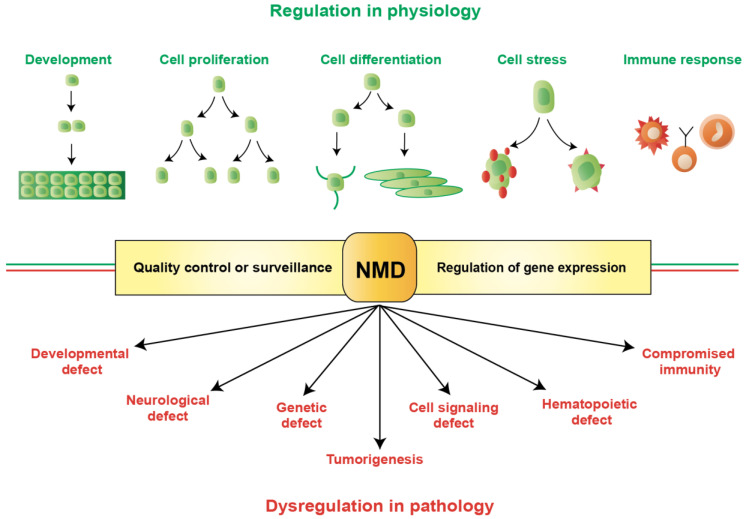
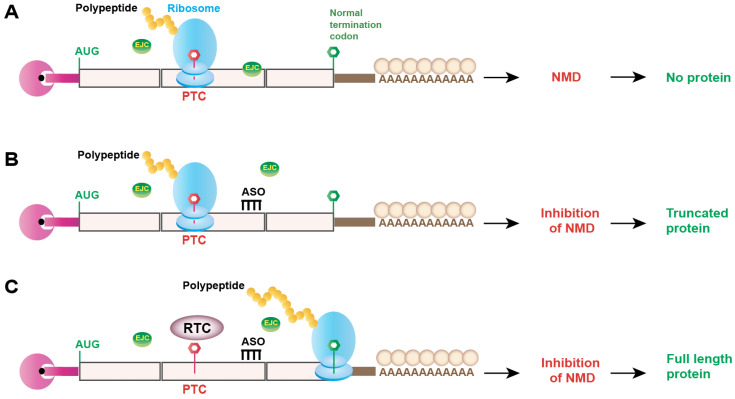
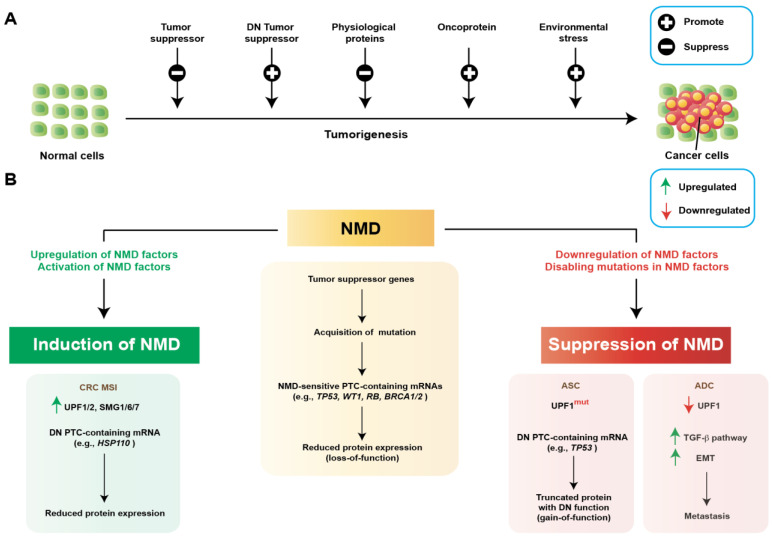
Nonsense-mediated mRNA decay (NMD) is an evolutionarily conserved and well-characterized biological mechanism that ensures the fidelity and regulation of gene expression. Initially, NMD was described as a cellular surveillance or quality control process to promote selective recognition and rapid degradation of erroneous transcripts harboring a premature translation-termination codon (PTC). As estimated, one-third of mutated and disease-causing mRNAs were reported to be targeted and degraded by NMD, suggesting the significance of this intricate mechanism in maintaining cellular integrity. It was later revealed that NMD also elicits down-regulation of many endogenous mRNAs without mutations (~10% of the human transcriptome). Therefore, NMD modulates gene expression to evade the generation of aberrant truncated proteins with detrimental functions, compromised activities, or dominant-negative effects, as well as by controlling the abundance of endogenous mRNAs. By regulating gene expression, NMD promotes diverse biological functions during development and differentiation, and facilitates cellular responses to adaptation, physiological changes, stresses, environmental insults, etc. Mutations or alterations (such as abnormal expression, degradation, post-translational modification, etc.) that impair the function or expression of proteins associated with the NMD pathway can be deleterious to cells and may cause pathological consequences, as implicated in developmental and intellectual disabilities, genetic defects, and cancer. Growing evidence in past decades has highlighted NMD as a critical driver of tumorigenesis. Advances in sequencing technologies provided the opportunity to identify many NMD substrate mRNAs in tumor samples compared to matched normal tissues. Interestingly, many of these changes are tumor-specific and are often fine-tuned in a tumor-specific manner, suggesting the complex regulation of NMD in cancer. Tumor cells differentially exploit NMD for survival benefits. Some tumors promote NMD to degrade a subset of mRNAs, such as those encoding tumor suppressors, stress response proteins, signaling proteins, RNA binding proteins, splicing factors, and immunogenic neoantigens. In contrast, some tumors suppress NMD to facilitate the expression of oncoproteins or other proteins beneficial for tumor growth and progression. In this review, we discuss how NMD is regulated as a critical mediator of oncogenesis to promote the development and progression of tumor cells. Understanding how NMD affects tumorigenesis differentially will pave the way for the development of more effective and less toxic, targeted therapeutic opportunities in the era of personalized medicine.
无意义介导的 mRNA 降解(NMD)是一种进化上保守且特征明确的生物机制,可确保基因表达的准确性和调控。最初,NMD 被描述为一种细胞监控或质量控制过程,以促进对含有过早翻译终止密码子(PTC)的错误转录本的选择性识别和快速降解。据估计,有三分之一的突变和致病 mRNA 被 NMD 靶向和降解,表明这种复杂机制在维持细胞完整性方面的重要性。后来发现,NMD 还会下调许多没有突变的内源性 mRNA(~人类转录组的 10%)。因此,NMD 通过调节基因表达来避免产生具有有害功能、功能受损或显性负效应的异常截断蛋白,以及通过控制内源性 mRNA 的丰度。通过调节基因表达,NMD 在发育和分化过程中促进多种生物学功能,并促进细胞对适应、生理变化、应激、环境损伤等的反应。与 NMD 途径相关的蛋白质的功能或表达的突变或改变(如异常表达、降解、翻译后修饰等)可能对细胞有害,并可能导致病理后果,如在发育和智力障碍、遗传缺陷和癌症中所暗示的那样。过去几十年来的大量证据强调了 NMD 作为肿瘤发生的关键驱动因素。测序技术的进步为在肿瘤样本中与匹配的正常组织相比鉴定许多 NMD 底物 mRNA 提供了机会。有趣的是,这些变化中的许多是肿瘤特异性的,并且通常以肿瘤特异性的方式进行微调,表明 NMD 在癌症中的复杂调控。肿瘤细胞通过生存获益来差异化地利用 NMD。一些肿瘤促进 NMD 降解一组 mRNA,如那些编码肿瘤抑制因子、应激反应蛋白、信号蛋白、RNA 结合蛋白、剪接因子和免疫原性新抗原的 mRNA。相比之下,一些肿瘤抑制 NMD 以促进癌蛋白或其他有利于肿瘤生长和进展的蛋白质的表达。在这篇综述中,我们讨论了 NMD 如何作为一种关键的致癌介质进行调控,以促进肿瘤细胞的发育和进展。了解 NMD 如何以不同的方式影响肿瘤发生将为在个性化医疗时代开发更有效和毒性更小的靶向治疗机会铺平道路。