MRC Cognition and Brain Sciences Unit, University of Cambridge, 15 Chaucer Road, Cambridge CB2 7EF, United Kingdom.
Wellcome Centre for Integrative Neuroimaging, Nuffield Department of Neurosciences, University of Oxford, United Kingdom.
Neuroimage. 2022 Feb 1;246:118768. doi: 10.1016/j.neuroimage.2021.118768. Epub 2021 Nov 30.
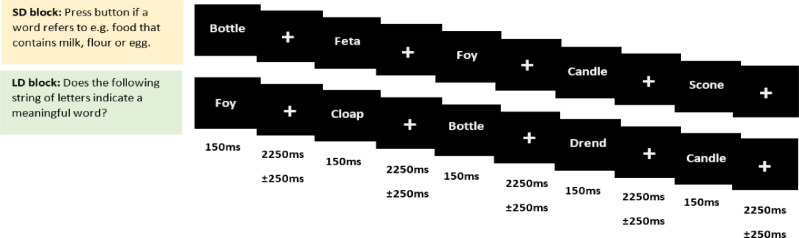
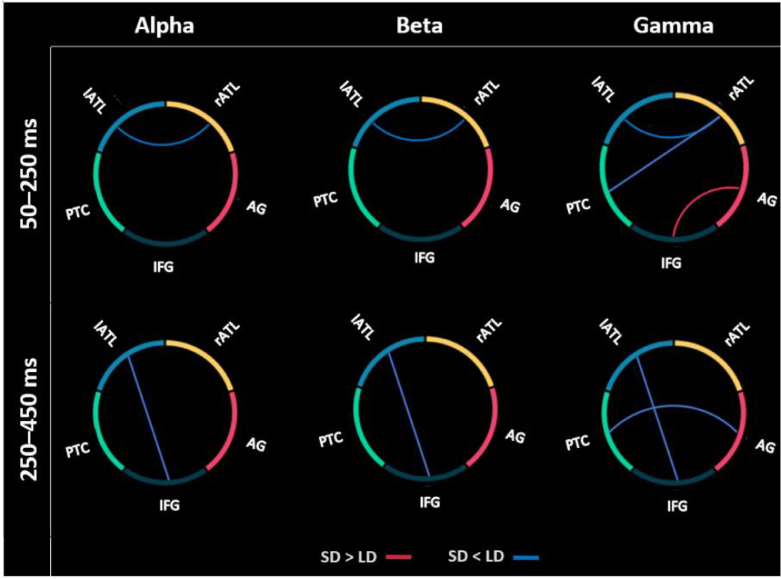
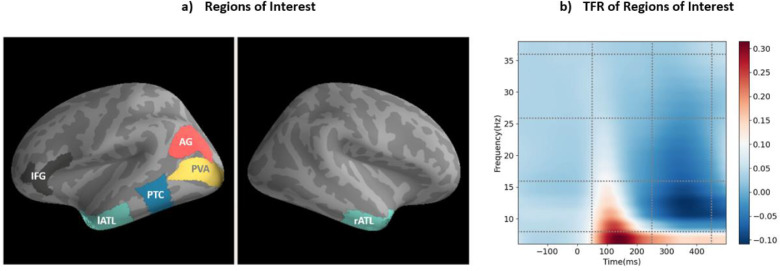
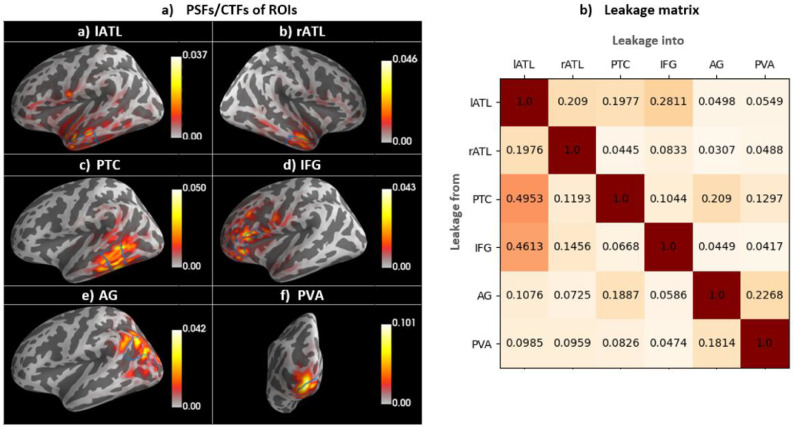
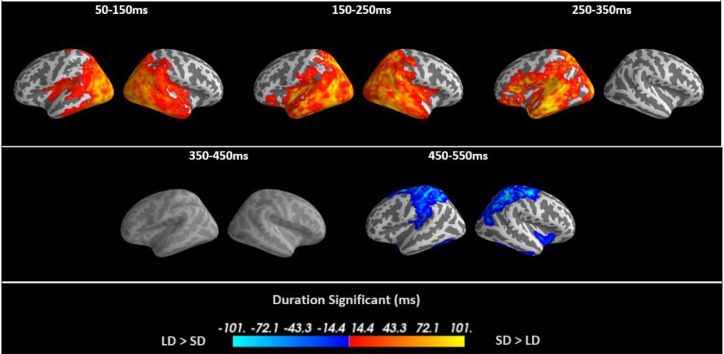
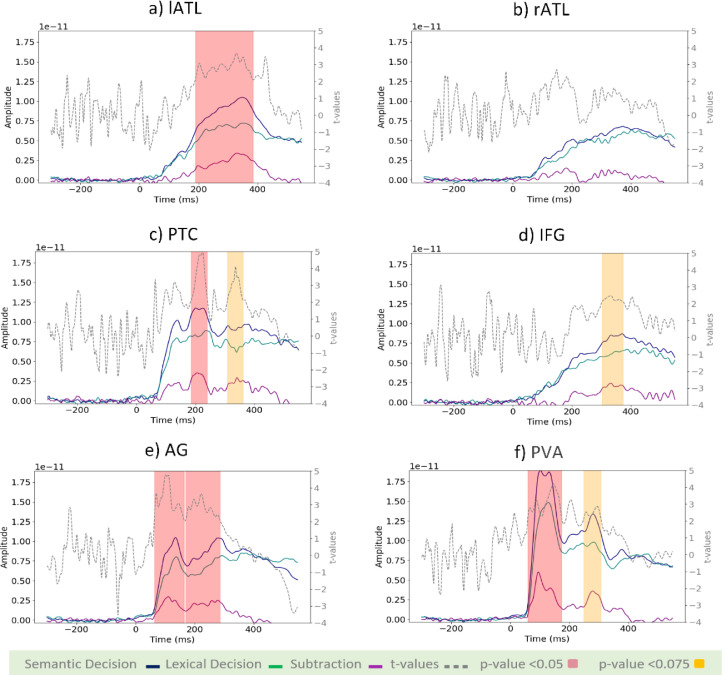
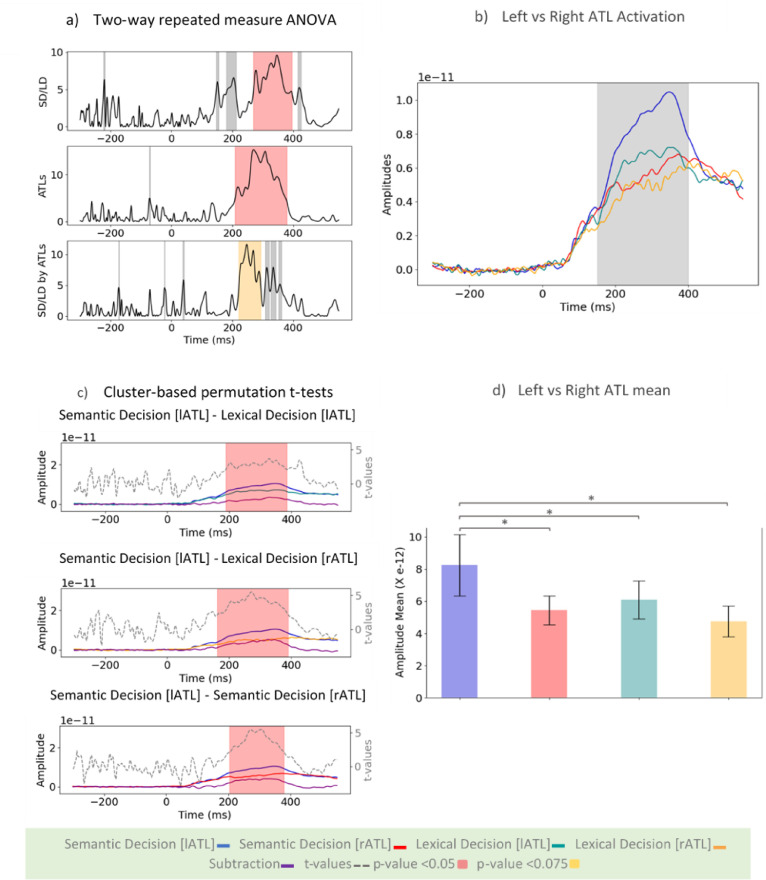
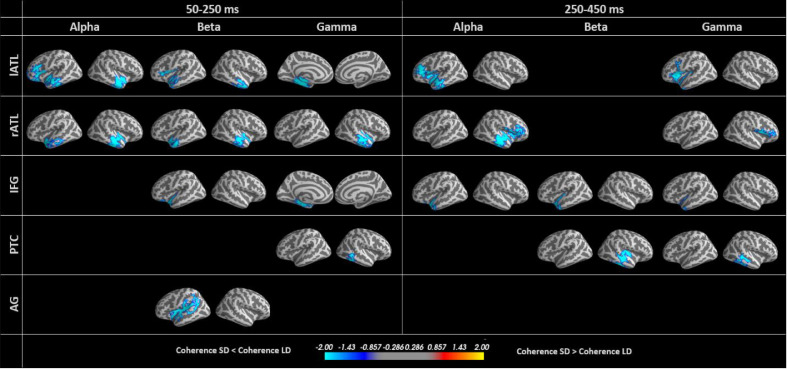
How does brain activity in distributed semantic brain networks evolve over time, and how do these regions interact to retrieve the meaning of words? We compared spatiotemporal brain dynamics between visual lexical and semantic decision tasks (LD and SD), analysing whole-cortex evoked responses and spectral functional connectivity (coherence) in source-estimated electroencephalography and magnetoencephalography (EEG and MEG) recordings. Our evoked analysis revealed generally larger activation for SD compared to LD, starting in primary visual area (PVA) and angular gyrus (AG), followed by left posterior temporal cortex (PTC) and left anterior temporal lobe (ATL). The earliest activation effects in ATL were significantly left-lateralised. Our functional connectivity results showed significant connectivity between left and right ATL, PTC and right ATL in an early time window, as well as between left ATL and IFG in a later time window. The connectivity of AG was comparatively sparse. We quantified the limited spatial resolution of our source estimates via a leakage index for careful interpretation of our results. Our findings suggest that the different demands on semantic information retrieval in lexical and semantic decision tasks first modulate visual and attentional processes, then multimodal semantic information retrieval in the ATLs and finally control regions (PTC and IFG) in order to extract task-relevant semantic features for response selection. Whilst our evoked analysis suggests a dominance of left ATL for semantic processing, our functional connectivity analysis also revealed significant involvement of right ATL in the more demanding semantic task. Our findings demonstrate the complementarity of evoked and functional connectivity analysis, as well as the importance of dynamic information for both types of analyses.
大脑在分布式语义脑网络中的活动如何随时间演变,这些区域如何相互作用以检索单词的意义?我们比较了视觉词汇和语义决策任务(LD 和 SD)之间的时空大脑动力学,分析了源估计脑电图和脑磁图(EEG 和 MEG)记录中的全皮质诱发反应和频谱功能连接(相干性)。我们的诱发分析显示,与 LD 相比,SD 通常会引起更大的激活,从初级视觉区(PVA)和角回(AG)开始,然后是左后颞叶(PTC)和左前颞叶(ATL)。ATL 中的最早激活效应明显偏向左侧。我们的功能连接结果显示,在早期时间窗口中,左、右 ATL、PTC 和右 ATL 之间存在显著的连通性,以及在较晚的时间窗口中,左 ATL 和 IFG 之间存在显著的连通性。AG 的连通性相对稀疏。我们通过泄漏指数来量化我们源估计的有限空间分辨率,以仔细解释我们的结果。我们的发现表明,在词汇和语义决策任务中对语义信息检索的不同需求首先调节视觉和注意力过程,然后在 ATLs 中进行多模态语义信息检索,最后在控制区域(PTC 和 IFG)中提取与任务相关的语义特征以进行响应选择。虽然我们的诱发分析表明左 ATL 在语义处理中占主导地位,但我们的功能连接分析也表明右 ATL 参与了更具挑战性的语义任务。我们的研究结果表明,诱发分析和功能连接分析具有互补性,动态信息对这两种分析都很重要。