Hafke-Dys Honorata, Kuźnar-Kamińska Barbara, Grzywalski Tomasz, Maciaszek Adam, Szarzyński Krzysztof, Kociński Jędrzej
Department of Acoustics, Faculty of Physics, Adam Mickiewicz University in Poznań, Poznań, Poland.
StethoMe Sp. z o.o., Poznań, Poland.
Front Physiol. 2021 Nov 11;12:745635. doi: 10.3389/fphys.2021.745635. eCollection 2021.
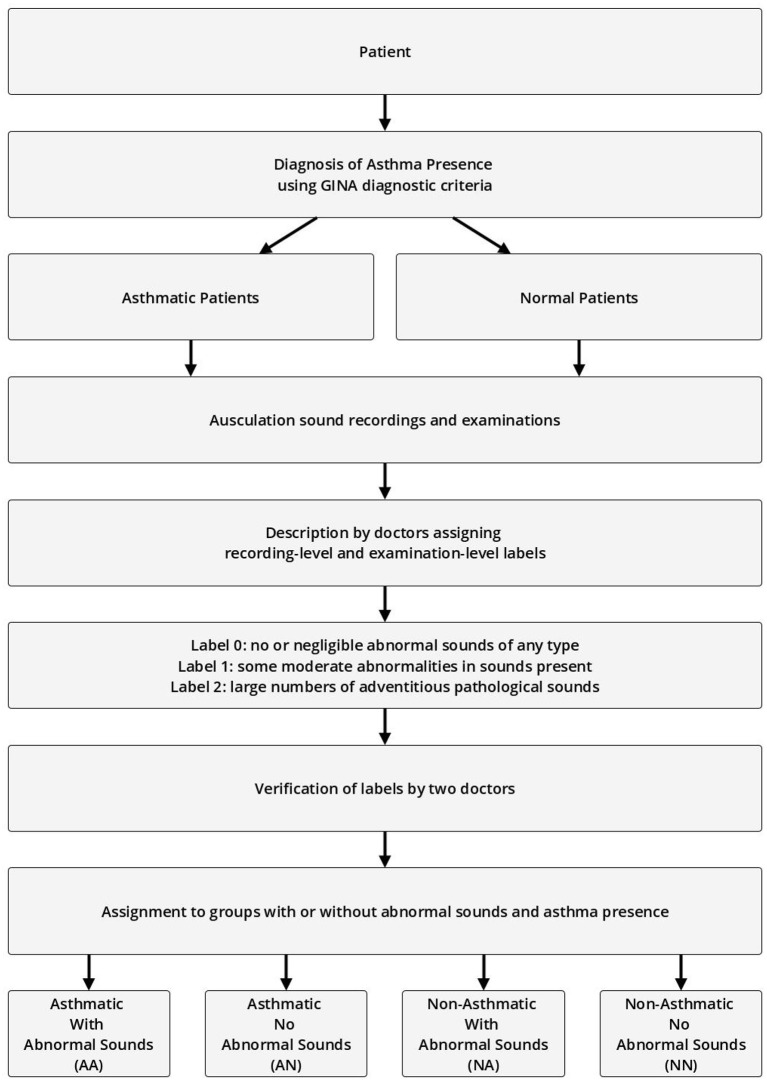
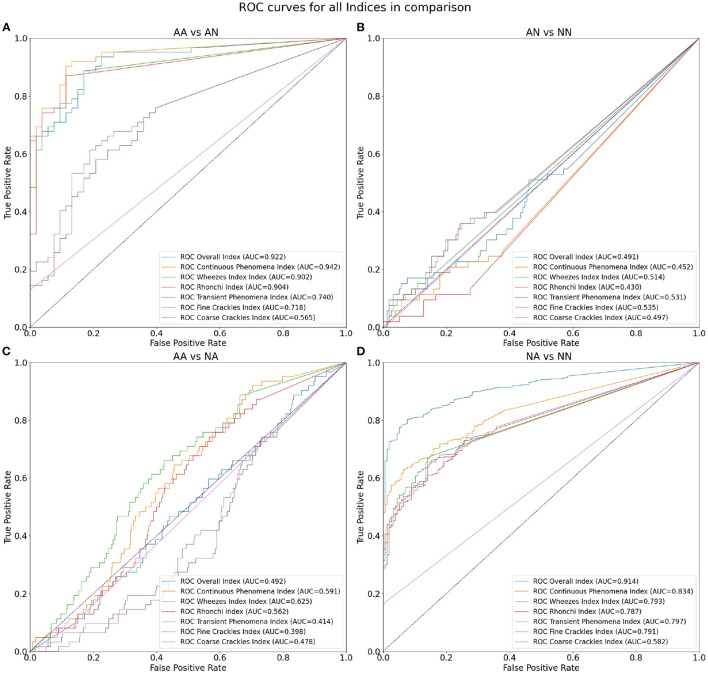
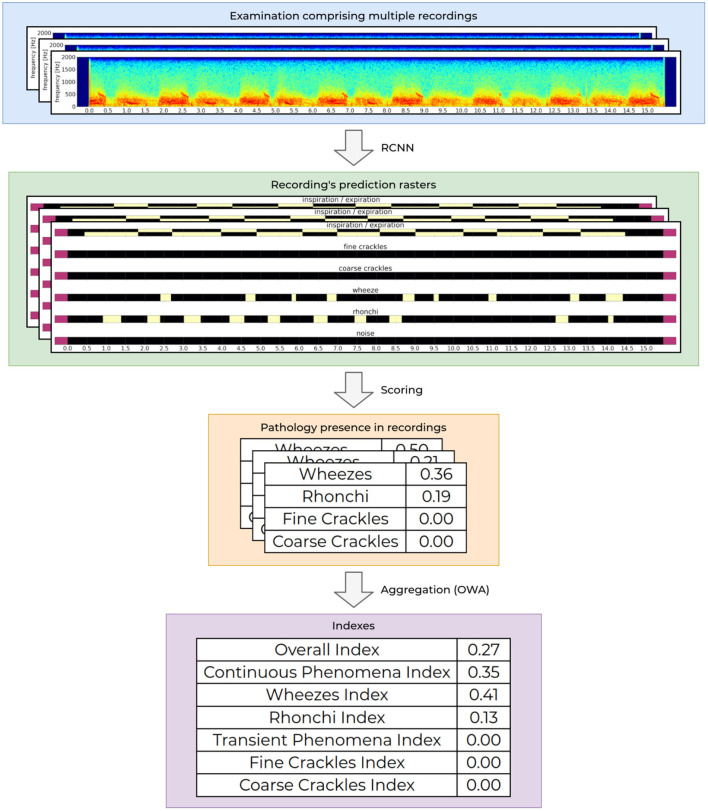
Effective and reliable monitoring of asthma at home is a relevant factor that may reduce the need to consult a doctor in person. We analyzed the possibility to determine intensities of pathological breath phenomena based on artificial intelligence (AI) analysis of sounds recorded during standard stethoscope auscultation. The evaluation set comprising 1,043 auscultation examinations (9,319 recordings) was collected from 899 patients. Examinations were assigned to one of four groups: asthma with and without abnormal sounds (AA and AN, respectively), no-asthma with and without abnormal sounds (NA and NN, respectively). Presence of abnormal sounds was evaluated by a panel of 3 physicians that were blinded to the AI predictions. AI was trained on an independent set of 9,847 recordings to determine intensity scores (indexes) of wheezes, rhonchi, fine and coarse crackles and their combinations: continuous phenomena (wheezes + rhonchi) and all phenomena. The pair-comparison of groups of examinations based on Area Under ROC-Curve (AUC) was used to evaluate the performance of each index in discrimination between groups. Best performance in separation between AA and AN was observed with Continuous Phenomena Index (AUC 0.94) while for NN and NA. All Phenomena Index (AUC 0.91) showed the best performance. AA showed slightly higher prevalence of wheezes compared to NA. The results showed a high efficiency of the AI to discriminate between the asthma patients with normal and abnormal sounds, thus this approach has a great potential and can be used to monitor asthma symptoms at home.
在家中对哮喘进行有效且可靠的监测是一个相关因素,它可能会减少亲自就医的需求。我们分析了基于人工智能(AI)对标准听诊器听诊期间记录的声音进行分析来确定病理性呼吸现象强度的可能性。从899名患者中收集了包含1043次听诊检查(9319条记录)的评估集。检查被分为四组之一:有和没有异常声音的哮喘(分别为AA和AN)、有和没有异常声音的非哮喘(分别为NA和NN)。由一组对AI预测不知情的3名医生评估异常声音的存在情况。AI在一组独立的9847条记录上进行训练,以确定哮鸣音、鼾音、细湿啰音和粗湿啰音及其组合的强度评分(指数):连续现象(哮鸣音 + 鼾音)和所有现象。基于ROC曲线下面积(AUC)对检查组进行配对比较,以评估每个指数在区分组间的性能。在区分AA和AN时,连续现象指数表现最佳(AUC 0.94),而对于NN和NA,所有现象指数(AUC 0.91)表现最佳。与NA相比,AA中哮鸣音的患病率略高。结果表明AI在区分有正常和异常声音的哮喘患者方面具有很高的效率,因此这种方法具有很大的潜力,可用于在家中监测哮喘症状。