Stojanovski Sonja, Scratch Shannon E, Dunkley Benjamin T, Schachar Russell, Wheeler Anne L
SickKids Research Institute, Program in Neuroscience and Mental Health, Hospital for Sick Children, Neuroscience and Mental Health Program, Toronto, ON, Canada.
Physiology Department, University of Toronto, Toronto, ON, Canada.
Front Neurol. 2021 Nov 10;12:751736. doi: 10.3389/fneur.2021.751736. eCollection 2021.
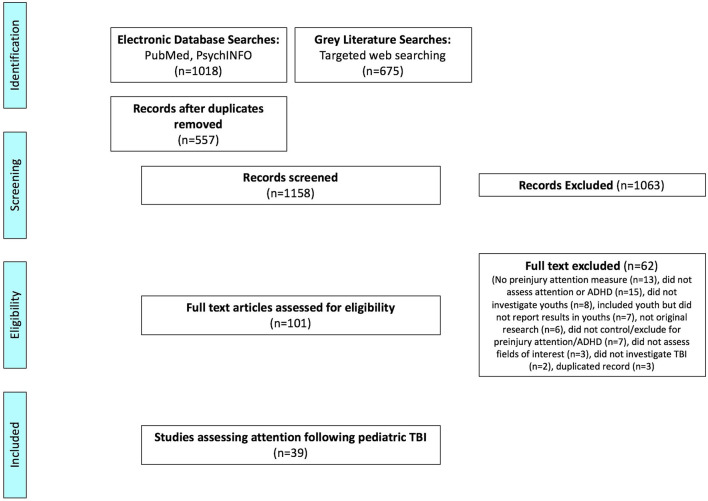
To summarize existing knowledge about the characteristics of attention problems secondary to traumatic brain injuries (TBI) of all severities in children. Computerized databases PubMed and PsychINFO and gray literature sources were used to identify relevant studies. Search terms were selected to identify original research examining new ADHD diagnosis or attention problems after TBI in children. Studies were included if they investigated any severity of TBI, assessed attention or ADHD after brain injury, investigated children as a primary or sub-analysis, and controlled for or excluded participants with preinjury ADHD or attention problems. Thirty-nine studies were included in the review. Studies examined the prevalence of and risk factors for new attention problems and ADHD following TBI in children as well as behavioral and neuropsychological factors associated with these attention problems. Studies report a wide range of prevalence rates of new ADHD diagnosis or attention problems after TBI. Evidence indicates that more severe injury, injury in early childhood, or preinjury adaptive functioning problems, increases the risk for new ADHD and attention problems after TBI and both sexes appear to be equally vulnerable. Further, literature suggests that cases of new ADHD often co-occurs with neuropsychiatric impairment in other domains. Identified gaps in our understanding of new attention problems and ADHD include if mild TBI, the most common type of injury, increases risk and what brain abnormalities are associated with the emergence of these problems. This scoping review describes existing studies of new attention problems and ADHD following TBI in children and highlights important risk factors and comorbidities. Important future research directions are identified that will inform the extent of this outcome across TBI severities, its neural basis and points of intervention to minimize its impact.
总结关于儿童各种严重程度创伤性脑损伤(TBI)继发注意力问题特征的现有知识。使用计算机化数据库PubMed和PsychINFO以及灰色文献来源来识别相关研究。选择检索词以识别研究儿童创伤性脑损伤后新的注意力缺陷多动障碍(ADHD)诊断或注意力问题的原创研究。如果研究调查了任何严重程度的创伤性脑损伤,评估了脑损伤后的注意力或ADHD,将儿童作为主要或次要分析对象,并对伤前患有ADHD或注意力问题的参与者进行了控制或排除,则纳入研究。本综述纳入了39项研究。这些研究调查了儿童创伤性脑损伤后新的注意力问题和ADHD的患病率及危险因素,以及与这些注意力问题相关的行为和神经心理学因素。研究报告了创伤性脑损伤后新的ADHD诊断或注意力问题的广泛患病率。有证据表明,更严重的损伤、幼儿期损伤或伤前适应性功能问题会增加创伤性脑损伤后出现新的ADHD和注意力问题的风险,而且两性似乎同样易受影响。此外,文献表明,新的ADHD病例往往与其他领域的神经精神损害同时出现。我们对新的注意力问题和ADHD认识上的空白包括轻度创伤性脑损伤(最常见的损伤类型)是否会增加风险,以及哪些脑异常与这些问题的出现有关。本范围综述描述了关于儿童创伤性脑损伤后新的注意力问题和ADHD的现有研究,并强调了重要的危险因素和共病情况。确定了重要的未来研究方向,这些方向将为不同严重程度创伤性脑损伤的这一结果范围、其神经基础以及最小化其影响的干预点提供信息。