Katyal Sucharit, Goldin Philippe
Betty Irene Moore School of Nursing, University of California Davis Medical Center, Sacramento, CA 95817, California.
Neurosci Conscious. 2021 Nov 29;2021(1):niab042. doi: 10.1093/nc/niab042. eCollection 2021.
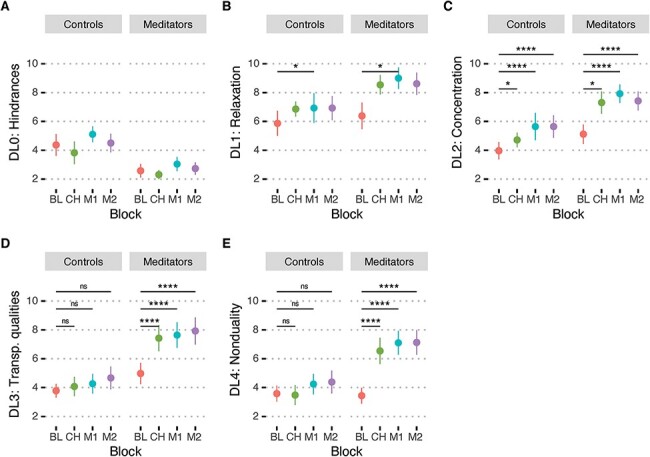
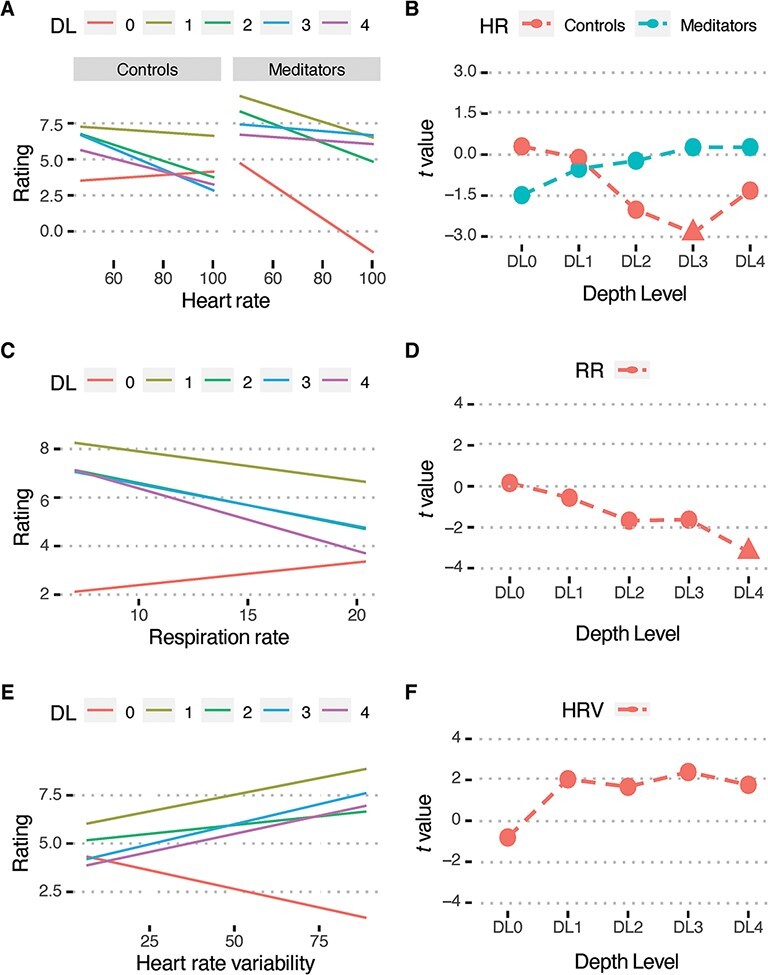
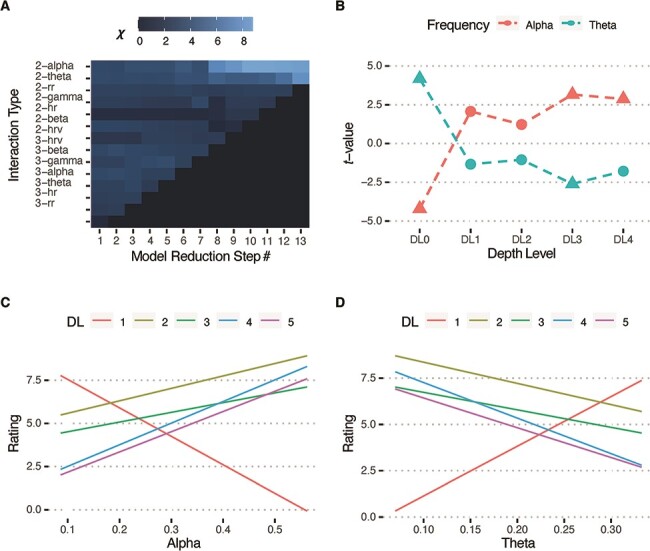
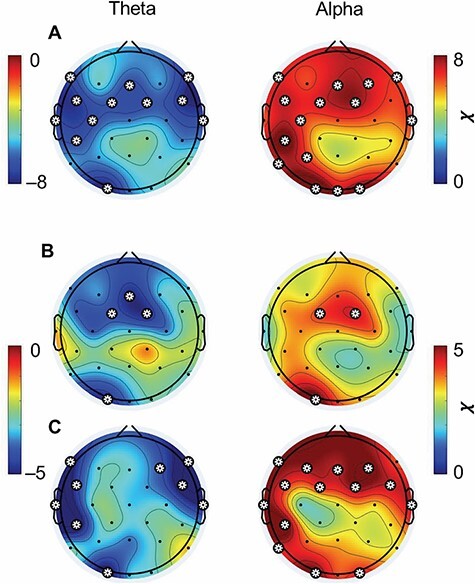
Meditation training is proposed to enhance mental well-being by modulating neural activity, particularly alpha and theta brain oscillations, and autonomic activity. Although such enhancement also depends on the quality of meditation, little is known about how these neural and physiological changes relate to meditation quality. One model characterizes meditation quality as five increasing levels of 'depth': hindrances, relaxation, concentration, transpersonal qualities and nonduality. We investigated the neural oscillatory (theta, alpha, beta and gamma) and physiological (respiration rate, heart rate and heart rate variability) correlates of the self-reported meditation depth in long-term meditators (LTMs) and meditation-naïve controls (CTLs). To determine the neural and physiological correlates of meditation depth, we modelled the change in the slope of the relationship between self-reported experiential degree at each of the five depth levels and the multiple neural and physiological measures. CTLs reported experiencing more 'hindrances' than LTMs, while LTMs reported more 'transpersonal qualities' and 'nonduality' compared to CTLs, confirming the experiential manipulation of meditation depth. We found that in both groups, theta (4-6 Hz) and alpha (7-13 Hz) oscillations were related to meditation depth in a precisely opposite manner. The theta amplitude positively correlated with 'hindrances' and increasingly negatively correlated with increasing meditation depth levels. Alpha amplitude negatively correlated with 'hindrances' and increasingly positively with increasing depth levels. The increase in the inverse association between theta and meditation depth occurred over different scalp locations in the two groups-frontal midline in LTMs and frontal lateral in CTLs-possibly reflecting the downregulation of two different aspects of executive processing-monitoring and attention regulation, respectively-during deep meditation. These results suggest a functional dissociation of the two classical neural signatures of meditation training, namely, alpha and theta oscillations. Moreover, while essential for overcoming 'hindrances', executive neural processing appears to be downregulated during deeper meditation experiences.
冥想训练被认为可通过调节神经活动,特别是α和θ脑电波振荡以及自主神经活动来提升心理健康。尽管这种提升也取决于冥想的质量,但对于这些神经和生理变化如何与冥想质量相关却知之甚少。一种模型将冥想质量描述为五个逐渐加深的“深度”水平:障碍、放松、专注、超个人特质和非二元性。我们研究了长期冥想者(LTMs)和未接触过冥想的对照组(CTLs)自我报告的冥想深度与神经振荡(θ、α、β和γ)及生理指标(呼吸频率、心率和心率变异性)之间的相关性。为了确定冥想深度的神经和生理相关性,我们对五个深度水平中每个水平的自我报告体验程度与多种神经和生理指标之间关系的斜率变化进行了建模。CTLs报告称比LTMs经历了更多的“障碍”,而与CTLs相比,LTMs报告了更多的“超个人特质”和“非二元性”,这证实了对冥想深度的体验性操控。我们发现,在两组中,θ(4 - 6赫兹)和α(7 - 13赫兹)振荡与冥想深度的关系恰好相反。θ波幅与“障碍”呈正相关,且与冥想深度水平的增加呈越来越强的负相关。α波幅与“障碍”呈负相关,且与深度水平的增加呈越来越强的正相关。两组中θ与冥想深度之间反向关联的增加发生在不同的头皮位置——LTMs为额中线,CTLs为额外侧——这可能分别反映了深度冥想期间执行加工的两个不同方面——监测和注意力调节——的下调。这些结果表明冥想训练的两种经典神经特征,即α和θ振荡,存在功能分离。此外,尽管执行神经加工对于克服“障碍”至关重要,但在更深层次的冥想体验中它似乎会被下调。