Xiao Huiyu, Wang Xiaojie, Li Shuang, Liu Ying, Cui Yijie, Deng Xiaoqin
Department of Radiation Oncology, The First Affiliated Hospital of Dalian Medical University, Dalian, China.
Heart Failure and Structural Cardiology Ward, The First Affiliated Hospital of Dalian Medical University, Dalian, China.
Front Cardiovasc Med. 2021 Nov 10;8:753313. doi: 10.3389/fcvm.2021.753313. eCollection 2021.
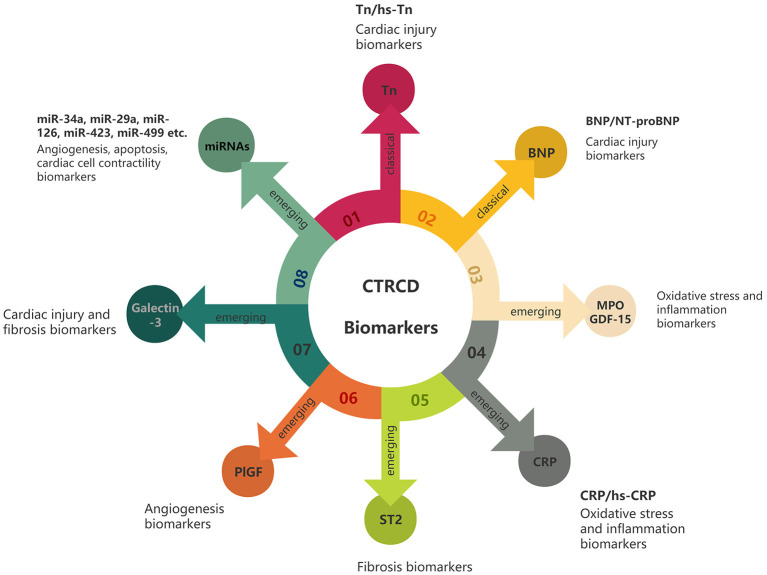
With the gradual prolongation of the overall survival of cancer patients, the cardiovascular toxicity associated with oncology drug therapy and radiotherapy has attracted increasing attention. At present, the main methods to identify early cancer treatment-related cardiac dysfunction (CTRCD) include imaging examination and blood biomarkers. In this review, we will summarize the research progress of subclinical CTRCD-related blood biomarkers in detail. At present, common tumor therapies that cause CTRCD include: (1) Chemotherapy-The CTRCD induced by chemotherapy drugs represented by anthracycline showed a dose-dependent characteristic and most of the myocardial damage is irreversible. (2) Targeted therapy-Cardiovascular injury caused by molecular-targeted therapy drugs such as trastuzumab can be partially or completely alleviated via timely intervention. (3) Immunotherapy-Patients developed severe left ventricular dysfunction who received immune checkpoint inhibitors have been reported. (4) Radiotherapy-CTRCD induced by radiotherapy has been shown to be significantly associated with cardiac radiation dose and radiation volume. Numerous reports have shown that elevated troponin and B-type natriuretic peptide after cancer treatment are significantly associated with heart failure and asymptomatic left ventricular dysfunction. In recent years, a few emerging subclinical CTRCD potential biomarkers have attracted attention. C-reactive protein and ST2 have been shown to be associated with CTRCD after chemotherapy and radiation. Galectin-3, myeloperoxidas, placental growth factor, growth differentiation factor 15 and microRNAs have potential value in predicting CTRCD. In this review, we will summarize CTRCD caused by various tumor therapies from the perspective of cardio-oncology, and focus on the latest research progress of subclinical CTRCD biomarkers.
随着癌症患者总体生存期的逐渐延长,与肿瘤药物治疗和放射治疗相关的心血管毒性日益受到关注。目前,识别早期癌症治疗相关心脏功能障碍(CTRCD)的主要方法包括影像学检查和血液生物标志物。在本综述中,我们将详细总结亚临床CTRCD相关血液生物标志物的研究进展。目前,导致CTRCD的常见肿瘤治疗方法包括:(1)化疗——以蒽环类药物为代表的化疗药物诱导的CTRCD呈剂量依赖性,且大多数心肌损伤是不可逆的。(2)靶向治疗——曲妥珠单抗等分子靶向治疗药物引起的心血管损伤可通过及时干预得到部分或完全缓解。(3)免疫治疗——已有报道接受免疫检查点抑制剂的患者出现严重左心室功能障碍。(4)放射治疗——放射治疗诱导的CTRCD已被证明与心脏辐射剂量和辐射体积显著相关。大量报告表明,癌症治疗后肌钙蛋白和B型利钠肽升高与心力衰竭和无症状左心室功能障碍显著相关。近年来,一些新出现的亚临床CTRCD潜在生物标志物引起了关注。C反应蛋白和ST2已被证明与化疗和放疗后的CTRCD相关。半乳糖凝集素-3、髓过氧化物酶、胎盘生长因子、生长分化因子15和微小RNA在预测CTRCD方面具有潜在价值。在本综述中,我们将从心脏肿瘤学的角度总结各种肿瘤治疗引起的CTRCD,并重点关注亚临床CTRCD生物标志物的最新研究进展。