McKernan C, Benson T, Farrell S, Dean M
Institute for Global Food Security, School of Biological Sciences, Queen's University Belfast, 19 Chlorine Gardens, Belfast BT9 5DL,UK.
JAC Antimicrob Resist. 2021 Nov 30;3(4):dlab178. doi: 10.1093/jacamr/dlab178. eCollection 2021 Dec.
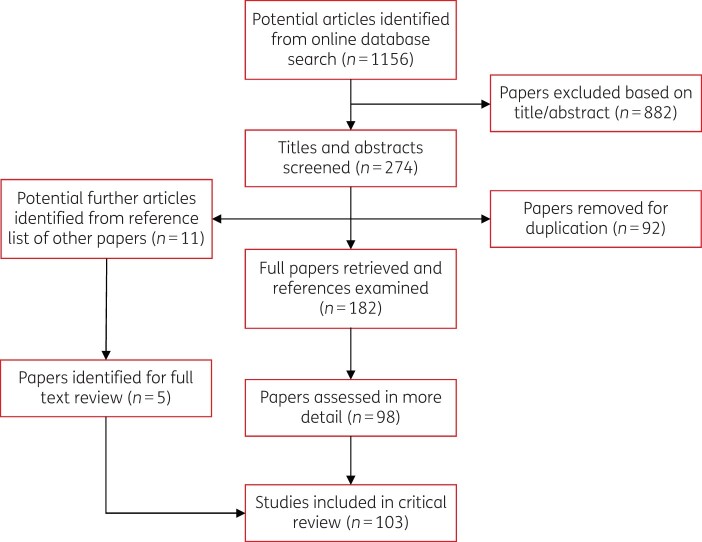
Antimicrobial resistance (AMR) is a global health emergency affecting humans and animals, diminishing the effectiveness of medication used to treat illness. The agri-food sector has attracted increased attention for imprudent antimicrobial use (AMU) and its contribution to AMR. Thus, ascertaining farmers' and veterinarians' behaviours surrounding AMU is essential to address imprudent AMU and generate behaviour change within the agri-food sector. Therefore, the aim of this critical review is to investigate, assess and collate the current body of evidence to identify psychosocial factors including knowledge, understanding, perceptions, attitudes and behaviours surrounding AMU. Database searches were limited to articles utilizing qualitative and quantitative methodologies, available in English with no restriction on publication year. Of the 1156 articles identified, 103 were retained for this review. Findings on the psychosocial aspects were thematically analysed. Five key themes emerged from the data: (i) knowledge and awareness of antimicrobials; (ii) attitudes towards antimicrobials; (iii) influential relationships; (iv) resources; and (v) factors influencing AMU. Results indicated that to overcome barriers experienced by key stakeholders, a carefully considered, evidence-based approach, incorporating behaviour change theory, is required when designing intricate interventions/strategies, in order to elicit successful and sustained AMU behaviour change.
抗菌药物耐药性(AMR)是一种影响人类和动物的全球卫生紧急情况,它降低了用于治疗疾病的药物的有效性。农业食品部门因不谨慎使用抗菌药物(AMU)及其对AMR的影响而受到越来越多的关注。因此,确定农民和兽医围绕AMU的行为对于解决不谨慎的AMU问题并在农业食品部门产生行为改变至关重要。因此,本综述的目的是调查、评估和整理当前的证据,以确定包括围绕AMU的知识、理解、认知、态度和行为等社会心理因素。数据库搜索仅限于使用定性和定量方法的文章,文章语言为英文,对出版年份无限制。在识别出的1156篇文章中,有103篇被保留用于本综述。对社会心理方面的研究结果进行了主题分析。数据中出现了五个关键主题:(i)对抗菌药物的知识和认识;(ii)对抗菌药物的态度;(iii)有影响力的关系;(iv)资源;以及(v)影响AMU的因素。结果表明,为了克服关键利益相关者遇到的障碍,在设计复杂的干预措施/策略时,需要采用一种经过深思熟虑、基于证据的方法,并纳入行为改变理论,以实现成功且持续的AMU行为改变。