Institute of Materials Science and Technology, 3D Printing and Biofabrication Group, TU Wien, Vienna, Austria.
Department of Orthopedics and Trauma-Surgery, Division of Trauma-Surgery, Medical University of Vienna, Vienna, Austria.
J Tissue Eng Regen Med. 2022 Feb;16(2):207-222. doi: 10.1002/term.3273. Epub 2021 Dec 15.
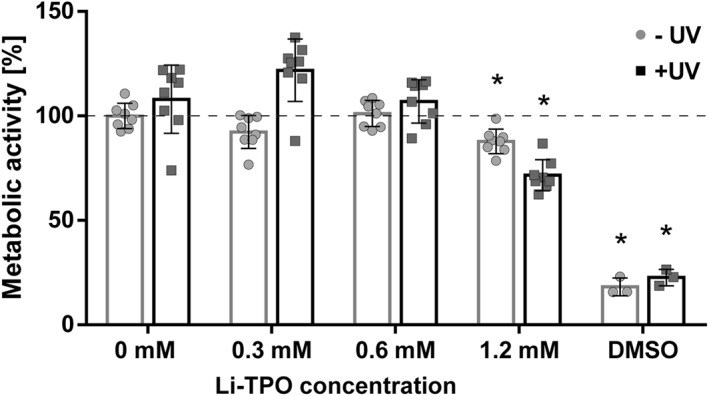
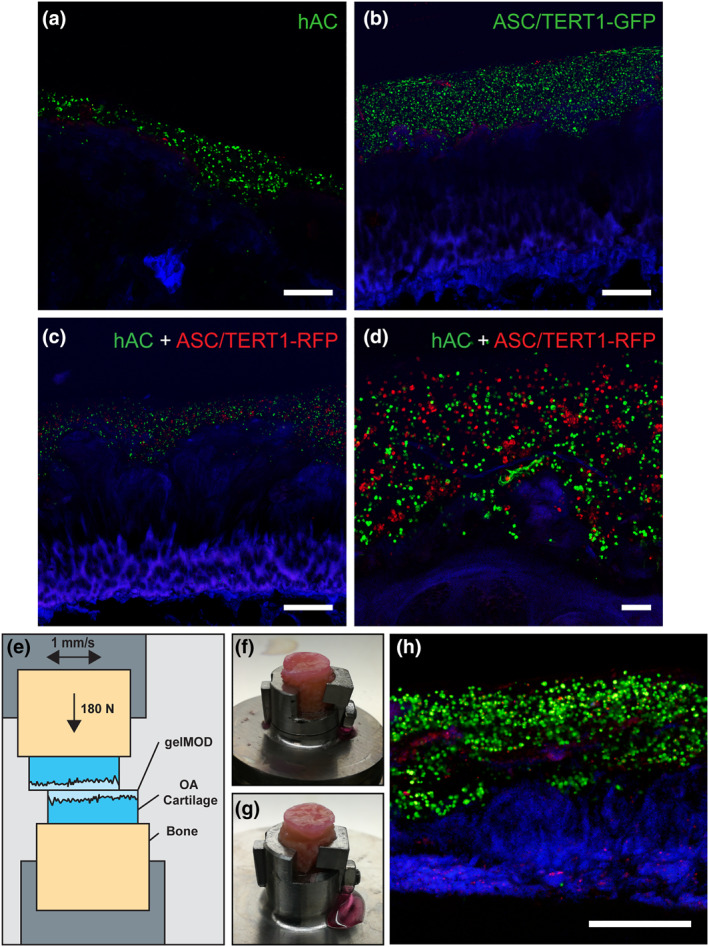
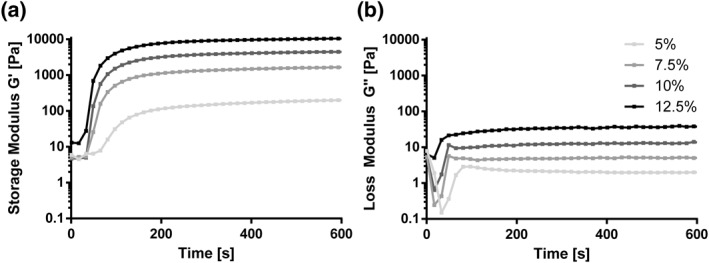
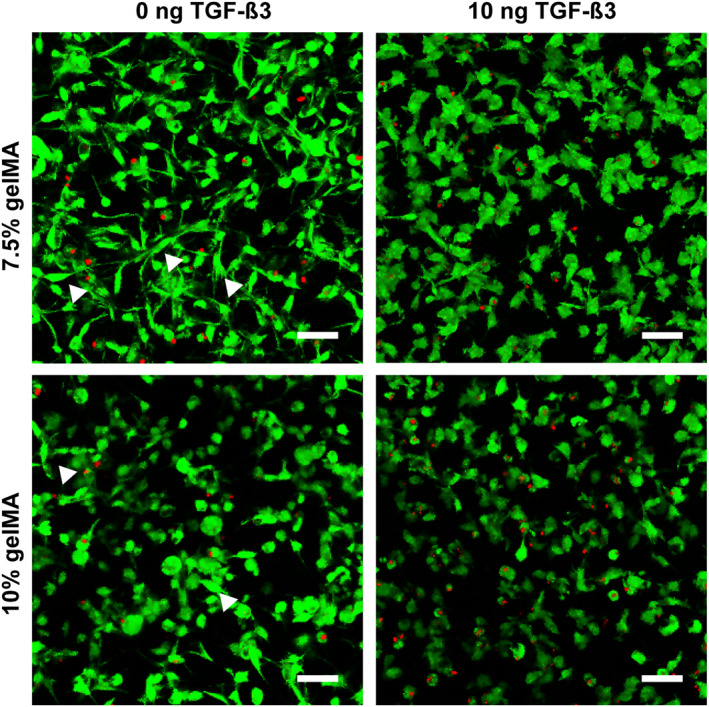
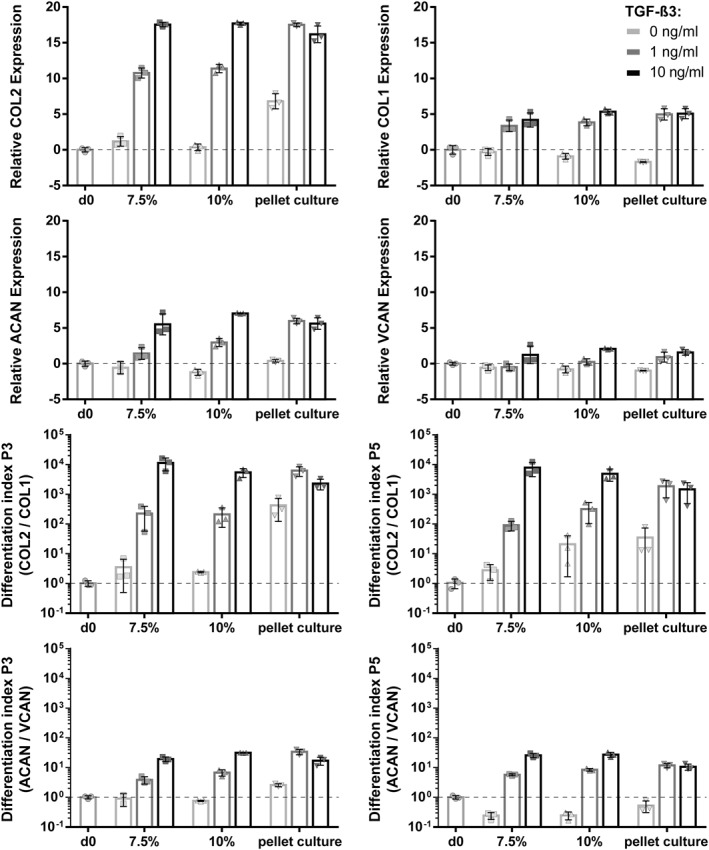
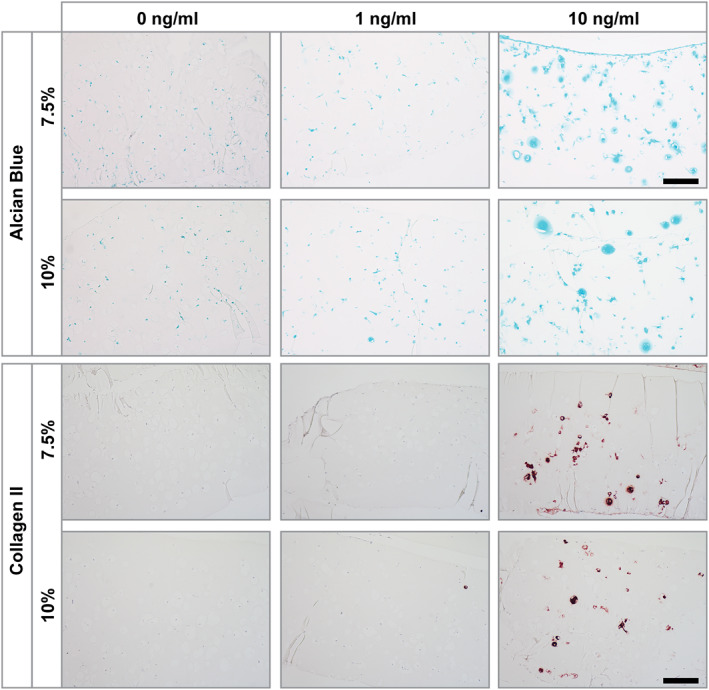
Cartilage damage typically starts at its surface, either due to wear or trauma. Treatment of these superficial defects is important in preventing degradation and osteoarthritis. Biomaterials currently used for deep cartilage defects lack appropriate properties for this application. Therefore, we investigated photo-crosslinked gelatin methacryloyl (gelMA) as a candidate for treatment of surface defects. It allows for liquid application, filling of surface defects and forming a protective layer after UV-crosslinking, thereby keeping therapeutic cells in place. gelMA and photo-initiator lithium phenyl-2,4,6-trimethyl-benzoylphosphinate (Li-TPO) concentration were optimized for application as a carrier to create a favorable environment for human articular chondrocytes (hAC). Primary hAC were used in passages 3 and 5, encapsulated into two different gelMA concentrations (7.5 wt% (soft) and 10 wt% (stiff)) and cultivated for 3 weeks with TGF-β3 (0, 1 and 10 ng/mL). Higher TGF-β3 concentrations induced spherical cell morphology independent of gelMA stiffness, while low TGF-β3 concentrations only induced rounded morphology in stiff gelMA. Gene expression did not vary across gel stiffnesses. As a functional model gelMA was loaded with two different cell types (hAC and/or human adipose-derived stem cells [ASC/TERT1]) and applied to human osteochondral osteoarthritic plugs. GelMA attached to the cartilage, smoothened the surface and retained cells in place. Resistance against shear forces was tested using a tribometer, simulating normal human gait and revealing maintained cell viability. In conclusion gelMA is a versatile, biocompatible material with good bonding capabilities to cartilage matrix, allowing sealing and smoothening of superficial cartilage defects while simultaneously delivering therapeutic cells for tissue regeneration.
软骨损伤通常始于其表面,原因要么是磨损,要么是创伤。治疗这些表面缺陷对于防止退化和骨关节炎很重要。目前用于治疗深层软骨缺陷的生物材料缺乏这种应用的适当特性。因此,我们研究了光交联明胶甲基丙烯酰(gelMA)作为治疗表面缺陷的候选材料。它允许液体应用,填充表面缺陷,并在紫外线交联后形成保护层,从而使治疗细胞保持原位。优化了 gelMA 和光引发剂二苯基(2,4,6-三甲基苯甲酰)膦(Li-TPO)的浓度,以用作载体,为人类关节软骨细胞(hAC)创造有利的环境。原代 hAC 分别在第 3 代和第 5 代时使用,包封在两种不同浓度的 gelMA 中(7.5wt%(软)和 10wt%(硬)),并在 TGF-β3(0、1 和 10ng/mL)存在下培养 3 周。较高浓度的 TGF-β3 诱导出与 gelMA 硬度无关的球形细胞形态,而低浓度的 TGF-β3 仅在硬 gelMA 中诱导出圆形形态。基因表达在凝胶硬度上没有差异。作为功能模型,gelMA 加载了两种不同的细胞类型(hAC 和/或人脂肪间充质干细胞[ASC/TERT1])并应用于人骨软骨骨关节炎塞。gelMA 附着在软骨上,使表面光滑,并将细胞固定在原位。使用摩擦仪测试了抵抗剪切力的能力,模拟了正常的人类步态,显示出细胞活力得以维持。总之,gelMA 是一种多功能、生物相容性材料,具有与软骨基质良好的结合能力,允许密封和光滑处理表面软骨缺陷,同时为组织再生提供治疗细胞。