Magnini Vincent P, Zehrer Anita
Pamplin College of Business, Virginia Tech, Blacksburg, VA, USA.
Family Business Center, MCI Management Center, Innsbruck, Austria.
Int J Hosp Manag. 2021 Apr;94:102761. doi: 10.1016/j.ijhm.2020.102761. Epub 2020 Nov 29.
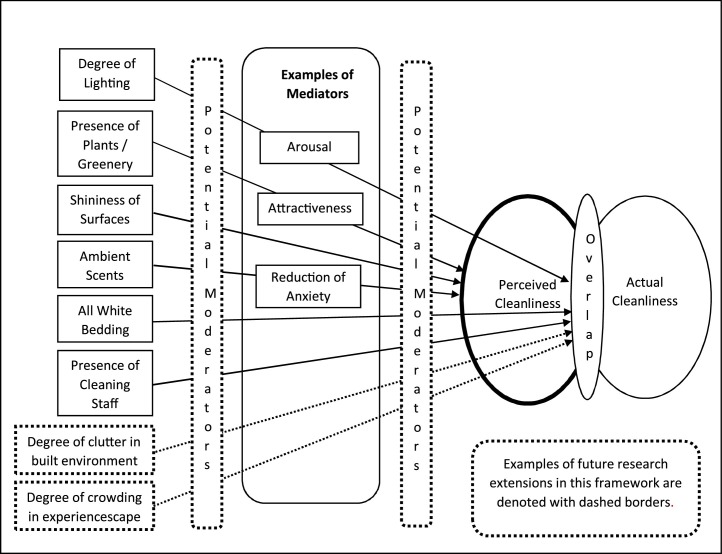
Due to the COVID-19 pandemic, now and for years to come, guests at hospitality venues will have heightened awareness with regard to formulating their perceptions of cleanliness. While perceived cleanliness has received attention in our existing body of literature, this conceptual paper integrates potential subconscious influencers on cleanliness perceptions into our understanding. Specifically, findings contained in various streams of research suggest that a number of factors can have subconscious influences on individuals' perceptions of cleanliness in service environments. Such factors include the degree of lighting, the presence of plants / greenery, the shininess of surfaces, the use of ambient scents, the use of white bedding, and the presence of cleaning staff. Evidently, the sooner hospitality venues (particularly airlines, lodging operations, restaurants, and cruise ships) are perceived as clean and safe, the faster they will recover from the pandemic. As such, this paper is rich with both practical and research implications.
由于新冠疫情,在当下及未来数年,酒店场所的客人在形成对清洁的认知方面将有更高的关注度。虽然感知到的清洁度在我们现有的文献中已受到关注,但这篇概念性论文将对清洁度认知的潜在潜意识影响因素纳入了我们的理解之中。具体而言,各研究领域的研究结果表明,一些因素会对个体在服务环境中对清洁度的认知产生潜意识影响。这些因素包括照明程度、植物/绿植的存在、表面的光泽度、使用环境香味、使用白色床上用品以及清洁人员的存在。显然,酒店场所(尤其是航空公司、住宿运营、餐厅和游轮)越快被视为干净和安全,它们从疫情中恢复的速度就越快。因此,本文具有丰富的实践和研究意义。