Feng Qian, Tang Liang-Jie, Luo Ding-Hai, Wang Ying, Wu Nan, Chen Hao, Chen Meng-Xia, Jiang Lei, Jin Rong
Department of Gastroenterology, The First Affiliated Hospital of Wenzhou Medical University, Wenzhou, 325000, People's Republic of China.
NAFLD Research Center, Department of Hepatology, The First Affiliated Hospital of Wenzhou Medical University, Wenzhou, 325000, People's Republic of China.
Cancer Manag Res. 2021 Nov 24;13:8809-8819. doi: 10.2147/CMAR.S338783. eCollection 2021.
Hyperuricemia and metabolic syndrome (MetS) have been shown to correlate with prognosis in patients with malignant tumors. The present study evaluated the relationship between preoperative hyperuricemia and MetS in colorectal cancer (CRC) patients and analyzed the effect of this combination on prognosis within 5 years.
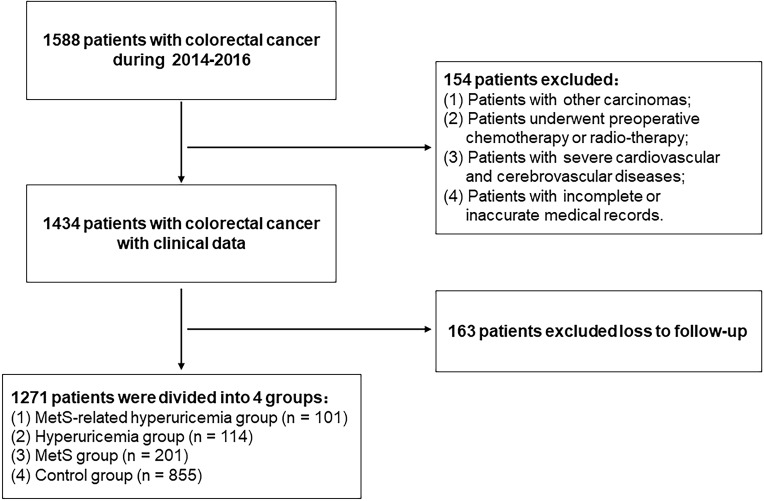
The study enrolled patients who had undergone radical CRC resection at three independent medical centers from January 2014 to December 2016. Patients were preoperatively categorized into four groups, those with hyperuricemia alone (H), those with MetS alone (MS), those with MetS-related hyperuricemia (MSH), and those with neither condition (control [C] group). The disease-free survival (DFS) and overall survival (OS) rates of these four groups were compared.
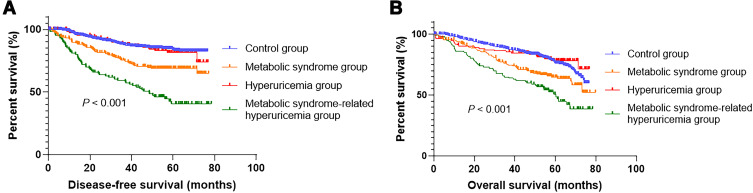
The study population consisted of 1271 patients, with 114, 201, 101, and 855 patients categorized into the H, MS, MSH and C groups, respectively. Preoperative MetS was found to be significantly associated with hyperuricemia ( < 0.001). Multivariate Cox regression analysis showed that MetS-related hyperuricemia (hazard ratio [HR] = 2.728; < 0.001) and MetS alone (HR = 1.631; < 0.001) were independent predictors of death, whereas simple hyperuricemia was not ( > 0.1). Relative to the C group, the MSH group had the highest rate of tumor recurrence or metastasis (HR = 5.103, < 0.001), followed by the MS (HR = 2.231, < 0.001) group. In contrast, prognosis did not differ significantly in the H and C groups ( > 0.1). MetS was significantly associated with poor prognosis, with MetS-related hyperuricemia resulting in a significantly poorer prognosis. In contrast, hyperuricemia alone had no effect on the long-term prognosis of CRC patients.
This study highlights the prognostic importance of MetS-related hyperuricemia on the survival of patients with CRC.
高尿酸血症和代谢综合征(MetS)已被证明与恶性肿瘤患者的预后相关。本研究评估了结直肠癌(CRC)患者术前高尿酸血症与MetS之间的关系,并分析了这种组合对5年内预后的影响。
本研究纳入了2014年1月至2016年12月在三个独立医疗中心接受根治性CRC切除术的患者。患者术前被分为四组,即单纯高尿酸血症组(H)、单纯MetS组(MS)、MetS相关高尿酸血症组(MSH)和无这两种情况的组(对照组[C])。比较这四组的无病生存期(DFS)和总生存期(OS)率。
研究人群包括1271例患者,分别有114、201、101和855例患者被归入H、MS、MSH和C组。术前发现MetS与高尿酸血症显著相关(<0.001)。多因素Cox回归分析显示,MetS相关高尿酸血症(风险比[HR]=2.728;<0.001)和单纯MetS(HR=1.631;<0.001)是死亡的独立预测因素,而单纯高尿酸血症不是(>0.1)。相对于C组,MSH组肿瘤复发或转移率最高(HR=5.103,<0.001),其次是MS组(HR=2.231,<0.001)。相比之下,H组和C组的预后无显著差异(>0.1)。MetS与预后不良显著相关,但MetS相关高尿酸血症导致的预后明显更差。相比之下,单纯高尿酸血症对CRC患者的长期预后没有影响。
本研究强调了MetS相关高尿酸血症对CRC患者生存的预后重要性。