Istituto di Ricovero e Cura a Carattere Scientifico (IRCCS) Humanitas Research Hospital, Milan, Italy.
Department of Biomedical Sciences, Humanitas University, Milan, Italy.
Front Immunol. 2021 Nov 18;12:785883. doi: 10.3389/fimmu.2021.785883. eCollection 2021.
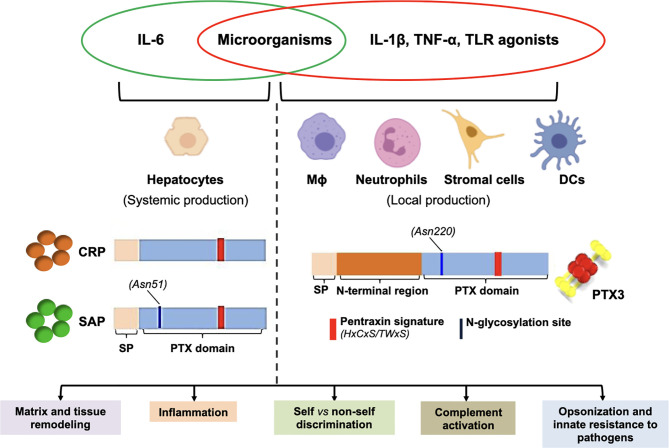
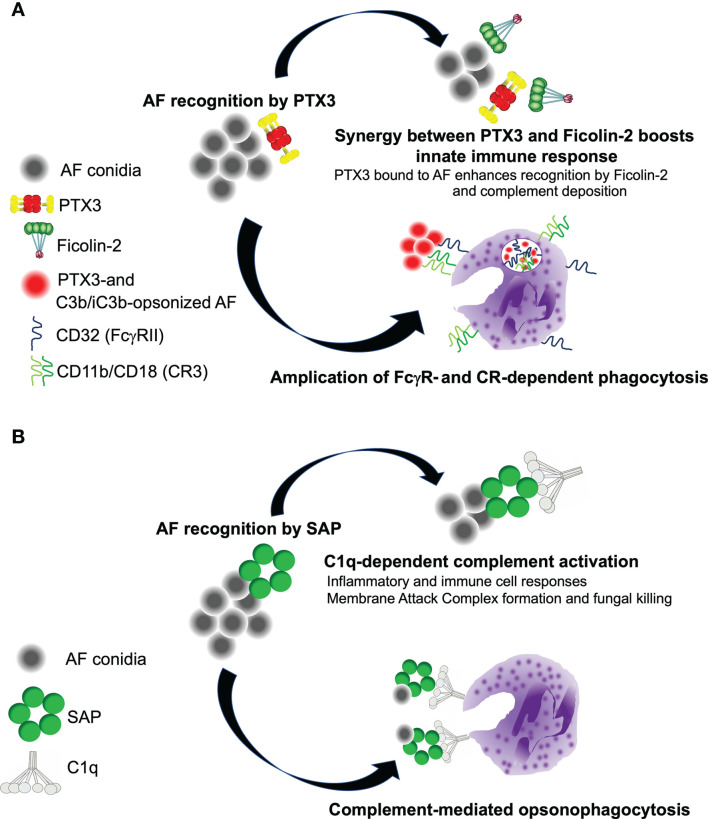
The ubiquitous mold is the major etiologic agent of invasive aspergillosis, a life-threatening infection amongst immune compromised individuals. An increasing body of evidence indicates that effective disposal of requires the coordinate action of both cellular and humoral components of the innate immune system. Early recognition of the fungal pathogen, in particular, is mediated by a set of diverse soluble pattern recognition molecules (PRMs) that act as "ancestral antibodies" inasmuch as they are endowed with opsonic, pro-phagocytic and killing properties. Pivotal is, in this respect, the contribution of the complement system, which functionally cooperates with cell-borne pattern recognition receptors (PRRs) and other soluble PRMs, including pentraxins. Indeed, complement and pentraxins form an integrated system with crosstalk, synergism, and regulation, which stands as a paradigm of the interplay between PRMs in the mounting and orchestration of antifungal immunity. Following upon our past experience with the long pentraxin PTX3, a well-established immune effector in the host response to , we recently reported that this fungal pathogen is targeted and by the short pentraxin Serum Amyloid P component (SAP) too. Similar to PTX3, SAP promotes phagocytosis and disposal of the fungal pathogen complement-dependent pathways. However, the two proteins exploit different mechanisms of complement activation and receptor-mediated phagocytosis, which further extends complexity and integration of the complement-pentraxin crosstalk in the immune response to . Here we revisit this crosstalk in light of the emerging roles of SAP as a novel PRM with antifungal activity.
无处不在的霉菌是侵袭性曲霉菌病的主要病原体,这种疾病是免疫功能低下个体的生命威胁性感染。越来越多的证据表明,有效处理霉菌需要细胞和先天免疫系统体液成分的协调作用。真菌病原体的早期识别,特别是由一组不同的可溶性模式识别分子(PRMs)介导的,因为它们具有调理、促吞噬和杀伤特性,所以可以被视为“祖传抗体”。在这方面至关重要的是补体系统的贡献,它与细胞携带的模式识别受体(PRRs)和其他可溶性 PRMs (包括五聚蛋白)协同作用。事实上,补体和五聚蛋白形成了一个具有串扰、协同和调节的整合系统,这是 PRMs 在启动和协调抗真菌免疫中相互作用的典范。在我们过去对长五聚蛋白 PTX3 的经验基础上,PTX3 是宿主对曲霉菌反应中的一种成熟的免疫效应物,我们最近报道,这种真菌病原体也是短五聚蛋白血清淀粉样蛋白 P 成分(SAP)的靶标。与 PTX3 相似,SAP 促进吞噬作用和真菌病原体的清除,这依赖于补体依赖性途径。然而,这两种蛋白质利用不同的补体激活机制和受体介导的吞噬作用,这进一步扩展了补体-五聚蛋白串扰在抗真菌免疫中的复杂性和整合。在这里,我们根据 SAP 作为具有抗真菌活性的新型 PRM 的新作用重新审视这种串扰。