Sugimoto Koichi, Iijima Yoko, Takabayashi Junji, Matsui Kenji
Tsukuba-Plant Innovation Research Center, University of Tsukuba, Tsukuba, Japan.
Department of Applied Chemistry, Kogakuin University, Tokyo, Japan.
Front Plant Sci. 2021 Nov 16;12:721572. doi: 10.3389/fpls.2021.721572. eCollection 2021.
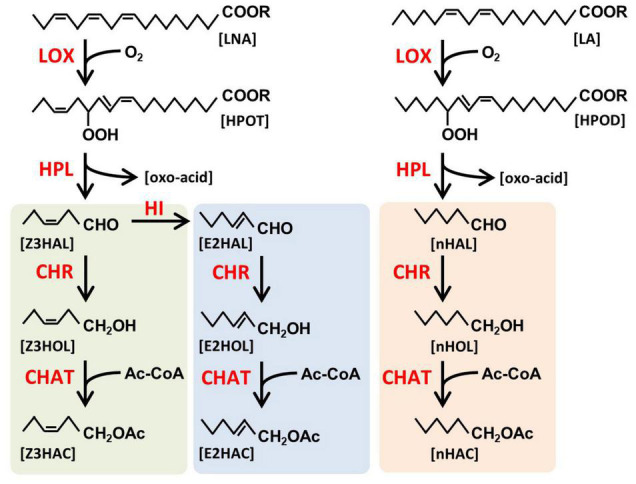
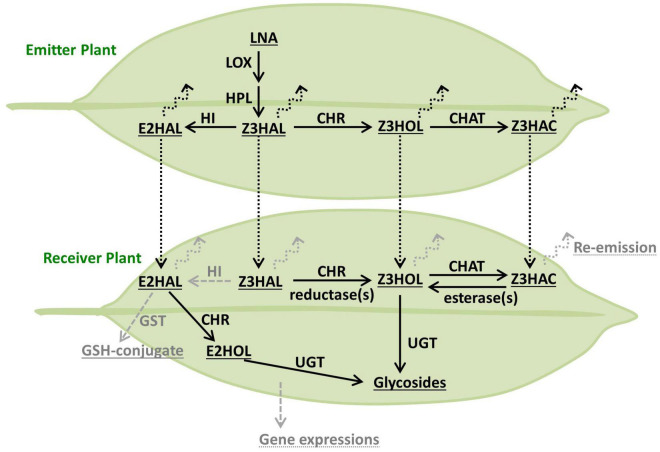
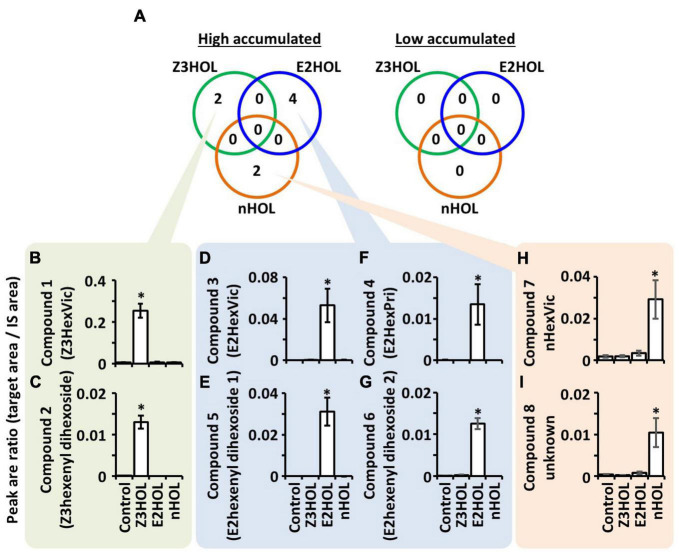
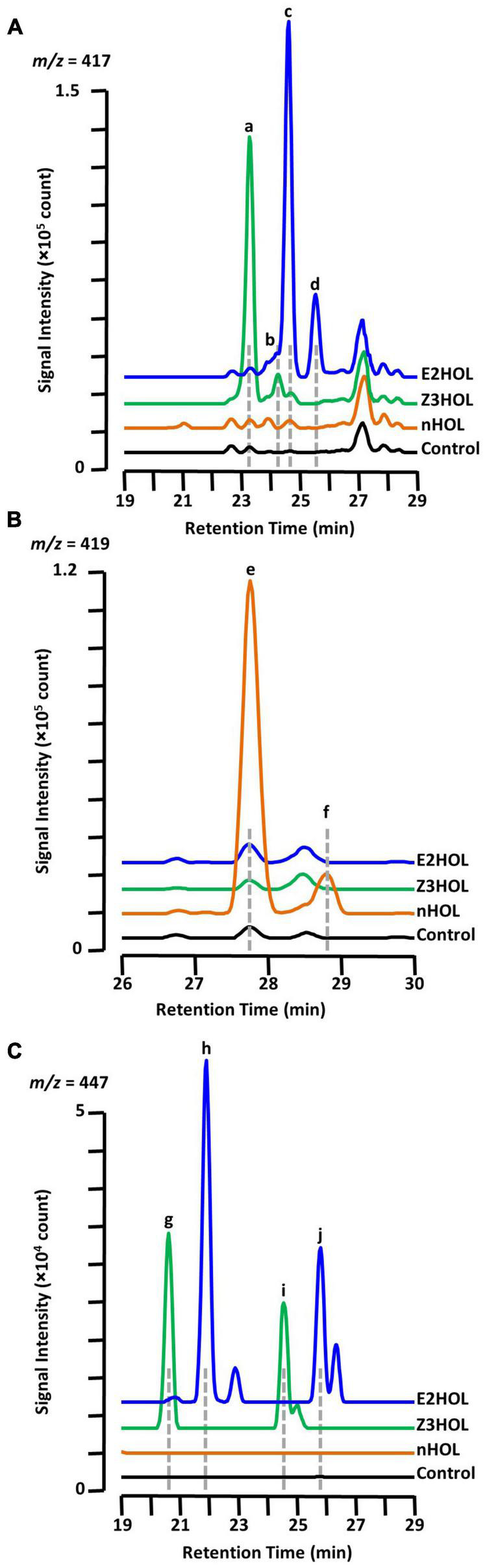
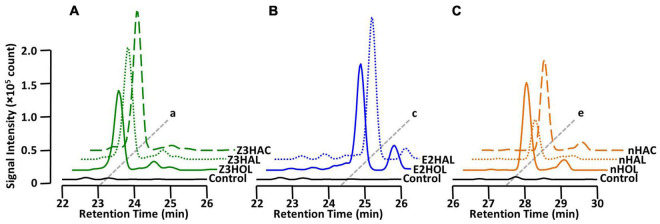
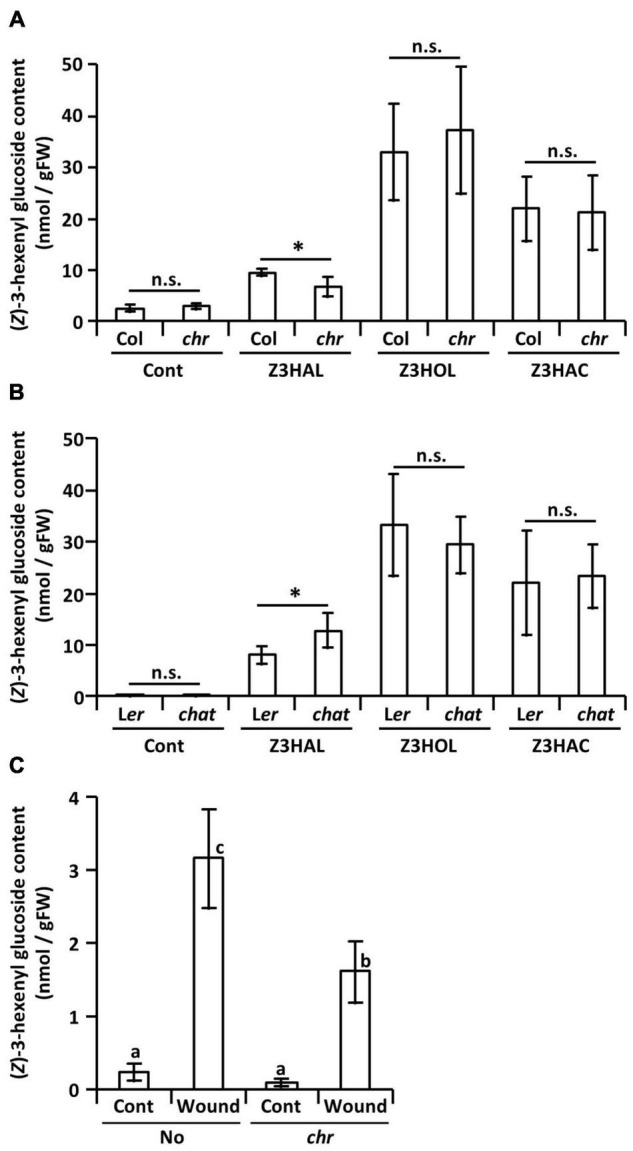
Green leaf volatiles (GLVs), the common constituents of herbivore-infested plant volatiles (HIPVs), play an important role in plant defense and function as chemical cues to communicate with other individuals in nature. Reportedly, in addition to endogenous GLVs, the absorbance of airborne GLVs emitted by infested neighboring plants also play a major role in plant defense. For example, the exclusive accumulation of ()-3-hexenyl vicianoside in the HIPV-exposed tomato plants occurs by the glycosylation of airborne ()-3-hexenol (Z3HOL); however, it is unclear how plants process the other absorbed GLVs. This study demonstrates that tomato plants dominantly accumulated GLV-glycosides after exposure to green leaf alcohols [Z3HOL, ()-2-hexenol, and -hexanol] using non-targeted LC-MS analysis. Three types of green leaf alcohols were independently glycosylated without isomerization or saturation/desaturation. Airborne green leaf aldehydes and esters were also glycosylated, probably through converting aldehydes and esters into alcohols. Further, we validated these findings in Arabidopsis mutants- ()-3-hexenal (Z3HAL) reductase () mutant that inhibits the conversion of Z3HAL to Z3HOL and the acetyl-CoA:()-3-hexen-1-ol acetyltransferase () mutant that impairs the conversion of Z3HOL to ()-3-hexenyl acetate. Exposure of the and mutants to Z3HAL accumulated lower and higher amounts of glycosides than their corresponding wild types (Col-0 and L), respectively. These findings suggest that plants process the exogenous GLVs by the reductase(s) and the esterase(s), and a part of the processed GLVs contribute to glycoside accumulation. Overall, the study provides insights into the understanding of the communication of the plants within their ecosystem, which could help develop strategies to protect the crops and maintain a balanced ecosystem.
绿叶挥发物(GLVs)是食草动物侵害植物挥发物(HIPVs)的常见成分,在植物防御中发挥重要作用,并作为化学信号在自然界中与其他个体进行交流。据报道,除了内源性GLVs外,受侵害的邻近植物释放的空气中GLVs的吸收在植物防御中也起主要作用。例如,暴露于HIPV的番茄植株中()-3-己烯基蚕豆糖苷的特异性积累是通过空气中()-3-己烯醇(Z3HOL)的糖基化实现的;然而,尚不清楚植物如何处理其他吸收的GLVs。本研究通过非靶向液相色谱-质谱分析表明,番茄植株在暴露于绿叶醇[Z3HOL、()-2-己烯醇和己醇]后主要积累GLV-糖苷。三种类型的绿叶醇独立进行糖基化,没有异构化或饱和/去饱和反应。空气中的绿叶醛和酯也进行了糖基化,可能是通过将醛和酯转化为醇来实现的。此外,我们在拟南芥突变体中验证了这些发现——()-3-己烯醛(Z3HAL)还原酶()突变体抑制Z3HAL向Z3HOL的转化,以及乙酰辅酶A:()-3-己烯-1-醇乙酰转移酶()突变体损害Z3HOL向()-3-己烯基乙酸酯的转化。将和突变体暴露于Z3HAL后,与相应的野生型(Col-0和L)相比,积累的糖苷量分别更低和更高。这些发现表明,植物通过还原酶和酯酶处理外源GLVs,并且部分处理后的GLVs有助于糖苷积累。总体而言,该研究为理解植物在其生态系统中的交流提供了见解,这有助于制定保护作物和维持生态系统平衡的策略。