Nephrology, Daqing Oilfield General Hospital, Daqing City, Heilongjiang Province 163000, China.
Nephrology, People's Hospital of Shache County, Kashgar, Xinjiang Uygur Autonomous Region 844700, China.
Comput Math Methods Med. 2021 Nov 24;2021:8802670. doi: 10.1155/2021/8802670. eCollection 2021.
The pathogenesis of nephrotic syndrome (NS) is complex, and there are differences between regions. This study attempted to collect clinicopathological data of patients diagnosed with NS in Xinjiang and Heilongjiang in the past 2 years, so as to explore the onset features of NS and treatment and prognosis of patients in the two regions.
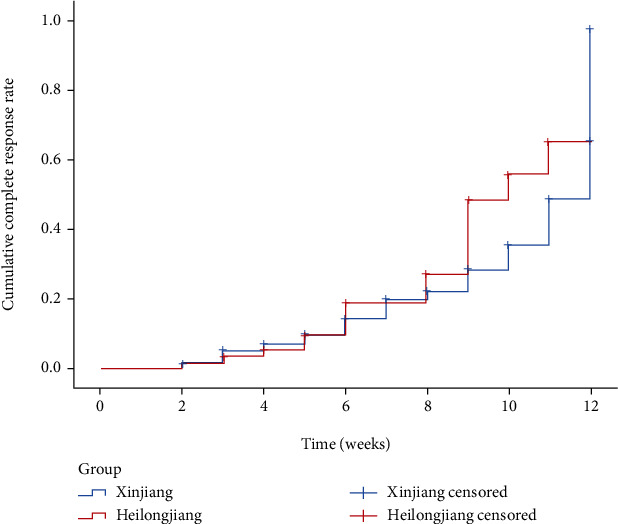
Clinical data of 375 patients diagnosed with NS using renal biopsy in Xinjiang and Heilongjiang from March 2019 to March 2021 were collected. Clinical data of patients before treatment were collected, and the chi-square test was utilized to compare the differences in the sex distribution of two groups. The test was utilized to compare abnormal distribution continuous data between two groups, such as age, hemoglobin, plasma albumin, proteinuria, and triglycerides. Independent sample -test was utilized to compare normal distribution continuous data between two groups, such as serum total protein, serum creatinine, blood urea nitrogen, glomerular filtration rate, and total cholesterol. The independent sample -test was also used to compare the immunoglobulin levels and complement levels between the two groups after treatment, including IgA, IgG, IgM, C3, and C4. Kaplan-Meier method was used to analyze and plot the cumulative curves of complete remission rate and partial remission rate.
For 275 NS patients from Xinjiang, the male-to-female ratio was 0.81 : 1. For 84 patients from Heilongjiang, the male-to-female ratio was 1.05 : 1. The onset ages of patients in Xinjiang and Heilongjiang were 22-45 years old and 22-47 years old, respectively. Respectively, there were 221 cases (80.36%) and 66 cases (78.57%) of primary NS in Xinjiang and Heilongjiang. There were 54 cases (19.64%) and 18 cases (21.43%) of secondary NS in Xinjiang and Heilongjiang, respectively. There was no statistically significant difference in cause distribution between the two regions ( = 0.756). After treatment, immunoglobulin levels (IgA ( = 0.009), IgG ( = 0.002), IgM ( < 0.001)) and complement C3 ( < 0.001) and C4 ( < 0.001) levels in Xinjiang and Heilongjiang were statistically significant. 129 cases in Xinjiang (46.91%) and 55 cases in Heilongjiang (65.48%) were treated with glucocorticoid (GC) combined with immunosuppressive therapy, respectively. After receiving treatment, 67 (24.36%) of 275 patients in Xinjiang achieved complete remission, 166 (60.36%) achieved partial remission, 22 (26.19%) of 84 patients in Heilongjiang achieved complete remission, and 56 (66.67%) achieved partial remission, and there was no statistically significant difference in remission rate between the two regions ( = 0.159). Patients in Xinjiang and Heilongjiang achieved complete remission at an average of 10.34 weeks (9.98-10.70) and 9.95 weeks (9.26-10.65), respectively. There was no significant difference in complete remission rates between the two regions ( = 0.663). Patients in Xinjiang and Heilongjiang achieved partial remission at an average of 8.76 weeks (8.38-9.14) and 7.99 weeks (7.33-8.65), respectively. There was no significant difference in the partial remission rate between the two regions ( = 0.065).
The causes of NS in Xinjiang and Heilongjiang were similar. After treatment, there were differences in immunoglobulin levels (IgA, IgG, IgM) and complement levels (C3, C4) in the two regions. The main treatment methods used in the two regions were GC combined with immunosuppressive therapy. The prognosis of patients in the two regions was similar. The complete remission rate and partial remission rate after treatment in the two regions were similar, and the average time required to achieve complete remission and partial remission was also similar.
肾病综合征(NS)的发病机制复杂,地区间存在差异。本研究试图收集过去 2 年新疆和黑龙江地区经肾活检诊断为 NS 的患者的临床病理资料,探讨 NS 的发病特征及两地区患者的治疗和预后。
收集 2019 年 3 月至 2021 年 3 月新疆和黑龙江地区 375 例 NS 患者的临床资料,收集患者治疗前的临床资料,采用卡方检验比较两组患者的性别分布差异,采用秩和检验比较两组患者年龄、血红蛋白、血浆白蛋白、蛋白尿、三酰甘油等异常分布的连续性资料,采用独立样本 t 检验比较两组患者血清总蛋白、血清肌酐、血尿素氮、肾小球滤过率、总胆固醇等正态分布的连续性资料,采用独立样本 t 检验比较两组患者治疗后的免疫球蛋白和补体水平,包括 IgA、IgG、IgM、C3 和 C4。采用 Kaplan-Meier 法分析和绘制完全缓解率和部分缓解率的累积曲线。
新疆 275 例 NS 患者中,男女性别比为 0.81∶1;黑龙江 84 例患者中,男女性别比为 1.05∶1。新疆和黑龙江地区患者发病年龄分别为 2245 岁和 2247 岁,分别有 221 例(80.36%)和 66 例(78.57%)为原发性 NS。新疆和黑龙江地区分别有 54 例(19.64%)和 18 例(21.43%)为继发性 NS。两组患者的病因分布差异无统计学意义(=0.756)。治疗后,新疆和黑龙江地区患者的免疫球蛋白水平(IgA=0.009,IgG=0.002,IgM<0.001)和补体 C3(<0.001)和 C4(<0.001)水平均有统计学差异。新疆 129 例(46.91%)和黑龙江 55 例(65.48%)患者采用糖皮质激素(GC)联合免疫抑制剂治疗。治疗后,新疆 275 例患者中 67 例(24.36%)达到完全缓解,166 例(60.36%)达到部分缓解,黑龙江 84 例患者中 22 例(26.19%)达到完全缓解,56 例(66.67%)达到部分缓解,两组患者的缓解率差异无统计学意义(=0.159)。新疆和黑龙江地区患者达到完全缓解的平均时间分别为 10.34 周(9.9810.70)和 9.95 周(9.2610.65),完全缓解率差异无统计学意义(=0.663)。新疆和黑龙江地区患者达到部分缓解的平均时间分别为 8.76 周(8.389.14)和 7.99 周(7.338.65),部分缓解率差异无统计学意义(=0.065)。
新疆和黑龙江地区 NS 的病因相似,治疗后两组患者的免疫球蛋白水平(IgA、IgG、IgM)和补体水平(C3、C4)存在差异。两地区主要治疗方法均为 GC 联合免疫抑制剂治疗,两地区患者的预后相似,治疗后完全缓解率和部分缓解率相似,达到完全缓解和部分缓解所需的平均时间也相似。